A real shipping route from China to USA is not just a line from one port to another. For importers, the practical route starts at the supplier’s factory in China and ends at the final U.S. delivery address. That full route may include China pickup, export warehouse handling, ocean or air transit, U.S. port or airport handling, customs release, rail transfer, truck delivery, warehouse appointment, or Amazon FBA delivery.
This article focuses on route planning and time breakdowns. It does not replace a full Shipping from China to USA guide, shipping cost article, customs clearance guide, or DDP guide. The goal is to help importers understand which China-to-USA route should be compared first based on supplier location, cargo size, delivery ZIP code, and required delivery timeline.
Quick Answer: Which China-to-USA Shipping Route Should You Compare First?
| Final U.S. Destination | First Route to Compare | Why |
|---|---|---|
| Southern California | Los Angeles or Long Beach | Shorter ocean leg and faster local delivery |
| West Coast / Nevada / Arizona | LA/LB or Oakland route | West Coast arrival usually fits western delivery better |
| Midwest / Chicago | LA/LB + inland rail or all-water East Coast comparison | West Coast rail can balance speed and inland reach |
| Texas / Houston / Dallas | Houston route or LA/LB + inland delivery comparison | Gulf routing may reduce inland trucking for Texas cargo |
| New York / New Jersey | All-water East Coast route | Longer ocean leg but shorter final delivery for East Coast |
| Southeast / Georgia / Florida | Savannah, Charleston, Norfolk, or East Coast routing | Better for Southeast distribution than West Coast trucking |
| Urgent commercial cargo | Air freight to LAX, ORD, JFK, DFW, or ATL | Speed matters more than ocean routing |
| Small samples / parcels | Express courier | Fastest and simplest for small packages |
If your shipment is not urgent, start with the final U.S. ZIP code. If the cargo is urgent, start with deadline and cargo size.
Not Sure Which Route to Use?
Send us your supplier city, cargo size, destination ZIP code, delivery address type, and target delivery date. We’ll help compare West Coast, East Coast, rail, air, and door-to-door route options.
*Fast response. No obligation.
Sea Shipping Routes from China to USA
Route 1: Shenzhen / Yantian to Los Angeles / Long Beach
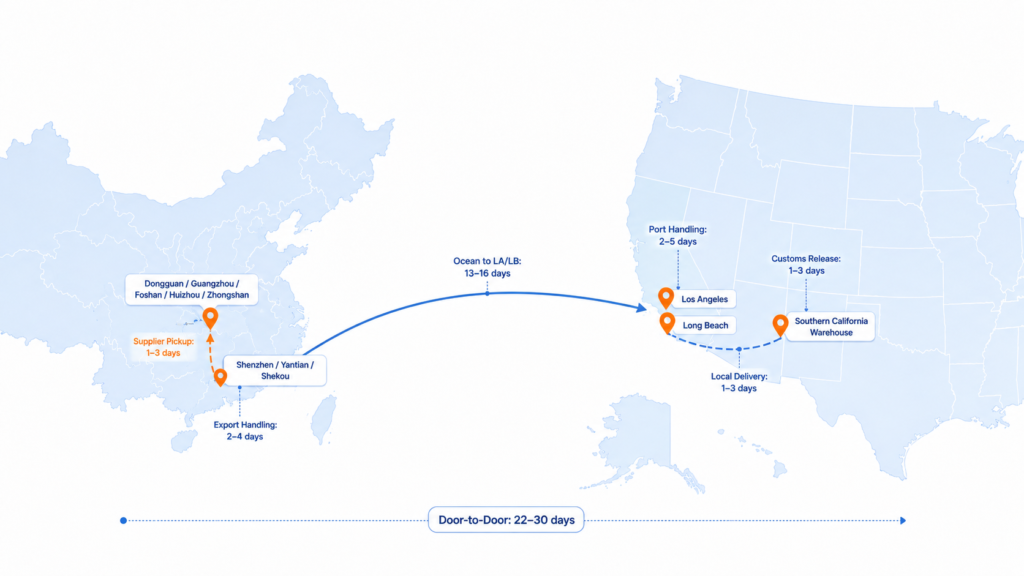
This is one of the fastest and most common ocean routes for South China cargo going to Southern California, West Coast warehouses, Amazon FBA facilities, and many inland rail moves. It is especially common for suppliers in Shenzhen, Dongguan, Guangzhou, Foshan, Huizhou, Zhongshan, and other Pearl River Delta areas.
Yantian and Shekou are major South China gateways. If your supplier is in Shenzhen or nearby, this is usually one of the first routes to compare. For more origin-specific planning, see shipping from Shenzhen to USA and shipping from Guangzhou to USA.
| Segment | Typical Time Direction | Notes |
|---|---|---|
| Supplier pickup in Shenzhen / Dongguan / Guangzhou | 1–3 days | Depends on exact factory address and cargo ready date. |
| Export warehouse / terminal handling | 2–4 days | LCL may wait for consolidation; FCL depends on terminal cutoff. |
| Ocean transit to LA/LB | About 13–16 days | One of the faster ocean options from South China. |
| U.S. port discharge / terminal handling | 2–5 days | Arrival does not mean cargo is immediately available. |
| Customs / cargo release if no hold | 1–3 days | Longer if customs review or exam occurs. |
| Local truck delivery to Southern California warehouse | 1–3 days | Depends on ZIP code, appointment, and truck availability. |
| Estimated door-to-door | About 22–30 days | Practical estimate, not a guaranteed delivery timeline. |
Best for:
- Southern California
- Nevada / Arizona
- West Coast Amazon FBA
- Fast sea freight from South China
- Many Pearl River Delta suppliers
Not ideal for:
- East Coast delivery if inland trucking or rail cost becomes too high
- Cargo with flexible timing but a final destination very close to East Coast ports
For Los Angeles-specific destination planning, see shipping from China to Los Angeles.
Route 2: Shenzhen / Ningbo / Shanghai to LA/LB + Rail to Chicago or Midwest
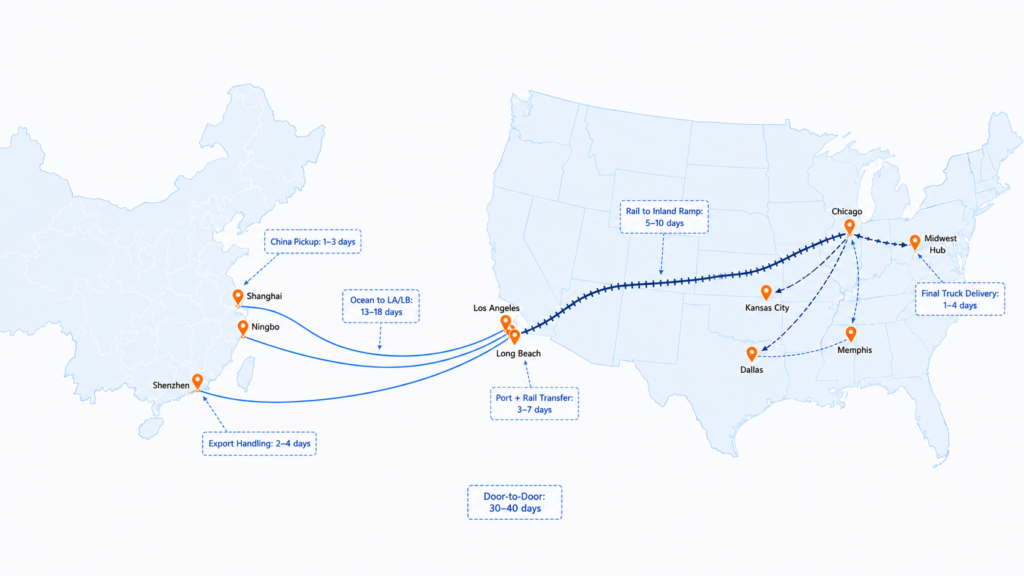
This route lands on the West Coast first, then moves inland by rail to Chicago, Dallas, Memphis, Kansas City, or other inland hubs. It can be useful when the importer wants faster West Coast arrival but the final delivery is inland.
Inland rail can be efficient, but it adds extra handoffs. Importers should not calculate this route using ocean transit only. Rail availability, ramp recovery, and final truck delivery all affect the real timeline.
| Segment | Typical Time Direction | Notes |
|---|---|---|
| China pickup | 1–3 days | Supplier location and cargo readiness matter. |
| Export / terminal handling | 2–4 days | Cutoff and consolidation can affect departure. |
| Ocean to LA/LB | 13–18 days | Depends on origin port, service, and sailing schedule. |
| Port discharge / rail transfer | 3–7 days | Rail handoff can add time after port arrival. |
| Rail to inland ramp | 5–10 days | Chicago and Midwest ramps depend on rail capacity and congestion. |
| Final truck delivery | 1–4 days | Depends on ramp location, ZIP code, and appointment. |
| Estimated door-to-door | About 30–40 days | Faster than some all-water routes in certain cases, but not always. |
Best for:
- Chicago
- Midwest warehouses
- Some Amazon FBA inland destinations
- Cargo needing a balance of speed and inland reach
This route is often worth comparing with all-water East Coast or Gulf routing when the final ZIP code is inland.
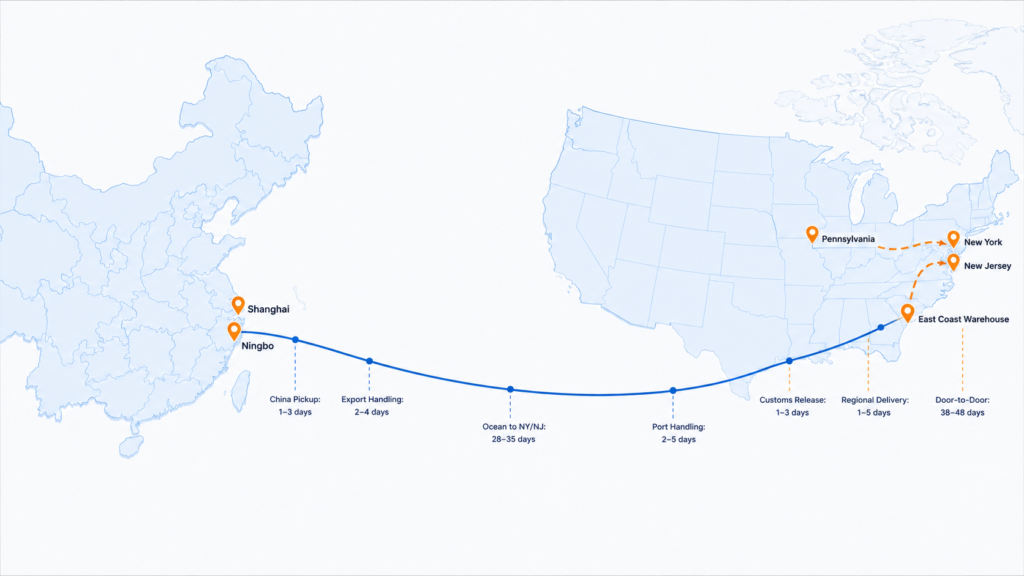
Route 3: Ningbo / Shanghai to New York / New Jersey
This route is slower on the ocean leg but often better for East Coast final delivery. It is common for importers delivering to New York, New Jersey, Pennsylvania, and nearby East Coast warehouses.
For dense or heavy cargo, all-water East Coast routing may make more sense than unloading in California and paying for cross-country inland delivery. This is why the fastest ocean route is not always the best route.
| Segment | Typical Time Direction | Notes |
|---|---|---|
| China pickup | 1–3 days | Supplier city and pickup address matter. |
| Export / terminal handling | 2–4 days | Depends on booking cutoff and cargo readiness. |
| Ocean to NY/NJ | About 28–35 days | Longer ocean route than West Coast. |
| Port discharge / terminal handling | 2–5 days | Terminal recovery and destination handling may vary. |
| Customs / release if no hold | 1–3 days | More if documents, exam, or hold issues appear. |
| Local / regional truck delivery | 1–5 days | Depends on final ZIP code and appointment. |
| Estimated door-to-door | About 38–48 days | Useful for East Coast delivery with planned inventory. |
Best for:
- New York
- New Jersey
- Pennsylvania
- East Coast warehouses
- Heavy cargo where cross-country inland trucking is expensive
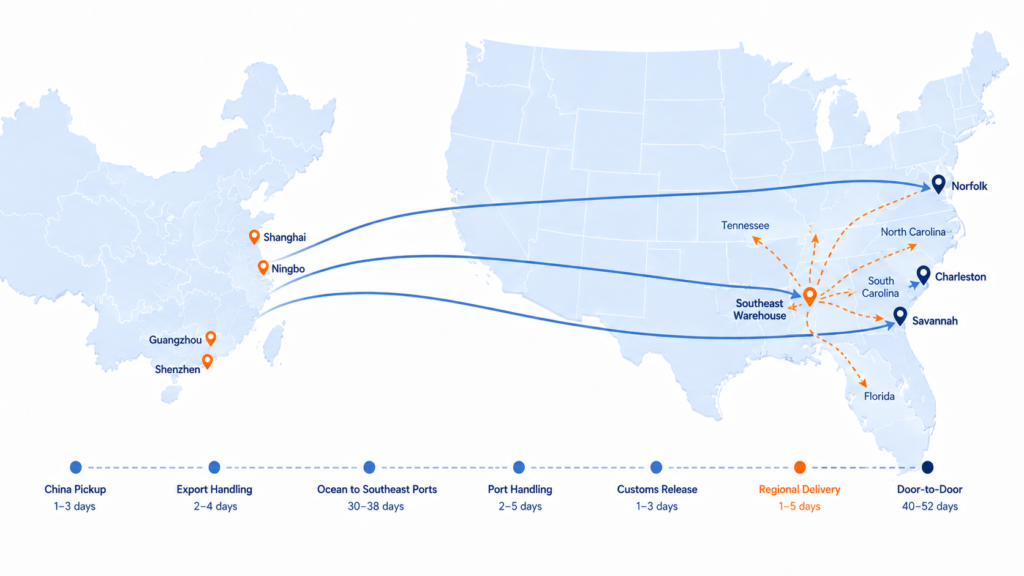
Route 4: China to Savannah / Charleston / Norfolk for Southeast Delivery
Southeast routes can work well for Georgia, Florida, North Carolina, South Carolina, Tennessee, and nearby distribution markets. These routes usually have a longer ocean leg than West Coast routes, but they may reduce inland trucking for Southeast final delivery.
| Segment | Typical Time Direction | Notes |
|---|---|---|
| China pickup | 1–3 days | Depends on supplier location and cargo ready date. |
| Export / terminal handling | 2–4 days | LCL and FCL timing may differ. |
| Ocean to Savannah / Charleston / Norfolk | About 30–38 days | Depends on origin port, service, and routing. |
| Port discharge / terminal handling | 2–5 days | Terminal availability and vessel schedule matter. |
| Customs / release if no hold | 1–3 days | Build buffer for document review or exam. |
| Regional truck delivery | 1–5 days | Shorter than West Coast delivery for many Southeast warehouses. |
| Estimated door-to-door | About 40–52 days | Better for planned inventory to Southeast destinations. |
Best for:
- Georgia
- Florida
- North Carolina
- South Carolina
- Tennessee
- Southeast 3PL and warehouse delivery
This route is useful when the final delivery point is close enough to Southeast ports to offset the longer ocean leg.
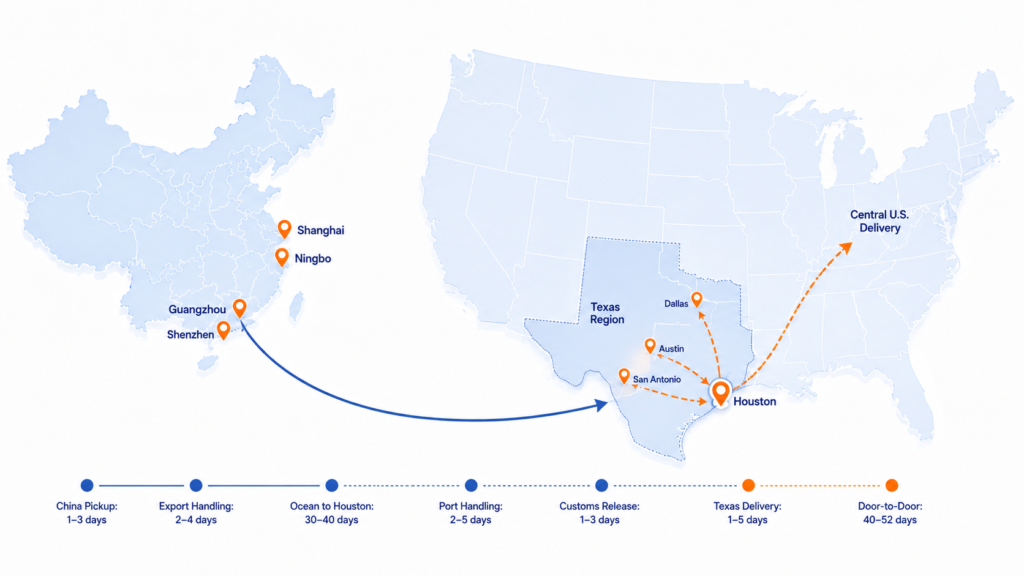
Route 5: China to Houston for Texas and Central U.S. Delivery
Houston can be useful for Texas, Gulf Coast, and some Central U.S. destinations. It is not always the fastest option, but it may reduce inland trucking for Houston, Dallas, Austin, San Antonio, and nearby regions depending on the delivery plan.
| Segment | Typical Time Direction | Notes |
|---|---|---|
| China pickup | 1–3 days | Exact supplier address matters. |
| Export / terminal handling | 2–4 days | Depends on origin port and cutoff. |
| Ocean to Houston / Gulf route | About 30–40 days | Longer route than West Coast. |
| Port discharge / terminal handling | 2–5 days | Port and terminal conditions can vary. |
| Customs / release if no hold | 1–3 days | More if cargo is held or examined. |
| Truck delivery to Houston / Dallas / Texas region | 1–5 days | Depends on final ZIP code and appointment. |
| Estimated door-to-door | About 40–52 days | Useful when Texas delivery makes Gulf routing practical. |
Best for:
- Houston
- Dallas
- Austin
- San Antonio
- Gulf Coast distribution
- Some Central U.S. destinations
Importers should compare this route with LA/LB + inland delivery when the cargo is time-sensitive or when rail/truck pricing changes.
Air Shipping Routes from China to USA
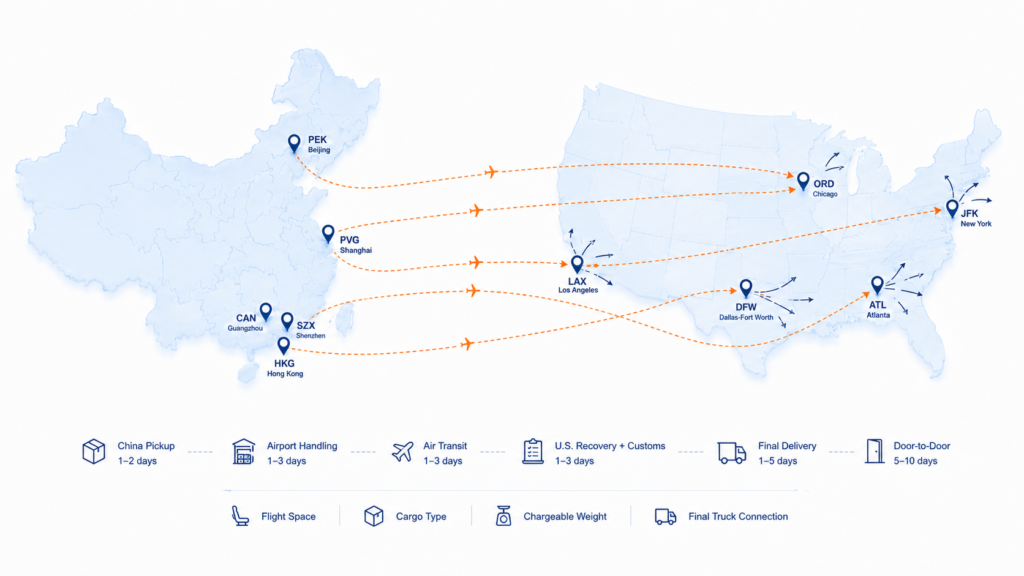
Air freight usually moves from major China or Hong Kong airports such as PVG, CAN, SZX, HKG, or PEK to U.S. gateways such as LAX, ORD, JFK, DFW, or ATL. Air route choice depends less on map distance and more on flight space, cargo type, chargeable weight, and final truck connection.
Air freight is useful when delivery speed matters more than ocean cost. For more details, see air freight from China to USA.
| Segment | Typical Time Direction | Notes |
|---|---|---|
| China pickup | 1–2 days | Depends on supplier city and cargo readiness. |
| Airport handling / export | 1–3 days | Cargo acceptance, screening, and export processing matter. |
| Air transit | 1–3 days | Direct vs consolidated flight affects timing. |
| U.S. airport recovery / customs if no hold | 1–3 days | Recovery and release can take longer than the flight. |
| Final delivery | 1–5 days | Depends on final ZIP code and address type. |
| Estimated door-to-door | About 5–10 days | Practical for urgent commercial cargo. |
Best for:
- Urgent replenishment
- High-value cargo
- Electronics or time-sensitive commercial goods
- Shipments too large for courier but too urgent for sea freight
Express Courier Shipping Routes from China to USA
DHL, FedEx, UPS, and similar courier networks usually move through their own hubs and deliver directly to the final address. Express is normally the fastest and simplest option for small parcels, samples, and urgent lightweight shipments.
| Segment | Typical Time Direction | Notes |
|---|---|---|
| Pickup in China | About 1 day | Courier or supplier pickup. |
| Courier export / flight network | 1–3 days | Network routing depends on service level. |
| U.S. customs / courier handling if no issue | 1–2 days | Duties, product type, and paperwork can affect timing. |
| Final delivery | 1–2 days | Depends on ZIP code and courier network. |
| Estimated door-to-door | About 3–7 days | Best for small urgent cargo. |
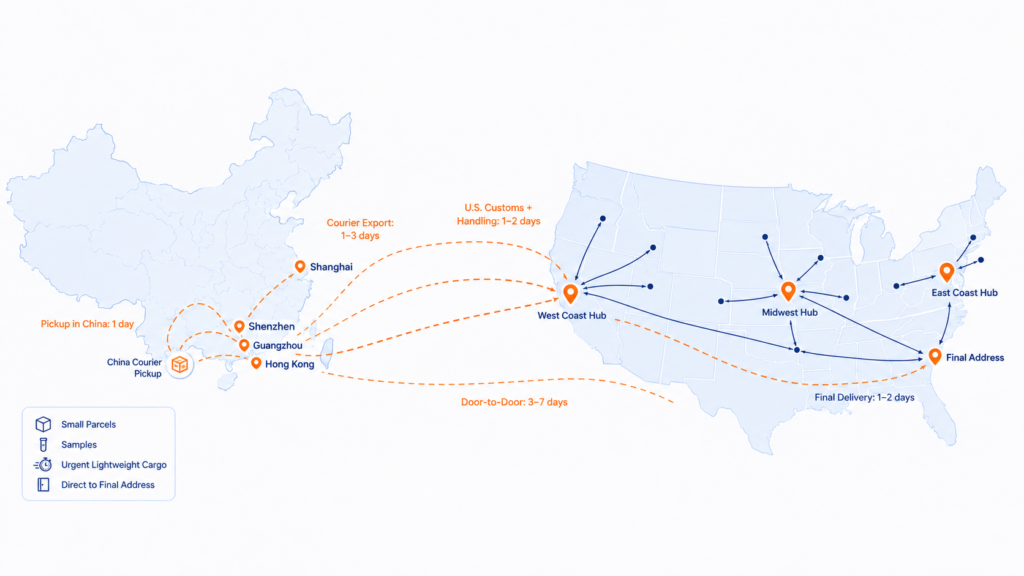
Best for: samples, small parcels, urgent lightweight cargo.
Not ideal for: bulky cartons, heavy commercial cargo, or shipments where dimensional weight makes courier too expensive.
For courier comparisons, see DHL vs FedEx vs UPS from China to USA.
How to Read a China-to-USA Shipping Route
A China-to-USA shipping route is a chain of logistics segments. Port-to-port time is only one part of the route. Door-to-door time includes origin handling, main transit, U.S. handling, customs/release buffer, inland movement, and final delivery.
| Route Segment | What Happens | Typical Time Range | What Can Delay It |
|---|---|---|---|
| China supplier pickup | Cargo is picked up from factory, warehouse, or supplier location | 1–3 days | Cargo not ready, wrong address, late supplier handoff |
| China export warehouse / terminal | Cargo is received, consolidated, loaded, or delivered to terminal | 2–4 days | Missed cutoff, export delay, LCL consolidation wait |
| Main ocean or air leg | Cargo moves by vessel or aircraft | Ocean: 13–40+ days / Air: 1–3 days | Vessel rollover, transshipment, airline space, weather |
| U.S. port / airport arrival | Cargo is discharged, recovered, or transferred | 2–5 days | Congestion, terminal delay, airport recovery delay |
| Customs / release buffer | Entry, release, or document review is handled | 1–3 days if no hold | Customs hold, exam, missing documents |
| Rail / drayage / truck delivery | Cargo moves inland or to local warehouse | 1–10+ days | Rail congestion, chassis shortage, appointment delay |
| Final warehouse / Amazon / 3PL delivery | Cargo is delivered to the final receiver | 1–5 days | Appointment issue, FBA rules, residential or limited access |
The real timeline is built from all segments, not just the vessel sailing days.
West Coast vs East Coast: Which Route Is Better?
West Coast is not always better, and East Coast is not always slower in practical delivery terms. The better route depends on final ZIP code, cargo size, delivery deadline, and total door-to-door result.
| Factor | West Coast Route | East Coast Route | Practical Advice |
|---|---|---|---|
| Ocean transit | Usually faster to LA/LB | Usually longer to NY/NJ, Savannah, or other East Coast ports | Use West Coast when speed to arrival matters. |
| Inland delivery | Strong for western states and many rail moves | Strong for eastern warehouses | Final ZIP code should guide the decision. |
| Cost logic | May have lower ocean time but higher inland delivery to eastern states | May reduce inland trucking for East Coast destinations | Compare total landed route, not ocean rate only. |
| Final destination | Best for California, Nevada, Arizona, and many West Coast locations | Best for NY/NJ, Southeast, and nearby eastern warehouses | Do not choose by map distance alone. |
| Heavy cargo | Can become expensive if trucked cross-country | May be better when final delivery is eastern | Heavy cargo should minimize inland trucking. |
| Urgency | Faster sea arrival | Slower ocean leg | If the deadline is tight, compare air as well. |
| Extra handoffs | May add rail transfer for inland destinations | May reduce rail/truck handoffs for eastern destinations | Handoffs can add risk and time. |
For method-level ocean planning, see sea shipping from China to USA. For cost-driven route decisions, see cheapest way to ship from China to USA.
West Coast or East Coast?
Tell us your China origin city, cargo volume, gross weight, and final U.S. ZIP code. We’ll compare the practical route by total door-to-door timing, not only port-to-port sailing days.
*Fast response. No obligation.
Route Examples by Final Destination
Example 1: Shenzhen to Los Angeles Warehouse
A Shenzhen supplier shipping to a Los Angeles warehouse often uses Yantian or Shekou to LA/LB, then local delivery after release.
| Segment | Estimated Time Direction |
|---|---|
| China pickup | 1–3 days |
| Export handling | 2–4 days |
| Ocean to LA/LB | 13–16 days |
| Port / customs / release if no hold | 3–8 days |
| Local truck delivery | 1–3 days |
| Estimated total | About 22–30 days |
This is a strong route for Southern California, West Coast warehouses, and many West Coast Amazon FBA shipments.
Example 2: Ningbo to Chicago Warehouse
A Ningbo-to-Chicago shipment may use LA/LB first, then inland rail to Chicago. It may also be compared with all-water East Coast routing depending on cost and timing.
| Segment | Estimated Time Direction |
|---|---|
| China pickup | 1–3 days |
| Export handling | 2–4 days |
| Ocean to LA/LB | 15–18 days |
| Port discharge / rail transfer | 3–7 days |
| Rail to Chicago ramp | 5–10 days |
| Final truck delivery | 1–4 days |
| Estimated total | About 30–40 days |
This route works when the importer needs a balance between West Coast speed and Midwest delivery reach.
Example 3: Shanghai to New Jersey Warehouse
A Shanghai-to-New Jersey shipment may move by all-water East Coast routing to NY/NJ, then local or regional truck delivery.
| Segment | Estimated Time Direction |
|---|---|
| China pickup | 1–3 days |
| Export handling | 2–4 days |
| Ocean to NY/NJ | 28–35 days |
| Customs / terminal release if no hold | 3–8 days |
| Local or regional delivery | 1–5 days |
| Estimated total | About 38–48 days |
This route is often practical for East Coast warehouses and heavier cargo where cross-country inland delivery would be costly.
What Can Change the Route or Timeline?
A route is not fixed until cargo details, destination details, and service scope are confirmed. The same shipment may move differently depending on FCL vs LCL, final ZIP code, FBA assignment, customs risk, or deadline.
| Factor | How It Changes the Route | What Importer Should Do |
|---|---|---|
| Final ZIP code | Determines whether West Coast, East Coast, Gulf, rail, or local truck delivery makes sense | Provide exact ZIP code, not only state. |
| Cargo volume | Affects LCL, FCL, air, and delivery choice | Provide CBM, carton count, and gross weight. |
| FCL vs LCL | LCL may add CFS handling; FCL may move differently | Confirm container or LCL plan early. |
| Delivery deadline | May make sea freight unrealistic | Compare air if deadline is tight. |
| Port congestion | Can delay discharge and recovery | Add buffer time and ask about terminal status. |
| Rail congestion | Can delay Midwest or inland delivery | Confirm rail timeline and ramp availability. |
| Customs hold | Can delay cargo release | Prepare documents and importer setup before arrival. |
Common Mistakes When Choosing Shipping Routes from China to USA
| Mistake | Why It Causes Problems | Better Approach |
|---|---|---|
| Choosing by ocean days only | Port arrival is not final delivery | Compare full door-to-door timeline. |
| Ignoring final ZIP code | The wrong coast may increase inland delivery cost | Use exact ZIP code for route comparison. |
| Choosing West Coast for East Coast warehouse without comparing inland cost | Cross-country trucking or rail may erase the time advantage | Compare West Coast + rail vs all-water East Coast. |
| Choosing East Coast when deadline is too tight | Longer ocean transit may miss delivery deadline | Compare West Coast or air freight if timing is urgent. |
| Ignoring rail time | Midwest delivery may take much longer after port arrival | Add rail transfer and final truck buffer. |
| Not checking Amazon FBA appointment needs | Cargo may arrive but fail final FBA delivery | Confirm warehouse code, labels, and appointment rules. |
| Comparing port-to-port with door-to-door | These quotes include different service scopes | Compare the same quote scope. |
| Not adding customs and delivery buffer | Small issues can delay final delivery | Add buffer for release, exams, and appointments. |
| Choosing route based only on cheapest ocean rate | Low ocean rate may create higher inland cost | Compare total landed route result. |
What Information Should You Send to Compare Routes?
A forwarder cannot compare routes accurately with only product name or supplier city. The route decision depends on origin, cargo size, final destination, deadline, and service scope.
| Information Needed | Example | Why It Matters |
|---|---|---|
| Supplier city in China | Shenzhen, Ningbo, Shanghai, Qingdao | Helps identify origin gateway. |
| Supplier address | Full factory or warehouse address | Needed for pickup and routing. |
| Nearest port if known | Yantian, Ningbo, Shanghai | Helps compare practical gateways. |
| Cargo ready date | May 20 | Affects vessel, flight, and quote validity. |
| Product type | Home goods, electronics, furniture | Helps identify restrictions and method fit. |
| Carton count | 80 cartons | Needed for handling and delivery planning. |
| Gross weight | 1,200 kg | Affects air, truck, and handling. |
| Total CBM | 6.72 CBM | Helps compare LCL, FCL, air, and express. |
| FCL or LCL | 40HQ / 20FT / LCL | Changes route and handling logic. |
| Destination ZIP code | 90021, 07036, 60106 | Main factor for U.S. gateway comparison. |
| Delivery address type | Commercial / Residential / Amazon FBA / 3PL | Affects final delivery and appointments. |
| Amazon FBA warehouse code if any | ONT8, LAX9, ABE8 | Can change the best route. |
| Target delivery date | Before June 15 | Helps judge whether sea freight is realistic. |
| Quote scope | Port-to-port / port-to-door / door-to-door / DDP | Defines included services and timing. |
For route comparison, use our shipping quote from China to USA checklist before booking. If you are still comparing providers, see how to choose a shipping agent from China to USA.
FAQ
What is the fastest shipping route from China to USA?
Express courier is usually the fastest door-to-door route for small parcels and samples, often around 3–7 days. For commercial cargo, air freight is usually the fastest practical route, often around 5–10 days door-to-door depending on cargo type, flight space, customs/release, and final ZIP code.
Which China port is best for shipping to Los Angeles?
For South China suppliers, Yantian and Shekou are common gateways to Los Angeles / Long Beach. For East China suppliers, Ningbo and Shanghai are common. The best port depends on supplier address, cargo ready date, carrier schedule, and final delivery plan.
Is West Coast shipping always faster?
West Coast ocean arrival is usually faster than all-water East Coast routes, but final delivery may not always be faster. If the final warehouse is on the East Coast or Southeast, East Coast or Gulf routing may reduce inland delivery complexity.
Which route is best for shipping to Chicago?
A common route is China to LA/LB, then rail to Chicago, then final truck delivery. However, the better route depends on cargo size, rail availability, deadline, and whether all-water East Coast routing plus inland delivery is more practical.
Which route is best for shipping to New York or New Jersey?
For New York or New Jersey delivery, an all-water route to NY/NJ is often the first option to compare. It has a longer ocean leg but may reduce inland delivery cost and handoffs compared with unloading on the West Coast.
Should I choose West Coast or East Coast for Amazon FBA?
Choose based on the assigned Amazon FBA warehouse code, not only by port preference. West Coast can be practical for Southern California FBA and transload plans, while East Coast FBA may work better for assigned eastern FCs.
How long does China to USA sea freight take by route?
West Coast port-to-port ocean transit may be around 13–21 days depending on origin and service. East Coast or Gulf routes may take around 28–40 days port-to-port. Door-to-door time is longer because it includes pickup, export, port handling, customs/release, inland delivery, and appointment planning.
Does DDP change the shipping route?
Yes, it can. Under some DDP-style services, the provider may choose the route based on cost, consolidation, customs setup, and delivery plan. Importers should ask which gateway and final delivery path will be used, not only whether the quote says DDP.
Can the route change after booking?
Yes. Routes may change because of vessel rollover, port congestion, carrier schedule changes, transshipment, rail availability, customs issues, or cargo readiness problems. Importers should confirm routing again before shipment departure.
What details are needed to compare routes?
You should send supplier city, pickup address, cargo ready date, product type, carton count, gross weight, CBM, FCL or LCL preference, destination ZIP code, delivery address type, Amazon FBA warehouse code if any, target delivery date, and quote scope.
Need a Route-Based Quote?
Send us your supplier address, cargo ready date, CBM, gross weight, destination ZIP code, and delivery deadline. We’ll help estimate the practical China-to-USA route before you book.
*Fast response. No obligation.
Conclusion
A real shipping route from China to USA should be judged by the full door-to-door chain, not only the ocean map. The best route depends on supplier location, U.S. destination ZIP code, cargo size, delivery deadline, shipping method, and final delivery requirements.
For many West Coast deliveries, LA/LB is the first route to compare. For Midwest deliveries, West Coast plus rail may work well. For East Coast and Southeast warehouses, all-water East Coast or Gulf routes may create better final delivery logic. For urgent shipments, air or express may be more practical.
If you are not sure which China-to-USA shipping route is best for your shipment, send your supplier city, cargo size, destination ZIP code, delivery address type, and target delivery date to Fasary Logistics. We can compare route options and estimate the practical door-to-door timeline before you book.