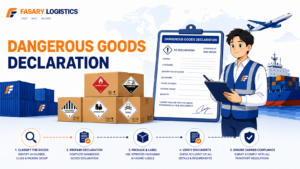
A dangerous goods declaration is a transport document used when cargo is classified or treated as dangerous goods and must be declared, packed, labeled, and handled according to the applicable air, ocean, or ground transport rules.
Importers should care because batteries, liquids, powders, chemicals, aerosols, glue, oils, magnets, or other sensitive goods may be refused, delayed, reclassified, held, fined, returned, or moved by a different shipping method if they are misdeclared or not reviewed early.
A dangerous goods declaration is different from MSDS / SDS for Shipping. Lithium batteries or battery-powered goods may also need battery-specific documents, so review how to ship lithium batteries from China to the USA before booking.
Quick Answer: What Is a Dangerous Goods Declaration?
| Question | Short answer | Importer note |
|---|---|---|
| What is a dangerous goods declaration? | A formal transport declaration for regulated dangerous goods | It supports safe handling, packing, labeling, and transport. |
| Is it the same as SDS/MSDS? | No | SDS supports review, but DG declaration is a transport document. |
| Who prepares or signs it? | Usually the shipper or qualified responsible party | It should not be guessed by the buyer. |
| Is it needed for every shipment? | No | It depends on classification, mode, quantity, packaging, and carrier rules. |
| Does it guarantee acceptance? | No | Carrier, route, packaging, documents, and regulations still matter. |
| What should importers provide? | SDS, photos, ingredients, quantity, packaging, battery data, and product details | Needed before route review. |
What Is a Dangerous Goods Declaration?
A dangerous goods declaration is used to declare regulated dangerous goods for transport. It is not a marketing document, customs invoice, or casual supplier statement saying “not dangerous.”
For air cargo, IATA’s Shipper’s Declaration for Dangerous Goods explains that consignors are required to prepare a form certifying that cargo has been packed, labeled, and declared according to the IATA Dangerous Goods Regulations.
For U.S. hazardous materials shipping papers, 49 CFR 172.202 lists basic shipping description elements such as identification number, proper shipping name, hazard class or division, packing group where applicable, and quantity. This article is not a legal manual; it is an importer planning guide.
Dangerous Goods Declaration vs SDS / MSDS
| Document | Main purpose | Importer should know |
|---|---|---|
| SDS / MSDS | Describes hazards, handling, storage, and emergency information | Supports review but may not be final transport approval. |
| Dangerous goods declaration | Declares regulated DG cargo for transport | Must match classification, packaging, labels, and mode rules. |
| Commercial invoice | Describes sale value and product details | Customs document, not a DG declaration. |
| Packing list | Shows carton or pallet details | Shipping document, not a DG classification document. |
| Battery test summary / UN38.3 | Supports lithium battery transport review | May be needed in addition to SDS or DG declaration. |
SDS/MSDS is useful for sensitive cargo review, but it does not replace a dangerous goods declaration when one is required.
Unsure If SDS Is Enough?
Send your SDS/MSDS, product photos, ingredients, quantity, packaging, and preferred shipping method before arranging pickup.
*Fast response. No obligation.
What Information May Appear on a Dangerous Goods Declaration?
A dangerous goods declaration form may include shipper and consignee, air waybill or booking reference, UN number, proper shipping name, hazard class or division, subsidiary risk if applicable, packing group if applicable, quantity, type of packaging, packing instruction, authorization or special provisions, emergency contact if required, overpack information, shipper certification, signature, and carrier, airport, or port details where applicable.
Importers should not invent these details. They should come from qualified product data, SDS, manufacturer information, test reports, dangerous goods professionals, or carrier-approved review.
Products That Often Need Dangerous Goods Review
| Product type | Why it may need review | What importers should prepare |
|---|---|---|
| Lithium batteries / power banks | Battery transport restrictions may apply | SDS, UN38.3 if applicable, battery specs, photos. |
| Liquids, gels, creams, pastes | Leakage, flammable, corrosive, or chemical risk | SDS, ingredients, quantity, packaging. |
| Powders | Unknown composition or contamination risk | SDS, composition, product use. |
| Aerosols and sprays | Pressurized container risk | SDS, net content, product photos. |
| Glue, paint, ink, coatings | Flammable or chemical classification risk | SDS, container size, packaging. |
| Oils and lubricants | Leakage or regulated material risk | SDS, packaging, volume. |
| Magnets / magnetic goods | Air transport magnetic field concern | Product specs and magnetic test if needed. |
| Chemicals / raw materials | Hazard class or handling risk | SDS, composition, quantity, packaging. |
Air Freight, Ocean Freight, Courier, and DDP: Why Rules Differ
| Shipping method | DG issue | What importers should confirm |
|---|---|---|
| Air freight | IATA DGR and airline acceptance can be strict | Classification, packing instruction, labels, declaration, carrier approval. |
| Ocean freight | IMDG Code and vessel/carrier rules apply | UN number, DG class, packing, segregation, container booking. |
| Courier / express | Many networks restrict batteries, liquids, aerosols, and chemicals | Product eligibility and declared details. |
| DDP / door-to-door | Many all-in networks exclude DG or sensitive cargo | Product acceptance, duty/tax scope, final delivery limits. |
| Ground / final delivery | Hazmat rules may apply after arrival | Shipping papers, labels, carrier capability, warehouse rules. |
IATA says the Dangerous Goods Regulations help classify, mark, pack, label, and document dangerous shipments by air. For sea freight, the IMO explains that the IMDG Code covers dangerous goods in packaged form and requirements such as packing, container traffic, stowage, and segregation.
For route planning, compare air freight from China to USA, ocean freight, and DDP shipping from China to USA only after product documents are reviewed.
Need Route Feasibility Checked?
Share your product type, SDS, packaging, quantity, carton data, destination, and preferred route so shipping options can be reviewed first.
*Fast response. No obligation.
Does a Dangerous Goods Declaration Mean the Cargo Can Ship?
No. A dangerous goods declaration may be necessary when required, but it does not automatically guarantee carrier acceptance.
Carrier acceptance depends on product classification, packaging, quantity, route, mode, documents, labels, warehouse rules, and current carrier policy. Some goods may be forbidden, restricted, or accepted only under specific conditions. Some DG cargo may not be accepted by express, air freight, DDP, or final delivery networks.
Incomplete or inconsistent documents can lead to rejection, delay, storage, route change, or a package held in customs situation. Cargo insurance also does not replace correct dangerous goods declaration and carrier approval.
Common Dangerous Goods Declaration Mistakes Importers Should Avoid
| Mistake | Why it is dangerous | Better approach |
|---|---|---|
| Hiding batteries, liquids, powders, aerosols, or chemicals | Cargo may be rejected or unsafe | Declare product nature early. |
| Relying only on “not dangerous” from supplier | Supplier statement may be incomplete | Request SDS and supporting data. |
| Assuming SDS equals shipping approval | SDS is not carrier acceptance | Ask for route review. |
| Guessing UN number or hazard class | Wrong declaration can create serious risk | Use qualified review. |
| Declaration does not match packaging | Carrier may reject the shipment | Check packaging and documents together. |
| Assuming air, sea, courier, and DDP rules are the same | Each mode has different acceptance rules | Check route separately. |
| Shipping before carrier review | Cargo may get stuck at warehouse or airport | Pre-check before pickup. |
| Using vague names like “samples” or “accessories” | Risk review becomes weak | Use clear product names. |
| Assuming FBA or 3PL accepts DG cargo | Receiver rules may differ | Confirm before delivery. |
What Fasary Can Help With Before DG Shipping
For dangerous goods or sensitive cargo that can be accepted by the selected carrier and route, Fasary can help coordinate supplier pickup, document collection, carrier or partner communication, shipping method comparison, booking arrangement, and final delivery planning. Depending on the product type, this may include air freight, ocean freight, courier, DDP, or alternative routing options.
Fasary can also help identify when more manufacturer data, test reports, battery documents, packaging details, or qualified DG review may be needed before pickup. The practical value is helping importers check transport feasibility early and avoid sending risky cargo into the wrong shipping channel.
Fasary can help ship many types of accepted dangerous goods and sensitive cargo, but acceptance depends on accurate product information, proper documents, packaging, labeling, carrier rules, route availability, and applicable regulations. Fasary does not provide final dangerous goods classification, legal compliance approval, chemical safety certification, or guaranteed carrier acceptance for every product.
Prepare Before Pickup
We can help organize product documents, cargo data, packaging details, route feasibility review, and final delivery requirements before pickup.
*Fast response. No obligation.
FAQ
What is a dangerous goods declaration?
A dangerous goods declaration is a formal transport document used when regulated dangerous goods must be declared for safe transport. It may support handling, packing, labeling, documentation, and carrier review for air, ocean, or ground movement.
Is a dangerous goods declaration the same as SDS?
No. SDS/MSDS describes product hazards, handling, storage, and emergency information. A dangerous goods declaration is a transport document used when regulated DG cargo must be declared under applicable transport rules.
When is a dangerous goods declaration required?
It depends on product classification, transport mode, quantity, packaging, carrier rules, route, and regulations. It may be needed for certain batteries, chemicals, liquids, aerosols, flammable goods, corrosive goods, or other regulated products.
Who is responsible for dangerous goods declaration?
The shipper or qualified responsible party usually provides or signs the declaration. Importers should not guess UN numbers, proper shipping names, hazard classes, packing groups, or packing instructions without qualified review.
Does a dangerous goods declaration guarantee shipment acceptance?
No. Carrier acceptance still depends on classification, packaging, labels, quantity, route, mode, documents, warehouse rules, and current carrier policy. Some goods may still be refused or need another route.
Can Fasary help check dangerous goods before shipping?
Fasary can help collect documents, product details, packaging information, and cargo data for preliminary route review. Final classification, compliance approval, and carrier acceptance depend on qualified review, documents, rules, and carrier decision.
Conclusion
A dangerous goods declaration is a transport document used when regulated dangerous goods must be declared for safe air, ocean, or ground movement. It is different from SDS/MSDS, invoice, packing list, and customs documents.
Before asking for a shipping option, prepare SDS/MSDS, product photos, UN number if confirmed, proper shipping name if confirmed, hazard class if confirmed, packaging details, quantity, weight, and destination. Fasary can help organize product information and check route feasibility, but acceptance depends on accurate classification, packaging, documents, carrier rules, and applicable regulations.