A Bill of Lading from China to USA is an ocean freight document used as a cargo receipt, contract of carriage, and sometimes a document of title. It shows key shipment details such as shipper, consignee, vessel, container, cargo description, and release method.
For China-to-USA sea freight, importers should check B/L details before final issuance because small document errors can delay release or create amendment fees. A B/L is not the full shipping process and does not replace customs clearance. For the broader route and delivery overview, see shipping from China to USA.
Quick Answer: What Is a Bill of Lading?
| Question | Short answer | Why it matters |
|---|---|---|
| What is a Bill of Lading? | An official ocean freight document issued by a carrier, NVOCC, or forwarder. | It supports cargo movement and release. |
| Is it used for sea freight or air freight? | Sea freight. | Air shipments use an Air Waybill, not a B/L. |
| What is an original B/L? | A physical paper Bill of Lading. | It may need endorsement and surrender. |
| What is telex release? | Digital destination release after original B/L surrender at origin. | It avoids couriering paper overseas. |
| What is a sea waybill? | A non-negotiable ocean transport document. | It simplifies release when paper control is not needed. |
| What happens if B/L details are wrong? | Cargo release, customs review, or final delivery may be delayed. | Corrections can cost time and money. |
For importers, the most important point is simple: check the draft before the final B/L is issued, not after the container arrives. Small errors are easier to fix at draft stage than after the carrier has printed or released the final document.
Need to Check Your B/L?
Send your draft B/L, consignee, notify party, vessel/voyage, container number, seal number, cargo details, and release method. We’ll help check key fields before final issue.
*Fast response. No obligation.
Bill of Lading Template
Use the Bill of Lading template below to check the key fields before approving the final B/L.
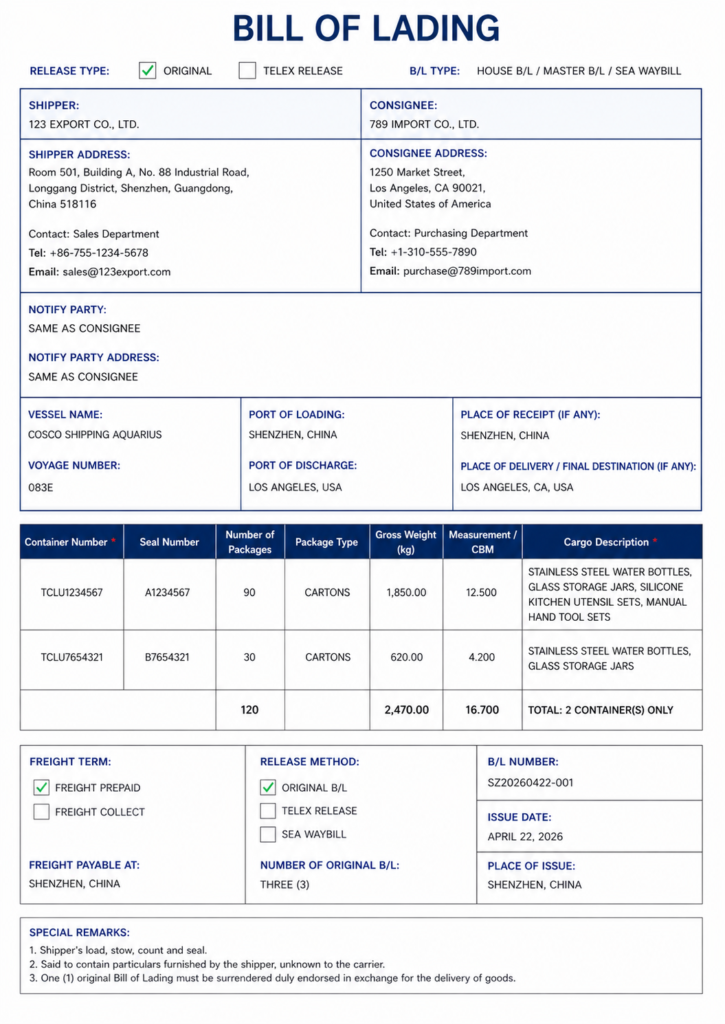
Before approving the B/L, check the shipper, consignee, notify party, vessel/voyage, port of loading, port of discharge, container number, seal number, package count, gross weight, cargo description, freight term, and release method.
Bill of Lading vs Commercial Invoice vs Packing List
These three documents are connected, but they do different jobs.
| Document | Main purpose | What importers should check |
|---|---|---|
| Bill of Lading | Supports ocean transport, cargo identity, and release method. | Consignee, notify party, container, seal, package count, weight, release method. |
| Commercial Invoice | Shows buyer, seller, product value, currency, and sale details. | Product description, value, country of origin, buyer and seller details. |
| Packing List | Shows physical packing details. | Cartons, pallets, dimensions, gross weight, net weight, CBM, shipping marks. |
The B/L controls ocean cargo release. The invoice supports value and transaction details. The packing list supports physical cargo handling.
Original Bill of Lading vs Telex Release vs Sea Waybill
The release method decides how cargo can be released at destination. Importers should confirm it before the vessel sails.
| Release method | Paper needed? | Best for | Main risk |
|---|---|---|---|
| Original B/L | Yes, physical paper may be needed. | Payment control, bank documents, negotiable release. | Paper may be late, lost, or incorrectly endorsed. |
| Telex Release | Original is surrendered at origin first. | Faster release after supplier payment is settled. | Destination release depends on correct origin surrender. |
| Sea Waybill | No original paper. | Trusted parties and simple non-negotiable release. | Less document-based control after shipment. |
Original B/L provides stronger document control, telex release avoids couriering paper internationally after surrender at origin, and sea waybill is simpler when paper control is not needed.
House Bill of Lading vs Master Bill of Lading
Most importers working with a freight forwarder will see a House B/L. The Master B/L is usually handled between the forwarder and the ocean carrier.
| Document | Issued by | Practical use |
|---|---|---|
| House B/L | Freight forwarder or NVOCC | Shows the actual shipper and importer relationship for the specific shipment. |
| Master B/L | Ocean carrier or steamship line | Covers the carrier-level movement, often between forwarder origin and destination agents. |
Importers usually use the House B/L for their cargo release and document coordination.
Key Fields on a Bill of Lading
| Field | What it means | What to check |
|---|---|---|
| Shipper | Party sending or exporting the goods. | Name should match the shipping arrangement. |
| Consignee | Party entitled to receive the goods. | Use the correct legal company name. |
| Notify party | Party receiving arrival notice. | Often importer, broker, or forwarder. |
| Port of loading / discharge | Origin and U.S. arrival ports. | Check routing and destination plan. |
| Vessel / voyage | Ship and sailing reference. | Needed for tracking and arrival planning. |
| Container / seal number | Physical container and security seal. | Must match loading records. |
| Packages / gross weight | Total packages and shipment weight. | Should match packing list. |
| Cargo description | General cargo description. | Use clear wording, not vague terms. |
Common Bill of Lading Mistakes
| Mistake | Why it causes problems | Better approach |
|---|---|---|
| Wrong consignee | Cargo may not be released to the correct party. | Confirm legal company name early. |
| Wrong notify party | Arrival notice may not reach the right person. | List broker or forwarder correctly. |
| Incorrect container or seal number | Tracking and release may be affected. | Cross-check before final approval. |
| Package count / weight mismatch | May create document or customs questions. | Match B/L with packing list. |
| Vague cargo description | “General goods” may cause review questions. | Use specific product wording. |
| Wrong release method | Importer may wait for paper or expect telex incorrectly. | Confirm original, telex, or sea waybill. |
| Corrections requested too late | Amendments after sailing can cost time and money. | Review the draft before final issue. |
Bill of Lading and Cargo Release
B/L release is a commercial release process with the carrier or forwarder. Depending on the release method, the importer may need original paper surrender, telex confirmation, payment confirmation, or destination agent approval.
Cargo usually needs both carrier or forwarder release and customs release before final pickup or delivery. For China-to-USA shipments, confirm the B/L release method, destination charges, and customs clearance from China to USA before sending a truck. For Amazon FBA shipments, the forwarder should confirm B/L release before arranging final warehouse delivery. Under DDP or door-to-door shipping, the forwarder may manage B/L release behind the scenes, but the importer should still know the release method.
What Information Should You Send Before the B/L Is Issued?
| Information needed | Example | Why it matters |
|---|---|---|
| Shipper | Shenzhen supplier name | Supports origin document consistency. |
| Consignee | U.S. importer company name | Controls who can receive cargo. |
| Notify party | Broker or forwarder | Supports arrival coordination. |
| Port of loading / discharge | Shanghai / Los Angeles | Confirms routing. |
| Container / seal number | TLLU1234567 / 987654 | Identifies the physical shipment. |
| Package count / gross weight | 250 cartons / 4,500 kg | Must match packing list. |
| Cargo description | Stainless steel tumblers | Should be specific and consistent. |
| Release method | Original B/L / Telex / Sea Waybill | Determines destination release process. |
Fasary Logistics can help check B/L details, release method, document consistency, and final delivery readiness.
Confirm B/L Release Method?
Share your B/L type, payment status, consignee, notify party, cargo details, and delivery plan. We’ll help compare original B/L, telex release, and sea waybill before cargo arrives.
*Fast response. No obligation.
FAQ
What is a Bill of Lading from China to USA?
A Bill of Lading from China to USA is an ocean freight document issued by a carrier, NVOCC, or forwarder. It supports cargo receipt, carriage terms, shipment identity, and release control at destination.
Is a Bill of Lading required for sea shipping?
Yes. Ocean freight normally uses a Bill of Lading or sea waybill as the transport and release document. Air freight uses an Air Waybill instead, so air shipments follow different release rules.
What is the difference between original B/L and telex release?
An original B/L uses physical paper that may need endorsement and surrender. A telex release allows destination release electronically after the original B/L has been surrendered at origin.
What is a sea waybill?
A sea waybill is a non-negotiable ocean transport document. It does not require original paper surrender and is usually used when buyer and supplier trust each other and document control is not needed.
What is the difference between house B/L and master B/L?
A House B/L is issued by the forwarder or NVOCC to the importer. A Master B/L is issued by the ocean carrier and usually supports carrier-level movement between forwarder agents.
Can wrong B/L details delay cargo release?
Yes. Wrong consignee, notify party, container number, seal number, cargo description, package count, weight, or release method can delay release, create amendment fees, or affect final delivery planning.
Conclusion
A Bill of Lading is a key ocean freight document for China-to-USA shipments. Importers should check consignee, notify party, cargo details, container and seal number, package count, gross weight, and release method before final issuance.
B/L release and customs release must both be confirmed before final delivery. Checking the draft early is the easiest way to reduce document corrections, release delays, and avoidable destination problems.