Telex release is an ocean freight release method where the original Bill of Lading is surrendered at origin, and the destination agent receives an instruction to release cargo without requiring the physical original paper B/L at destination.
Telex release is not customs clearance. It does not replace freight payment, destination charges, carrier or forwarder release, or official customs release. For a broader explanation of B/L types, consignee fields, house B/L, master B/L, and ocean shipping document flow, see our guide to Bill of Lading in ocean shipping. This article focuses only on telex release and original B/L surrender.
Quick Answer: What Is Telex Release?
| Question | Short answer | Why it matters |
|---|---|---|
| What is telex release? | An electronic cargo release instruction after original B/L surrender at origin. | Destination release can proceed without original paper B/L presentation. |
| Does telex release require original B/L at destination? | No. | The original paper is surrendered at origin instead. |
| Who approves telex release? | Usually the shipper or supplier. | Supplier approval often depends on payment status. |
| When is telex release useful? | When the supplier has been paid and paper delivery should be avoided. | It can reduce courier-document delay. |
| Is telex release the same as sea waybill? | No. | Sea waybill starts without original paper; telex release starts with original B/L surrender. |
| Does telex release mean customs clearance is complete? | No. | Commercial release and customs release are separate. |
Telex release can make destination release faster, but only when origin surrender and destination instruction are confirmed.
Need to Check Telex Release?
Send your B/L number, consignee, notify party, vessel/voyage, container number, and release method. We’ll help check whether the telex release status is clear.
*Fast response. No obligation.
Telex Release Confirmation Template
Use the telex release confirmation template below when checking release status with your supplier, freight forwarder, or destination agent.
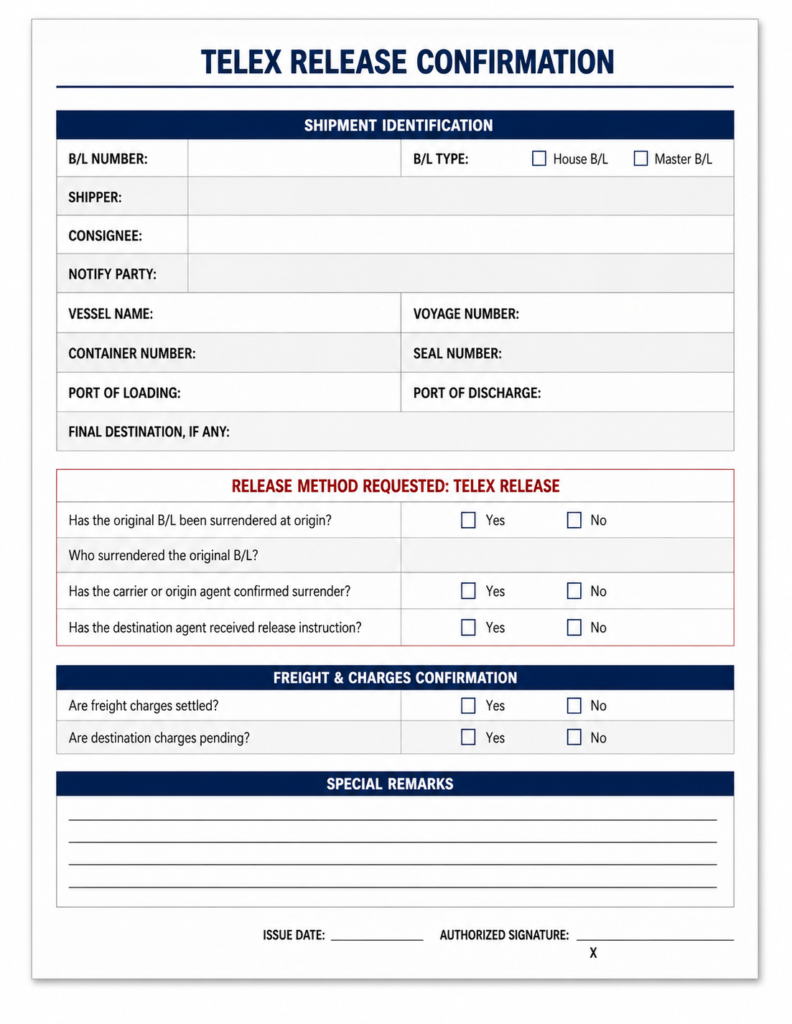
Before relying on telex release, confirm the B/L number, consignee, notify party, vessel/voyage, container number, original B/L surrender status, destination release instruction, freight payment status, destination charges, and customs release status.
How Telex Release Works Step by Step
- Cargo is loaded and B/L is issued. The carrier or forwarder issues the Bill of Lading after cargo is received for ocean transport.
- Supplier or shipper surrenders the original B/L at origin. This usually happens after payment or document-control requirements are satisfied.
- Origin carrier or forwarder confirms original B/L surrender. The origin office records that the paper B/L requirement has been cleared.
- Release instruction is sent to the destination agent. The destination office receives the instruction and updates release status.
- Cargo moves only after all release conditions are cleared. Commercial release, destination charges, customs release, and pickup readiness should be confirmed.
Telex Release vs Original Bill of Lading vs Sea Waybill
| Release method | Original paper needed at destination? | Best for | Main risk |
|---|---|---|---|
| Telex release | No; original is surrendered at origin. | Paid suppliers and faster destination release. | Origin surrender or destination instruction may not be confirmed. |
| Original Bill of Lading | Yes, usually physical paper is required. | Bank documents, Letter of Credit, or strict payment control. | Paper may be late, lost, or incorrectly endorsed. |
| Sea waybill | No original paper is issued. | Trusted parties and simple non-negotiable release. | Less document-based control after shipment. |
Telex release is useful when original B/L control was needed first, but paper presentation at destination should be avoided after surrender at origin. Original B/L keeps physical paper control, while sea waybill is simpler when paper control is not needed.
When Telex Release Makes Sense
Telex release may be practical when:
- Supplier has been paid and no longer needs to hold the original B/L as payment control.
- Buyer wants to avoid mailing original B/L documents internationally.
- Cargo is arriving soon and paper delivery may be slower than vessel arrival.
- Buyer and supplier have a stable relationship and both sides understand the release process.
It is often used to reduce document delays while still allowing supplier control until payment is settled.
When Telex Release May Not Be Suitable
Telex release may not fit when:
- Supplier still needs payment control and does not want cargo released yet.
- Letter of Credit or bank documents require original B/L under the transaction terms.
- Cargo ownership control is still needed because goods may be transferred while in transit.
- Release method or consignee details are unclear and could create destination release problems.
In these cases, original B/L or another release method may be safer.
Common Telex Release Mistakes
| Mistake | Why it causes problems | Better approach |
|---|---|---|
| Assuming telex release is automatic | Supplier must actively surrender the original B/L. | Confirm surrender status. |
| Supplier has not surrendered original B/L | Destination agent cannot release cargo. | Ask who confirmed origin surrender. |
| Destination agent has not received release instruction | Cargo may remain blocked despite supplier claims. | Confirm destination release status. |
| Consignee name is wrong | Release is tied to the named party. | Check B/L draft before final issue. |
| Freight or destination charges are unpaid | Telex release does not waive payment requirements. | Settle invoices before pickup. |
| Scheduling final delivery before release confirmation | Dry-run, storage, or waiting fees may occur. | Wait for commercial and customs release. |
Also confirm notify party, customs release, and whether the shipment is telex release or sea waybill before sending a truck.
Telex Release and Customs Clearance
Telex release controls carrier or forwarder commercial cargo release. It confirms that the original paper B/L does not need to be presented at destination after surrender at origin.
Customs clearance is separate. Cargo usually needs both commercial release and customs release before pickup or delivery. For China-to-USA shipments, confirm telex release status and customs clearance from China to USA before arranging final delivery. For FBA, DDP, or door-to-door shipments, the forwarder may manage telex release behind the scenes, but cargo still needs correct B/L release and customs release.
What Information Should You Send to Confirm Telex Release?
| Information needed | Example | Why it matters |
|---|---|---|
| B/L number | HBL123456789 | Identifies the shipment file. |
| Consignee | Importer company name | Confirms who can receive cargo. |
| Notify party | Broker or forwarder | Supports arrival coordination. |
| Vessel / voyage | Vessel name / voyage number | Tracks arrival timing. |
| Container number | TLLU1234567 | Links release to the cargo. |
| Port of discharge | Los Angeles / New York | Confirms the destination office. |
| Release method requested | Telex Release | Confirms the intended workflow. |
| Original B/L surrender status / destination release instruction | Surrendered / received | Confirms both sides of the process. |
Freight payment, destination charges, and customs release should also be confirmed before final delivery.
Confirm Cargo Release?
Share the B/L number, port of discharge, original B/L surrender status, destination release instruction, freight payment status, and customs release status before pickup.
*Fast response. No obligation.
FAQ
What does telex release mean in shipping?
Telex release means the original Bill of Lading is surrendered at origin, and the destination agent receives an instruction to release cargo without physical original paper B/L at destination.
How does telex release work?
After cargo is loaded and the B/L is issued, the shipper or supplier surrenders the original B/L at origin. The origin office then sends a release instruction to the destination agent.
Is telex release the same as original Bill of Lading?
No. Original Bill of Lading usually requires physical paper presentation or surrender. Telex release allows destination release after the original B/L has already been surrendered at origin.
Is telex release the same as sea waybill?
No. Sea waybill is issued as a non-negotiable document without original paper. Telex release involves an original Bill of Lading that must first be surrendered at origin.
Who approves telex release?
The shipper or supplier usually approves telex release because they control the original B/L at origin. Approval often depends on payment status and agreed release terms.
Does telex release mean customs clearance is complete?
No. Telex release only supports commercial release from the carrier or forwarder. Customs clearance is separate, and cargo usually cannot move until both releases are confirmed.
Conclusion
Telex release allows destination release without physical original B/L at destination after original B/L surrender at origin.
Importers should confirm original B/L surrender, destination instruction, consignee details, freight/payment status, destination charges, customs release, and final delivery readiness before scheduling pickup.