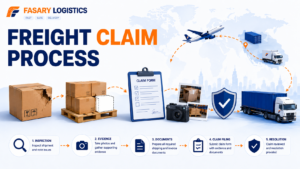
Imagine this scenario: You are shipping from China to USA, and your latest shipment of goods has finally arrived at the Port of Los Angeles. You are eager to get your products into your warehouse and out to your customers. But instead of a smooth delivery, you open your email to find a completely unexpected invoice for hundreds—or even thousands—of dollars. The reason? Your container sat at the port for a few extra days.
The Core Differences Between Demurrage and Detention
To fight these charges, you must first understand the language of international logistics. The entire system revolves around the concept of “Free Time.”
Free time is the specific grace period granted to you by the ocean carrier or the port terminal to handle your cargo without incurring any extra fees. Once this free time expires, the financial clock starts ticking, and the penalties accrue daily.
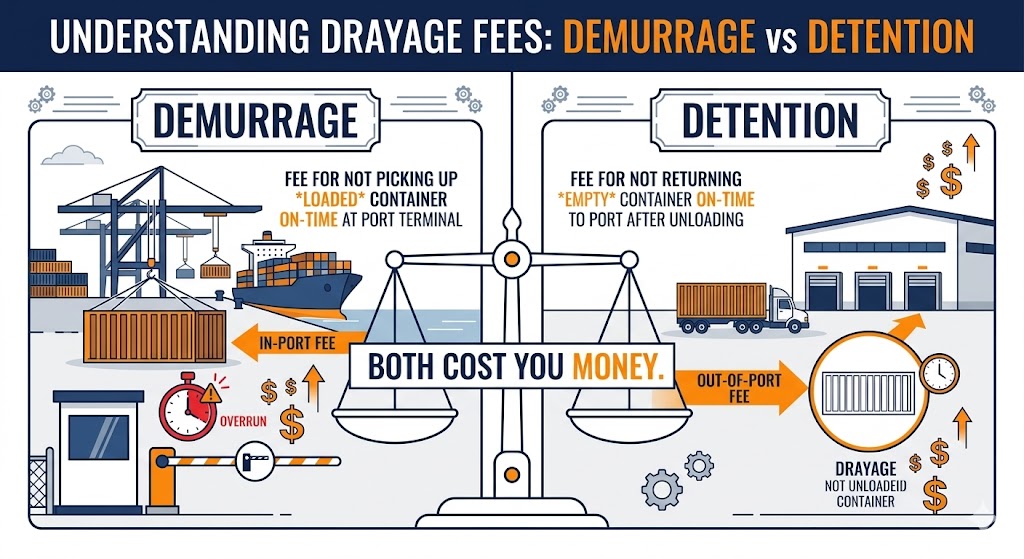
While they are often grouped together, what is demurrage and what is detention are two entirely different penalties that occur at different stages of your shipment’s journey.
The Federal Maritime Commission provides official information on detention and demurrage. Importers should use this as a reference when reviewing whether an invoice is properly documented, especially when the delay was caused by terminal conditions, carrier issues, or other factors outside normal warehouse control.
What is Demurrage?
Demurrage is a penalty fee assessed when your full container load (FCL) of any container size remains inside the port or marine terminal beyond the allotted free time. Essentially, it is a fee for taking up valuable real estate at the port. This fee is typically charged by the port or terminal operator, or by the ocean carrier passing the terminal’s cost on to you. This risk is most common in ocean freight and containerized import movements.
What is Detention?
Detention is a penalty fee assessed when your container has been picked up from the port, but you fail to return the empty container to the ocean carrier’s designated depot within the allotted free time. Because ocean carriers need their containers back in circulation for the next customer, they charge you this fee to penalize you for holding onto their equipment. In practice, detention is closely connected with drayage planning, warehouse unloading speed, and empty container return timing.
What About Per Diem and Storage?
- Per Diem: You will often hear the term “per diem” mixed up with detention. Per diem is Latin for “per day,” and in US logistics, it simply refers to the daily late fee charged for failing to return the equipment. For all practical purposes, consider per diem and detention to be the same thing.
- Container Storage Fees: While demurrage penalizes you for holding the carrier’s container at the port, container storage fees are specifically charged by the terminal for occupying physical space in their yard.
Here is a simple, easy-to-read breakdown to keep these terms straight:
| Feature | Demurrage | Detention (Per Diem) |
| Where is the container? | Inside the Port / Terminal | Outside the Port / Terminal |
| Status of the container? | Full / Loaded | Full or Empty |
| Why are you being charged? | You did not pick up the cargo on time. | You did not return the empty container on time. |
| Who bills you? | Port / Terminal Operator | Ocean Carrier |
| Typical Free Time | 3 to 5 Days | 3 to 7 Days |
Quick Cost Reference: What a 3-Day Delay Could Cost You
| Port | Demurrage (Day 1-3) | Demurrage (Day 4+) | Detention (Per Day) |
| Los Angeles / Long Beach | $150–$200 | $250–$350 | $150–$200 |
| New York / New Jersey | $125–$175 | $200–$300 | $135–$185 |
| Savannah | $100–$150 | $175–$250 | $125–$175 |
Example: A container stuck at LA/LB for 6 days beyond free time could cost: (3 × $175) + (3 × $300) = $1,425 in demurrage alone.
Don’t let a 3-day delay cost you $1,425.
*We’ll help you secure extended free time and pre-book drayage. Reply within 2 hours.
Why Are These Fees So Expensive and Easy to Incur?
You might be wondering, “If I have free time, why is it so hard to just move my cargo?” The reality of modern logistics is that the supply chain is highly volatile. Here is why these fees catch so many importers off guard.
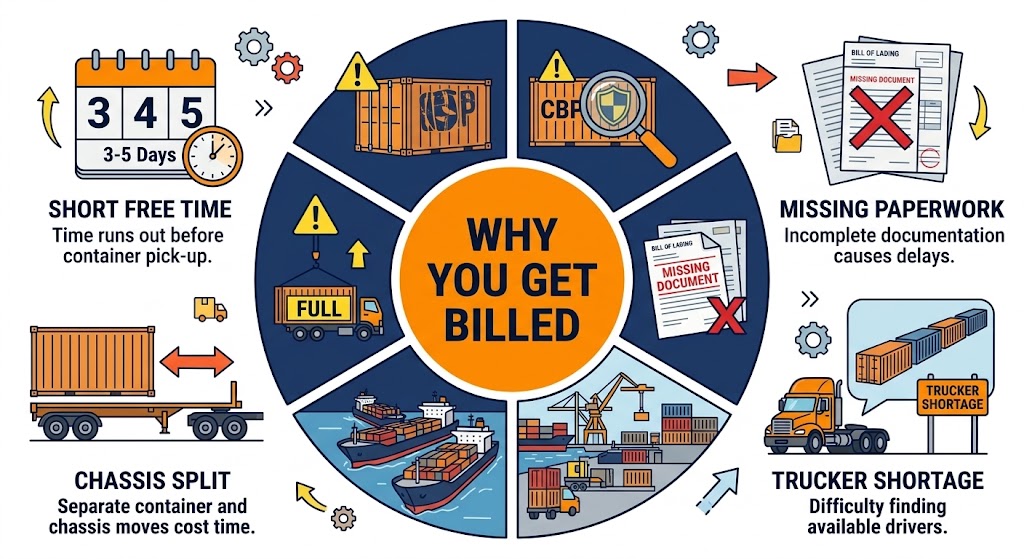
1. Free Time is Extremely Short Terminals and carriers operate on razor-thin margins and need maximum throughput. Typically, you only get 3 to 5 days of free time at the terminal. Worse yet, for many ports, weekends and holidays count towards your free time. If your container is discharged on a Friday evening, Saturday and Sunday will eat up half of your grace period before the business week even begins.
2. US Customs (CBP) Exams US Customs and Border Protection (CBP) randomly, or based on risk assessments, flags containers for inspection. If your container is flagged for a CBP Exam, it cannot leave the port—but your free time clock keeps ticking.
- X-Ray (VACIS) Exam: Takes 1-2 days.
- Tailgate Exam: Customs breaks the seal and looks inside, taking 2-5 days.
- Intensive Exam: The container is moved to a Centralized Examination Station (CES) and completely emptied. This can delay your cargo by 7 to 14 days, guaranteeing massive demurrage bills.
3. Incomplete Customs Documentation If your paperwork is wrong, your cargo stops moving. Issues like mismatched HS codes, missing commercial invoices, or failing to file ISF on time can result in customs holds, immediately triggering terminal delays. For U.S. ocean shipments, review sea shipping from China to USA and prepare customs documents before arrival.
4. Trucking Capacity and Appointment Shortages You cannot simply send a truck to the port whenever you want. Truckers (drayage carriers) must secure an appointment slot from the terminal to pick up your container. During busy periods, appointment slots vanish in minutes. Even if your cargo is cleared by customs, a lack of available truck drivers or missing chassis (the trailer the container sits on) will leave your goods stranded.
5. Port Congestion When vessels bunch up and terminals reach maximum capacity, the resulting bottlenecks grind operations to a halt. In severe cases, ocean carriers may even apply a port congestion surcharge to account for the operational nightmare, while your containers sit buried in stacks, unable to be retrieved before free time expires.
6. Chassis Shortages and Split Locations
Even when a trucker secures an appointment, they may discover the chassis is not at the same location as your container. This “chassis split” forces the driver to make an extra trip to a separate depot, burning precious hours. If the delay pushes the empty return past the free time cutoff, you get billed for detention—even though the inefficiency was entirely outside your control.
Want someone to handle all 6 strategies for you?
From pre-clearance to drayage booking and free time monitoring—we do it all.
*Free consultation. We’ll audit your current shipping process within 2 hours.
6 Actionable Strategies to Avoid Demurrage and Detention
Understanding the problem is only half the battle. As an importer, you need practical, immediately executable steps to protect your bottom line. Here are six expert strategies you can implement on your next shipment.
Strategy 1: Prepare All Customs Documents Early
Do not wait until the vessel is docking in Los Angeles or New York to start your customs clearance. Work with your supplier in China to ensure all documents (Commercial Invoice, Packing List, Bill of Lading) are pristine and accurate weeks in advance.
- Ensure your ISF (10+2) is filed at least 24 hours before the cargo is loaded onto the vessel at the origin port.
- Pre-clear your cargo while it is still on the water. By submitting documentation to your customs broker 5-7 days before arrival, CBP can clear the shipment before it even hits the terminal deck.
Strategy 2: Pre-Book Your Truck (Drayage) Well in Advance
In today’s logistics environment, waiting until the container arrives to find a trucker is a guaranteed recipe for demurrage. You should provide your delivery order to your drayage provider at least two weeks before the vessel’s Estimated Time of Arrival (ETA). This allows the trucking dispatcher to monitor the vessel, secure the earliest possible terminal appointment, and ensure they have a chassis reserved for your container.
Strategy 3: Choose the Right Freight Forwarder
Not all freight forwarders are created equal. You need a partner who has a robust network of reliable drayage truckers and operates closely with your destination port. A freight forwarder with established relationships can often secure terminal appointments and chassis when standard truckers cannot. They will also track your container’s milestones in real-time, warning you before free time expires.
Strategy 4: Optimize with “Merchant Haulage” or Fast Return Services
In shipping, there are two main ways to handle the inland trucking leg: Carrier Haulage and Merchant Haulage.
- Carrier Haulage: The ocean carrier organizes the truck to your door. This is highly convenient, and if the carrier’s truck is late and your contract explicitly holds the carrier responsible for terminal delays, you generally aren’t hit with demurrage. However, this protection is not automatic—always verify the terms in your service contract.
- Merchant Haulage (also known as Shipper-Arranged Trucking): You or your freight forwarder hire a third-party trucker. While this puts the liability on you, it gives you immense flexibility.
If you use Merchant Haulage, consider “drop and pick” services at your warehouse. Unload your goods immediately so the trucker can return the empty container on the same day, totally eliminating your risk of detention fees.
Strategy 5: Proactively Request an Extension of Free Time
Everything in logistics is negotiable—if you ask early enough. If you know your warehouse is backed up, or if you are moving a high volume of containers, negotiate extended free time before you sign the shipping contract.
If the shipment is already in transit and you foresee a delay, proactively contact the ocean carrier. Some carriers now offer digital portals where you can purchase a few extra days of free time for a small, flat fee. Paying $150 upfront for an extension is much better than getting hit with a $600 penalty later.
Strategy 6: Route Planning and Port Diversification During Peak Season
If a specific port (like Los Angeles or Long Beach) is experiencing extreme congestion, do not send your cargo into the bottleneck. Work with your logistics partner to diversify your routing. Routing your cargo through alternative gateways—such as Seattle, Oakland, or even East Coast ports like Savannah—can help you bypass terminal chaos, ensuring your cargo flows smoothly within its free time.
What to Do If You Receive a Bill
Even with the best preparation, unforeseen events like extreme weather or random CBP exams can result in an invoice landing on your desk. If this happens, do not just pay it blindly.
1. Audit the Invoice for Accuracy Under the Ocean Shipping Reform Act of 2022 (OSRA 2022), the Federal Maritime Commission (FMC) implemented strict new billing requirements. Carriers and terminals must issue invoices within exactly 30 calendar days of the charge being incurred. Furthermore, the invoice must contain highly specific information, including the exact start and end dates of your free time, the container number, and a statement that the carrier did not cause the delay. If the invoice is missing required information or arrives late, you are legally not obligated to pay it.
2. Submit a Waiver Request If you were charged demurrage due to circumstances completely outside of your control—such as a mandatory Customs intensive exam, or the terminal being so congested that your trucker physically could not secure an appointment—you have the right to dispute the charge.
You have 30 days to submit a formal fee mitigation or Waiver Request to the billing party. When submitting your dispute, be highly specific and provide indisputable proof. Include your customs hold notices, emails from your broker, and time-stamped screenshots from the terminal’s website proving that no truck appointments were available during your free time. Carriers are much more likely to waive or reduce the fees if you provide overwhelming documentation.
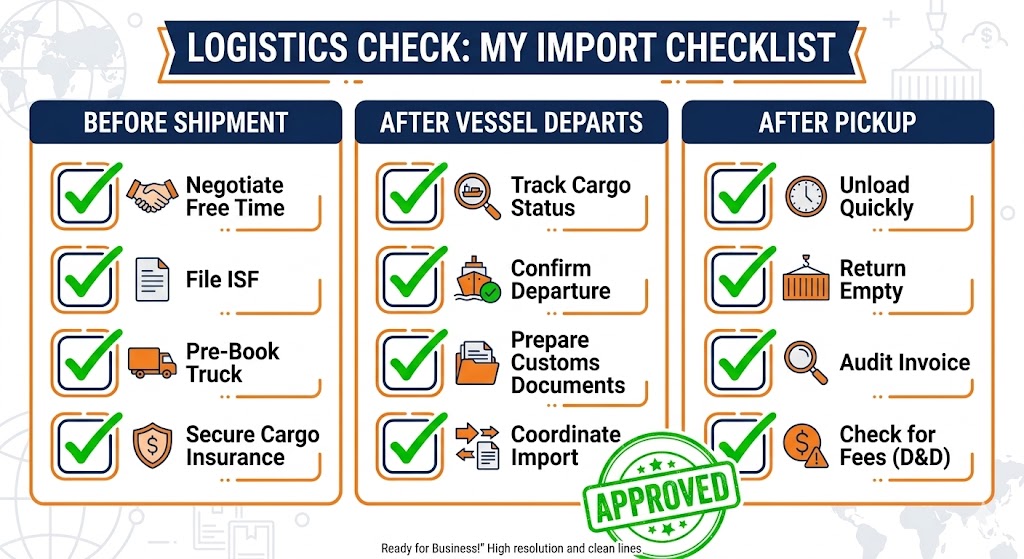
Your Demurrage & Detention Prevention Checklist
| Before Shipment | After Vessel Departs | After Container Pickup |
| ☐ Negotiate 7-10 days free time in contract | ☐ File ISF 24h before loading | ☐ Unload within 24 hours |
| ☐ Prepare all customs docs | ☐ Send docs to broker 5 days pre-arrival | ☐ Return empty immediately (same-day if possible) |
| ☐ Pre-book drayage 2 weeks before ETA | ☐ Monitor terminal appointments daily | ☐ Save all delivery receipts and EIRs |
| ☐ Confirm chassis availability | ☐ Request free time extension if needed | ☐ Audit any invoice within 30 days |
Stop Paying Invisible Killers. Start Shipping Smarter.
Partner with Fasary Logistics for proactive customs clearance, reliable drayage, and zero demurrage surprises.
*Response within 2 hours. No obligation.
Conclusion
In the world of international logistics, time literally is money. A container sitting idle is a liability that can quickly erase the profit margins you worked so hard to build. While demurrage and detention charges are a persistent threat, they are not an unavoidable cost of doing business.
By understanding the strict differences between terminal delays and equipment return delays, mastering your customs paperwork, booking trucks early, and knowing your rights under the new FMC billing regulations, you can protect your business from these invisible killers.
The most effective way to eliminate these risks is to stop them at the source. We highly recommend partnering with a professional freight forwarder who can seamlessly orchestrate your entire logistics chain—from the factory floor in Asia to your warehouse doors in the US. Fasary Logistics, an expert in China-to-US freight forwarding, specializes in proactive customs clearance, securing reliable drayage capacity, and actively managing your container’s free time to effectively bypass these costly penalties.
To dive deeper into optimizing your supply chain and protecting your margins, check out our shipping from China to USA guide.