Import duty from China to USA is not one flat percentage. A typical China-origin entry stacks a base HTS duty (0–25% depending on classification), Section 301 tariffs of 7.5–25% on many China goods, MPF at 0.3464% of value, and HMF at 0.125% for ocean — before any broker fee or bond. In our experience, the two costliest duty mistakes are using a supplier’s China export HS code as the U.S. HTS code, and budgeting the base duty while forgetting Section 301. Below is the exact duty formula, how classification and customs value drive the result, and what DDP actually includes.
Import duty is separate from freight cost, customs broker fees, destination charges, and final delivery. This article focuses on duty-related cost planning only, not the full shipping from China to USA process or a complete customs clearance from China to USA guide.
Quick Answer: How Is Import Duty from China to USA Calculated?
| Question | Short answer |
|---|---|
| What determines import duty? | U.S. HTS code, customs value, country of origin, and applicable trade measures. |
| What is an HTS code? | The U.S. 10-digit tariff classification used to determine duty rates and entry data. |
| What is customs value? | Usually the declared transaction value shown on the commercial invoice, subject to customs valuation rules. |
| What is Section 301 tariff? | An additional tariff that may apply to certain China-origin goods based on current trade rules. |
| What are MPF and HMF? | U.S. import-related fees that may apply separately from duty. |
| Are duties included in freight quotes? | Usually not, unless the quote clearly states DDP-style or duty-included scope. |
| What is the biggest duty mistake? | Using a vague product description or supplier HS code without U.S. HTS review. |
Estimated import duty = customs value × duty rate
If Section 301 or other tariffs apply, they may be added based on the product’s HTS code, country of origin, and current trade rules.
This formula only estimates the duty and tariff portion. MPF, HMF, broker fees, bond fees, freight, destination charges, and final delivery may still need to be added for landed cost.
Not Sure What Duty May Apply?
Send us your product description, material, invoice value, HTS code if available, country of origin, and shipping method. We’ll help review which duty-related cost items should be checked before shipping.
*Fast response. No obligation.
What Determines Import Duty from China to USA?
Import duty should be estimated before the shipment is booked. The duty result depends on classification, value, origin, and the entry treatment confirmed by the broker or official sources.
| Factor | Simple explanation |
|---|---|
| HTS code | Determines the baseline duty rate and product category. |
| Customs value | The value used to calculate duty, often based on the commercial invoice. |
| Country of origin | China origin may trigger additional China-related tariffs depending on the product. |
| Section 301 / trade measures | Some China-origin goods may have additional tariff exposure. |
| Broker / CBP review | Final duty treatment may depend on broker review or CBP determination. |
The official Harmonized Tariff Schedule is the main reference for U.S. tariff classification and duty rates. For commercial shipments, importers should still confirm classification and duty treatment with a licensed customs broker when the product is not simple.
HTS Code, China Origin, and Section 301 Tariffs
The HTS code determines the baseline duty rate. China origin may also trigger additional tariffs depending on the product and current rules. USTR maintains official information on China Section 301 tariff actions, but the exact impact depends on the current HTS code and product coverage.
Your supplier’s HS code is only a starting point. Chinese export codes may not match the U.S. 10-digit HTS code used for import entry. If you are unsure, review HS code for imports from China to USA before using a duty estimate in pricing.
In our experience reviewing China-to-USA duty estimates, the two costliest mistakes are structural. First, buyers use the supplier’s China export HS code as the U.S. HTS code — but the U.S. 10-digit code can carry a very different rate, and a misclassification discovered at entry triggers penalties and re-filing. Second, buyers budget the base duty but forget Section 301: a product with a 0% base rate can still owe 25% simply because it is China-origin. We always run the HTS code and Section 301 list check before the cargo leaves China.
Simple example: a “bag” is not enough for duty review. A polyester backpack, plastic-coated tote bag, leather handbag, and cotton shopping bag may not follow the same classification logic. Another example: a “metal part” is not enough. A steel furniture bracket, aluminum machine part, and general-purpose screw may need different classification review. The more specific the product description, material, function, and intended use are, the more useful the duty estimate will be.
Customs Value and Declared Value
Duty is often estimated from the customs value shown on the commercial invoice. The invoice should show product value, quantity, unit price, currency, buyer, seller, and country of origin.
For example, if the invoice shows 1,000 units at USD 10 each, the commercial invoice value is USD 10,000. Duty estimation usually starts from that value, subject to customs valuation rules.
Undervaluing goods can create customs questions, delays, penalties, or future compliance issues. If the value is not straightforward because of assists, tooling, discounts, or unusual transaction terms, ask your broker to review the valuation before shipping.
Duty, Tariff, MPF, HMF, Broker Fee, and Freight Cost Are Different
Importers often mix duty with shipping cost. Separating each cost item helps you understand the real landed cost from China to the USA. For the full fee layer, see customs cost from China to USA. For terminology differences, see import duty vs tariff vs tax.
| Cost item | What it means | Is it import duty? |
|---|---|---|
| Import duty | Baseline customs duty based on HTS code and customs value | Yes |
| Section 301 tariff | Additional China-related tariff (7.5–25%) if applicable | No, but it is a duty-related tariff charge |
| MPF | Merchandise Processing Fee, 0.3464% of value (min ~$33.58, max ~$651.50) | No, but it is an import-related government fee |
| HMF | Harbor Maintenance Fee, 0.125% for certain ocean imports | No, but it is an import-related government fee |
| Customs broker fee | Service fee for entry filing or customs work | No |
| Customs bond fee | Cost for a single-entry or continuous bond if needed | No |
| Freight cost | Sea, air, express, LCL, or FCL transportation charge | No |
| Destination charges | Port, CFS, terminal, warehouse, or handling charges | No |
| Final delivery | Trucking, parcel delivery, appointment, or FBA delivery | No |
For full transportation pricing, use the shipping quote from China to USA article separately. This article focuses on duty-related planning.
DDP vs DAP: Are Duties Included in the Quote?
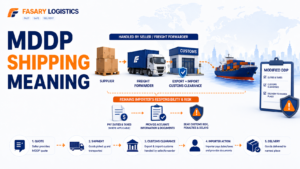
DAP or duty-unpaid quotes usually leave duties to the buyer or Importer of Record. DDP-style quotes may include duties depending on the written quote scope. Door-to-door is not automatically DDP, and Amazon FBA does not pay import duties for third-party sellers.
| Question to ask | Why it matters |
|---|---|
| Are import duties included? | Prevents surprise duty bills after arrival. |
| Are Section 301 tariffs included if applicable? | China-origin products may have additional tariff exposure. |
| Is MPF included? | MPF may apply separately from duty. |
| Is HMF included for ocean freight? | HMF may apply to certain sea shipments. |
| Is customs broker service included? | Broker fee is not the same as duty. |
| Who acts as Importer of Record? | The IOR is responsible for entry accuracy and duty responsibility. |
| Are destination charges and final delivery included? | These are logistics costs, not import duty. |
For duty-included scope, review DDP shipping from China to USA. For delivery scope, see door-to-door shipping from China to USA. If the destination is Amazon, see Amazon FBA shipping from China to USA for FBA delivery planning.
Use cautious wording when comparing quotes. A DDP-style quote may include duties, but importers should confirm the HTS code, duty assumptions, IOR structure, broker role, and exclusions in writing.
DDP, DAP, or Duty-Unpaid?
Share your quote, product details, invoice value, HTS code if known, shipping method, and destination ZIP code. We’ll help check whether duties, tariffs, MPF, HMF, broker fees, and delivery costs are clearly included or excluded.
*Fast response. No obligation.
How Import Duty Affects Landed Cost
Import duty affects landed cost because it adds to product cost and freight-related charges. A simple landed cost formula is:
Estimated landed cost = product value + estimated duty/tariff + MPF/HMF if applicable + broker/bond fees + freight + destination charges + final delivery
| Cost item | Example input |
|---|---|
| Product value | USD 10,000 |
| Estimated duty | Customs value × duty rate |
| Section 301 if applicable | Based on HTS code and current trade rules |
| MPF/HMF | Check official rules or broker estimate |
| Freight | Quoted separately |
| Final delivery | Based on ZIP code and address type |
This does not create a guaranteed landed cost. It helps importers separate duty-related costs from freight, destination, and delivery charges before comparing suppliers or logistics quotes.
Import Duty by Shipping Method
The shipping method does not usually change the basic duty logic. HTS code, customs value, and origin remain the main duty factors. But billing and related fees may differ.
- Sea freight: Duty logic is still based on HTS, value, and origin. HMF may be relevant for certain ocean shipments.
- Air freight: Duty logic is similar, but airport handling and broker costs may be billed differently.
- Express: Courier may bill duties and taxes to the receiver, sender, or account holder depending on setup.
- Amazon FBA: Amazon does not pay import duty for third-party sellers. The seller or importer must plan duty before FBA delivery.
Do not assume a shipping method removes duty responsibility. Even a fast express shipment may still need accurate product description, declared value, and classification details.
Common Import Duty Mistakes
- Using supplier HS code without U.S. HTS review. Supplier export codes may not match U.S. import classification.
- Providing vague product descriptions like “parts” or “accessories.” Duty review needs material, use, and product details.
- Undervaluing the commercial invoice. This can create customs questions, delays, penalties, or future compliance problems.
- Ignoring Section 301 tariffs. Some China-origin goods may have additional tariff exposure.
- Assuming DDP always shows duty clearly. Some quotes may bundle duty without explaining the duty assumptions.
- Confusing customs broker fee, freight cost, or destination charges with import duty. These are separate cost categories.
If a document or classification mismatch becomes serious, the shipment may face customs questions or a customs hold from China to USA. This article does not replace a customs hold guide; it only explains duty planning.
What Information Should You Send for a Duty Estimate?
A useful China-to-USA duty estimate needs more than a product name. Send enough detail for the broker, forwarder, or destination agent to understand the product and quote scope.
| Information needed | Example |
|---|---|
| Product description | Stainless steel water bottle / polyester backpack / LED desk lamp |
| Material | Steel, plastic, cotton, polyester, aluminum |
| Main use | Household use / industrial part / retail product |
| Product photos or spec sheet | Photos, catalog page, technical drawing |
| Country of origin | Made in China |
| Commercial invoice value | USD 10,000 |
| Quantity / unit price | 1,000 units / USD 10 per unit |
| HTS code if known | 10-digit U.S. HTS code if available |
| Shipping method / DDP or DAP preference | Sea, air, or express / DDP / DAP / duty-unpaid |
| Destination ZIP code / FBA code if any | 90021 / ONT8 / LAX9 / FTW1 |
Need Duty Estimate Details Checked?
Send your product photos, material, main use, invoice value, quantity, HTS code if known, quote type, and destination ZIP code. We’ll help organize the information needed for duty-related cost planning.
*Fast response. No obligation.
How Fasary Logistics Helps with Import Duty Planning
Fasary Logistics helps importers organize duty-related information before shipping from China to the USA. We do not provide legal customs advice, do not guarantee final duty rates, and do not guarantee customs clearance. Final HTS classification and duty treatment should be confirmed with a customs broker and official sources.
We can help you:
- Organize product and invoice information.
- Separate freight cost from duty-related costs.
- Clarify DDP/DAP quote scope.
- Coordinate with a broker or destination agent when needed.
The goal is not to promise the lowest duty. The goal is to help importers avoid unclear quotes, missing cost items, and landed cost surprises.
FAQ
How do I calculate import duty from China to USA?
Import duty is usually estimated by multiplying customs value by the duty rate from the correct U.S. HTS code. If Section 301 or other tariffs apply, those may need to be added. MPF, HMF, broker fees, bond fees, freight, destination charges, and delivery costs may still affect landed cost.
Is import duty the same as tariff?
Not exactly. Import duty usually refers to the baseline customs duty based on product classification. A tariff often refers to an additional trade-related duty, such as Section 301 tariffs on certain China-origin goods.
Do all goods from China have the same duty rate?
No. Duty rates vary by HTS classification, material, use, country of origin, and current trade rules. Similar-looking products can have different duty treatment.
What is an HTS code?
An HTS code is the U.S. Harmonized Tariff Schedule classification used to identify imported products and determine duty rates, tariff exposure, and customs entry data.
Does DDP shipping include import duty?
DDP-style shipping may include import duty depending on the written quote scope. Importers should confirm duties, Section 301 tariffs if applicable, MPF, HMF, broker fee, bond, destination charges, final delivery, and exclusions.
Can my supplier give me the correct duty rate?
Your supplier can provide a useful starting point, such as a China export HS code. However, U.S. import duty should be reviewed using the U.S. 10-digit HTS code and confirmed with a broker or official source when needed.
Conclusion
Import duty from China to USA depends on HTS classification, customs value, country of origin, Section 301 or other tariffs if applicable, and the quote scope. Importers should separate duty from freight cost, broker fees, destination charges, and final delivery.
A practical approach is to prepare clear product details, confirm HTS classification when needed, and clarify whether the quote is DDP-style, DAP, or duty-unpaid before shipping.
If you are unsure what duty-related costs may apply, send Fasary Logistics your product description, material, invoice value, HTS code if available, shipping method, and destination details. We can help review what to check before you ship. For the full freight process, see shipping from China to USA.