A commercial invoice is the final sales document used in international trade to show what was sold, who sold it, how much was paid, and under what terms. For importers in the United States and Canada, it is also one of the key documents customs uses to assess value, verify classification, and determine duties, taxes, and compliance requirements.
In practice, the commercial invoice is not just a payment document. It is a customs document. If the information is incomplete, inconsistent, or vague, your shipment can be delayed, revalued, or flagged for review at the border.
Quick Answer
| Question | Short Answer |
|---|---|
| What is a commercial invoice? | The final sales document used for customs valuation, payment, and compliance. |
| Who issues it? | The exporter / seller. |
| Who uses it? | The buyer, customs broker, freight forwarder, and customs authorities. |
| Why does it matter? | It helps customs determine value, classification, origin, and duties. |
| What happens if it is wrong? | Clearance may be delayed, revalued, or subject to further review. |
Note: If you are looking for information on preliminary quoting, see our guide on what is a proforma invoice or the complete commercial invoice vs proforma invoice comparison.
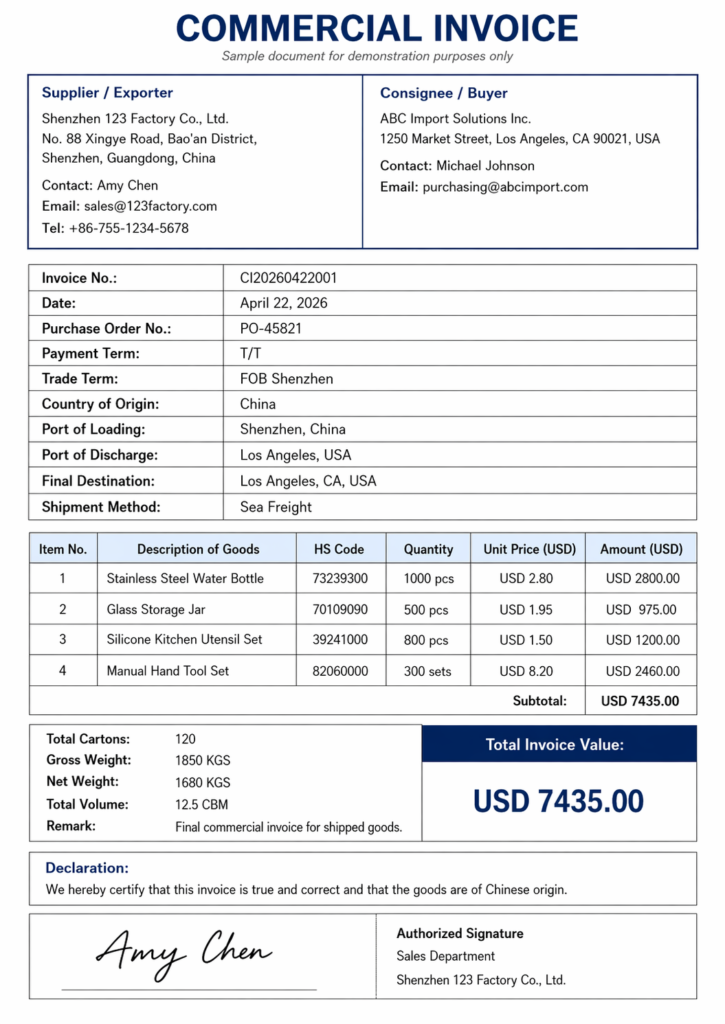
Sample Commercial Invoice / Example Template
Below is a simplified structural example of how a compliant commercial invoice should look to satisfy North American customs requirements:
Why the Commercial Invoice Dictates Your Supply Chain
Many new importers assume that the commercial invoice is just a standard invoice used by the accounting department to pay the supplier. This is a critical misconception. In domestic trade, an invoice is just a request for payment. In international trade, the commercial invoice is an official government declaration.
When your shipping container arrives at the port, customs agents use the data on this single sheet of paper to answer critical security and economic questions: What is entering the country? Is it legal? How much tax does the importer owe the government?
If the information provided by your overseas supplier is incomplete, vague, or inaccurate, it results in customs holds, expensive daily storage fees at the port, and potentially severe financial penalties. Customs authorities hold you liable—not your supplier, not your freight forwarder. For U.S.-bound shipments, our customs clearance from China to USA guide explains how invoice data affects the broker workflow and release process.
Domestic Invoice vs. Commercial Invoice
| Feature | Standard Domestic Invoice | Commercial Invoice (International Trade) |
|---|---|---|
| Primary Audience | Your accounting department | Customs authorities (CBP / CBSA) |
| Main Purpose | Requesting payment for goods/services | Assessing import duties, taxes, and legal compliance |
| Legal Status | Proof of debt | Binding customs declaration and proof of sale |
| Required Data | Price, quantity, basic description | HS Codes, Country of Origin, Incoterms, Port of Entry |
| Consequence of Error | Payment delay | Cargo seized, port storage fines, legal penalties |
How the Commercial Invoice Interacts with Other Shipping Documents
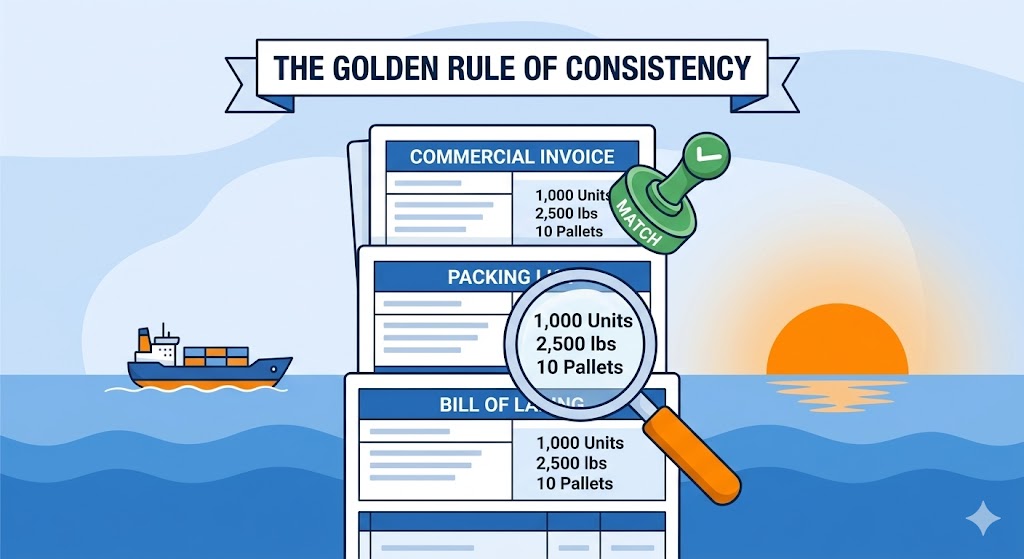
The commercial invoice explains the value, the packing list explains the physical shipment, and the bill of lading proves the carrier received the cargo. Customs expects these three documents to align perfectly.
If your Commercial Invoice says you bought 1,000 widgets, your Packing List must show exactly how those 1,000 widgets are packed in boxes, and your Bill of Lading must reflect the exact total weight of those widgets. Discrepancies between these documents trigger immediate customs audits.
The Document Triad
| Document | Primary Focus | Who Issues It? | What Customs Looks For |
|---|---|---|---|
| Commercial Invoice | Financial Value & Compliance | Supplier | Correct valuation, origin, HTS classification, and tax calculation. |
| Packing List | Physical Logistics | Supplier | Discrepancies in weight or carton count compared to the invoice. |
| Bill of Lading | Title of Goods & Freight | Ocean Carrier / Airline | Verification that the physical cargo matches the declared paperwork. |
Specific Requirements for North American Importers
For the United States, a commercial invoice is generally required for each shipment unless a specific exception applies under CBP regulations (19 CFR 141.83). For Canada, importers generally need a compliant commercial invoice or CI1-equivalent data containing the required customs information.
Mandatory Fields Checklist (US & Canada)
The Code of Federal Regulations governing U.S. 19 CFR § 141.86 invoice contents, and the CBSA Invoice Requirements Memorandum D1-4-1 in Canada, dictate exactly what must be on your documents.
| Section | Required Information | Why Customs Needs It |
|---|---|---|
| Header | Seller & Buyer Info: Complete names, addresses, and tax IDs (IRS/EIN or Business Number). | Identifies who is legally responsible for paying duties and verifies parties are not sanctioned. |
| Body | Detailed Description: “Men’s 100% cotton woven shirts” (NOT just “Apparel”). | To determine the correct tariff rate and safety regulations. |
| Body | HTS / HS Codes: The 6 to 10 digit Harmonized System code. | The exact numeric classification dictating your tax rate. |
| Body | Country of Origin: Where the goods were actually manufactured. | Applies specific tariffs or Free Trade benefits. |
| Body | Quantities & Weights: Exact units, net weight, gross weight. | Used to calculate specific duties. |
| Financials | Unit Price, Total Value & Currency: Exact price paid per item in the agreed currency (e.g., USD, CAD). | The basis for “Ad Valorem” (value-based) duties. |
| Terms | Incoterms: Delivery terms like FOB or CIF. | Determines if freight/insurance costs should be added to or deducted from the taxable value. |
For U.S. imports, the HTS / HS code, country of origin, declared value, and product description are especially important because they affect classification and duty calculation. If the shipment is from China to the United States, review our HS code for imports from China to USA and import duty from China to USA guides before finalizing the invoice.
When Should You Stop and Recheck the Commercial Invoice?
| Red Flag | Why It Matters |
|---|---|
| Description is vague (“parts”, “accessories”, “sample”) | Customs may not be able to classify the goods correctly. |
| Country of origin is missing | Duty rate and trade preference may be applied incorrectly. |
| Incoterms are missing | Customs value may be interpreted incorrectly. |
| Invoice quantity and packing list do not match | Shipment may be flagged for discrepancy. |
| Currency is unclear | Broker may have to pause valuation. |
| Supplier listed $0 value or unrealistically low value | This can trigger rejection, revaluation, or compliance risk. |
Commercial Invoice Audit Checklist Before Shipment
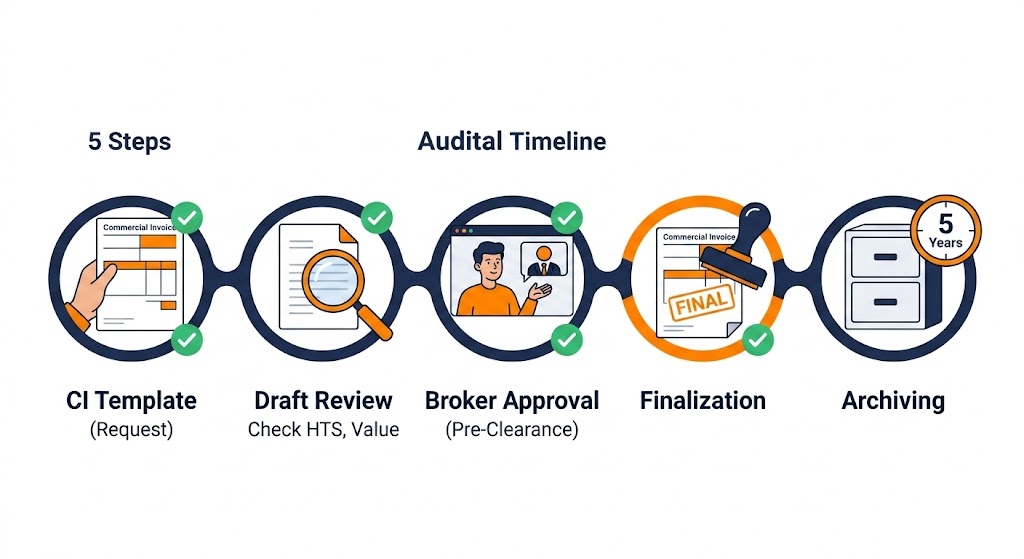
Do not wait until the cargo ship is sitting outside the port to look at your documents. Implementing a pre-shipment invoice audit will save you from 99% of customs clearance delays.
- Confirm the seller and buyer names match the transaction documents.
- Confirm the product description is plain-language and classification-friendly.
- Confirm the country of origin is correct for each line item.
- Confirm unit price, total value, and currency are clearly shown.
- Confirm Incoterms (like FOB, CIF, EXW vs DAP, DDP) are listed and, where necessary, freight is separated.
- Confirm quantities, weights, and packaging details align with the packing list.
- Confirm the customs broker has reviewed the draft before cargo departure.
Deep Dive: The Three Most Critical Fields Importers Get Wrong
Vague descriptions, incorrect valuation, and missing Incoterms are the top three reasons US and Canadian importers face supply chain disruptions.
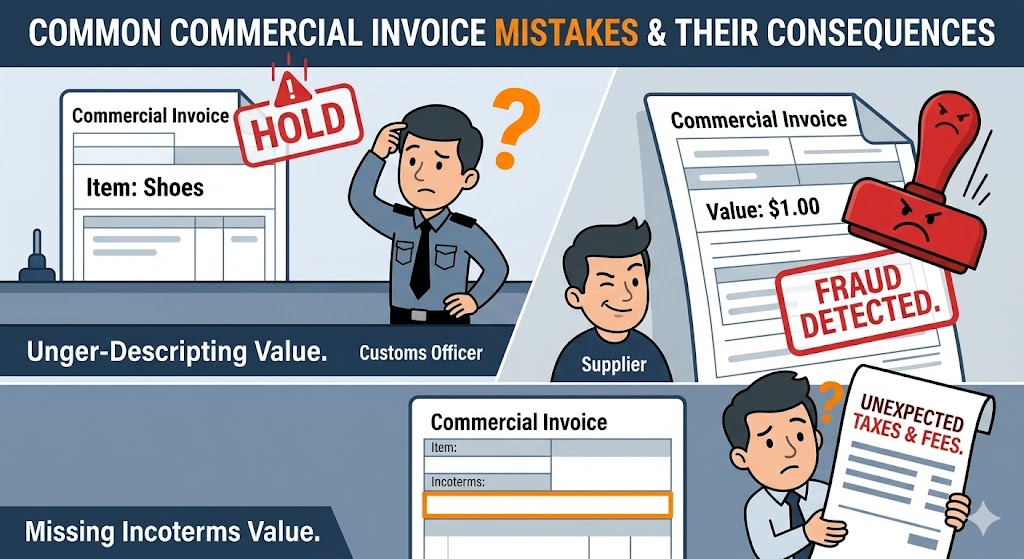
Trap 1: Vague Product Descriptions
Customs officers are not experts in your specific industry. If your commercial invoice lists a product as “Machine Part #8843,” the customs officer has no idea what that is. Is it made of steel? Plastic? The Fix: Your invoice must read in plain English. For example: “Steel ball bearing for automotive engine.” CBP and CBSA require descriptions that allow a layman to understand what the item is, what it is made of, and what it is used for.
Trap 2: Under-declaring Value (The Free Sample Myth)
Overseas suppliers will often offer to declare a lower value to help you “save on import taxes,” or list items as “Free Samples – Value $1.” The Fix: Never do this. This is customs fraud. Both the US and Canada require the exact transaction value. If it is a true free sample, customs still requires the “Fair Market Value” of the item to be listed. Under-declaring value can lead to severe fines, cargo seizure, and the loss of your customs bond privileges.
Trap 3: Ignoring Incoterms (Terms of Sale)
Customs calculates import duty vs tariff vs tax based on the value of the goods at specific points in the journey. In the US, CBP generally assesses duties on the FOB value (the value excluding international ocean freight). If your invoice says “CIF $10,000” but doesn’t break down how much is freight and insurance, CBP might charge you tax on the entire $10,000.
Special Considerations: USMCA (CUSMA) and Free Trade
A commercial invoice alone does not automatically grant free-trade preference. For USMCA/CUSMA claims, the importer must have the required certification data, which may be placed on the invoice or in a separate certification document. If this specific legal certification language is missing from your documentation, customs will charge you standard duty rates, even if the goods were made entirely in North America.
Frequently Asked Questions (FAQ)
Can customs reject a shipment because of invoice mistakes?
Yes. If the invoice is incomplete, inconsistent, or unclear, customs may delay release, request corrections, or re-evaluate the declared value and classification.
Can the supplier’s HS code be used directly?
Not always. Suppliers may use an export-side code that does not fully match the 10-digit U.S. or Canadian import classification, so importers should have the broker verify the final code to ensure an accurate landed cost calculation.
Does the commercial invoice have to be in English?
Yes. Both CBP and CBSA require the commercial invoice to be translated into English (or French, for Canada). If your supplier sends an invoice entirely in Chinese or Spanish, your broker will have to translate it, delaying clearance.
What if the supplier made a mistake on the commercial invoice, and the goods have already cleared customs?
If you discover that your supplier over-declared or under-declared the value after the goods have entered the US or Canada, you must file a correction. In the US, this is called a Post Summary Correction (PSC). It is a legal obligation to correct the record and pay any missing duties.
Final Thoughts: The Commercial Invoice Is a Compliance Document First
For importers in the United States and Canada, the commercial invoice is not just paperwork for payment. It is one of the core documents customs uses to evaluate value, origin, classification, and duties. A weak invoice slows the shipment down. A strong invoice keeps the shipment moving.
If you want one rule to remember, treat the commercial invoice as a customs document before you treat it as an accounting document. Review it before the goods leave the factory, not after the cargo reaches the border.