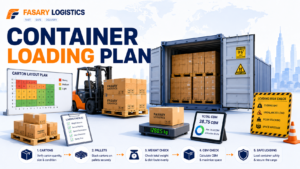
When using FCL sea freight, choosing the wrong container size can lead to wasted space, split shipments, loading delays, and extra destination charges. The theoretical capacity of a 20GP, 40GP, or 40HQ container is always higher than the practical loading volume you can safely use.
For most commercial shipments, importers should expect to lose around 10% to 15% of total container space because of pallets, carton shape, loading clearance, cargo securing, and warehouse handling limits.
Quick Answer: 20GP, 40GP, and 40HQ Container Dimensions and CBM
| Container Type | Internal Dimensions (L x W x H) | Theoretical Volume | Practical Loading CBM | Main Watchout |
|---|---|---|---|---|
| 20GP | 5.90m x 2.34m x 2.35m | About 33 CBM | 28–29 CBM | Heavy cargo may reach weight limits before filling the space |
| 40GP | 12.03m x 2.34m x 2.35m | About 67 CBM | 56–58 CBM | Similar payload limit to 20GP, but much larger volume |
| 40HQ | 12.03m x 2.34m x 2.69m | About 76 CBM | 65–68 CBM | Better for bulky cargo, but height and delivery access must be checked |
The most important point is this: do not plan your shipment based only on theoretical CBM. A container may mathematically hold 33 CBM, 67 CBM, or 76 CBM, but your actual loading plan must account for cargo shape, packaging, pallets, weight limits, and loading safety.
Not Sure Which Container Fits?
Send us your packing list, carton sizes, pallet details, gross weight, total CBM, and delivery address. We’ll help you check whether a 20GP, 40GP, or 40HQ is more practical for your shipment.
*Fast response. No obligation.
Theoretical CBM vs Practical Loading CBM
Theoretical CBM is the empty internal volume of the container. It is calculated from the internal length, width, and height.
Practical loading CBM is the volume you can realistically load after considering real cargo conditions.
For example, a 20GP container has a theoretical capacity of about 33 CBM. But in real freight forwarding, importers usually plan around 28–29 CBM for standard cartons or palletized cargo. If you calculate based on the full 33 CBM, some cargo may not fit, and the shipment may need to be split.
If you are still calculating your shipment volume, use a CBM calculator before booking. It helps you estimate total carton volume, but the final container choice should still be checked against actual packaging and loading method.
| Container Type | Theoretical CBM | Safer Practical Planning Range |
|---|---|---|
| 20GP | About 33 CBM | 28–29 CBM |
| 40GP | About 67 CBM | 56–58 CBM |
| 40HQ | About 76 CBM | 65–68 CBM |
Why You Lose 10% to 15% of Container Space
Losing space inside a container is normal. It does not always mean the factory loaded poorly. In most shipments, some space is lost because cargo is not shaped like perfect building blocks.
Common reasons include:
| Reason | How It Affects Loading |
|---|---|
| Pallets | Pallets do not always match container width perfectly, leaving side gaps |
| Carton shape | Bulging, soft, or irregular cartons reduce stacking efficiency |
| Loading clearance | Workers need space to load, stack, and close the container doors safely |
| Dunnage and lashing | Airbags, straps, wood bracing, or other securing materials take space |
| Cargo protection | Fragile goods may need stronger cartons, corner protection, or wooden crates |
| Weight distribution | Heavy cargo cannot always be stacked to the full container height |
This is why two shipments with the same total CBM may require different containers. A shipment of strong square cartons can load more efficiently than furniture, loose parts, lamps, mattresses, or irregular machinery.
20GP Container: Best for Dense and Heavy Cargo
A 20GP container is often used for heavy products that reach weight limits before using the full container volume.
Typical cargo includes:
- Ceramic tiles
- Stone products
- Metal parts
- Machinery
- Hardware
- Canned goods
- Dense industrial products
Although a 20GP only provides around 28–29 CBM of practical loading space, it can often handle heavy cargo better than a larger container from a cost-efficiency perspective. If your cargo is already near the road weight limit at 20–25 CBM, booking a 40GP may not provide much benefit.
For importers comparing cost options, our guide to 20ft container shipping cost from China to USA explains the main pricing factors for 20-foot FCL shipments.
When a 20GP Makes Sense
| Cargo Situation | Why 20GP May Work |
|---|---|
| Cargo is heavy and dense | You may reach weight limits before filling a larger container |
| Total volume is below 28 CBM | A 20GP may be enough if the packaging is regular |
| Delivery site has limited space | A shorter container may be easier to handle |
| You want one clean FCL shipment | Avoids mixing your cargo with other LCL shipments |
40GP Container: Standard Option for General Cargo
A 40GP container offers roughly double the length of a 20GP, but not double the legal payload. This is important: 40GP is mainly a volume upgrade, not a weight upgrade.
A 40GP is often suitable for:
- General consumer goods
- Carton-packed products
- Medium-density cargo
- Non-bulky retail goods
- Mixed commercial shipments
In practical loading, a 40GP usually fits around 56–58 CBM depending on cargo shape and packaging.
If your cargo is too large for a 20GP but does not need extra height, a 40GP can be a reasonable choice. For cost planning, see our guide to 40ft container shipping cost from China to USA.
When a 40GP Makes Sense
| Cargo Situation | Why 40GP May Work |
|---|---|
| Cargo volume is around 40–58 CBM | A 20GP is too small, but 40HQ may not be necessary |
| Cargo height is not a problem | Standard container height is enough |
| Cargo is not extremely light or bulky | You do not need the extra high-cube space |
| You want to avoid LCL overflow | One FCL container may be cleaner than splitting cargo |
40HQ Container: Best for Bulky Cargo
A 40HQ container has the same length and width as a 40GP, but it has extra internal height. This makes it useful for bulky products that take up space before reaching the weight limit.
Typical 40HQ cargo includes:
- Furniture
- Mattresses
- Apparel
- Light household goods
- Large plastic products
- E-commerce inventory
- Foam, cushions, and soft goods
A 40HQ usually provides around 65–68 CBM of practical loading volume, compared with around 56–58 CBM for a 40GP. For bulky cargo, this extra space can make a big difference.
For example, when shipping furniture from China to USA, the cargo may be light but physically large. Sofas, chairs, tables, bed frames, and cabinets often use volume quickly, so 40HQ is frequently more practical than 40GP.
When a 40HQ Makes Sense
| Cargo Situation | Why 40HQ May Work |
|---|---|
| Cargo is bulky but not too heavy | Extra height gives more usable loading space |
| Products are large or irregular | More vertical space improves loading flexibility |
| Cartons are tall | High cube height helps avoid wasted top space |
| Cargo volume is above 58 CBM | 40GP may be too tight |
How to Choose Between 20GP, 40GP, and 40HQ
Choosing the right container is not only about total CBM. You also need to consider cargo density, carton size, pallet use, factory loading method, delivery access, and whether the cargo can be stacked safely.
| Choose This Container | Best For | Practical Planning Logic |
|---|---|---|
| 20GP | Heavy and dense cargo | Use when weight is the main limit, not volume |
| 40GP | General cargo | Use when cargo needs more length and volume but not extra height |
| 40HQ | Bulky and light cargo | Use when volume is the main limit and extra height is useful |
For FCL container planning, especially when arranging sea shipping from China to USA, always confirm both CBM and gross weight before booking.
A shipment may look suitable for 40HQ by volume but may still face weight restrictions. Another shipment may look suitable for 20GP by volume but become difficult to load because the cartons are oversized or cannot be stacked.
Real-World Loading Example
Suppose an importer originally books a 20GP because the supplier estimates the cargo at 32 CBM.
On paper, a 20GP has about 33 CBM of theoretical space. But after final packing, the cartons are larger than expected, and the factory adds protective wooden crating. The real loading volume becomes 42 CBM.
At this point, a 20GP is no longer realistic. The importer has several options:
| Option | Result |
|---|---|
| Force the 20GP plan | Some cargo may be left behind |
| Ship overflow by LCL | Extra handling, destination charges, and split delivery |
| Upgrade to 40GP | More space and one clean FCL shipment |
| Upgrade to 40HQ | Better if cargo is bulky or tall |
In this situation, upgrading to 40GP or 40HQ may be more practical than forcing a 20GP plan. Even if some space is unused, it may help avoid split shipment handling, extra destination charges, and delivery coordination problems.
Practical Container Loading Checklist
Before confirming the booking, check these details with your supplier or forwarder:
- Total carton quantity
- Carton dimensions
- Gross weight and net weight
- Whether the cargo is palletized
- Pallet size and pallet height
- Whether cartons can be stacked
- Whether cargo is fragile or irregular
- Whether wooden crates or protective packaging are added
- Whether the final delivery location can receive a 40GP or 40HQ
- Whether the cargo may exceed road weight limits
The goal is not to fill every centimeter. The goal is to choose a container that can be loaded safely, moved legally, and delivered without unnecessary split shipments or last-minute changes.
Need a Loading Plan Review?
Send us your packing list, carton dimensions, pallet details, gross weight, product type, and destination. We’ll help you review the practical loading volume before you book.
*Fast response. No obligation.
FAQ
What is the difference between theoretical CBM and practical loading CBM?
Theoretical CBM is the mathematical internal volume of an empty container. Practical loading CBM is the volume you can realistically load after considering pallets, carton shape, loading clearance, cargo securing, and safe stacking.
How many CBM can a 20GP container actually load?
A 20GP has about 33 CBM of theoretical space, but practical loading is usually around 28–29 CBM for standard commercial cargo.
How many CBM can a 40GP container actually load?
A 40GP has about 67 CBM of theoretical space, but practical loading is usually around 56–58 CBM, depending on cargo type and loading method.
How many CBM can a 40HQ container actually load?
A 40HQ has about 76 CBM of theoretical space, but practical loading is usually around 65–68 CBM. It is commonly used for bulky and light cargo.
Is 40HQ always better than 40GP?
Not always. A 40HQ gives more vertical space, but it is most useful when cargo is bulky or tall. If your cargo is heavy, dense, or already limited by weight, the extra height may not help.
When should I choose a 20GP instead of a 40GP?
Choose a 20GP when the cargo is dense and heavy, such as tiles, stone, metal products, machinery, or hardware. In these cases, weight limits may be reached before the container is full.
Can I load a container to its full theoretical CBM?
Usually no. Loading to full theoretical CBM is not practical because cargo needs clearance, stacking space, securing materials, and safe loading conditions.
What information should I send to check the right container size?
Send the packing list, carton quantity, carton dimensions, gross weight, net weight, pallet details if any, product type, and whether the cargo can be stacked.
Need Help Choosing Your Container Size or Checking Your Loading Plan?
A spreadsheet CBM calculation is useful, but it does not always match real loading conditions at the factory. Carton shape, pallets, crating, cargo weight, and stacking limits can all change the final container decision.
If you are unsure whether your cargo requires a 20GP, 40GP, or 40HQ, send us your packing list, cargo dimensions, and total weight. Fasary Logistics can help you review the practical loading volume and choose a container size that fits your shipment plan.