A sea waybill is a non-negotiable ocean freight transport document that allows cargo release to the named consignee without presenting or surrendering original paper Bills of Lading at destination.
A sea waybill is not customs clearance. It does not replace freight payment, destination charges, customs release, or final delivery planning. It only simplifies commercial document release when original paper control is not needed. For broader B/L types and document flow, see Bill of Lading in ocean shipping. This article focuses only on sea waybill release.
Quick Answer: What Is a Sea Waybill?
| Question | Short answer | Why it matters |
|---|---|---|
| What is a sea waybill? | A non-negotiable ocean freight document used as a receipt and contract of carriage. | It can simplify cargo release to the named consignee. |
| Is a sea waybill negotiable? | No. | It cannot normally be endorsed or transferred like a negotiable original B/L. |
| Does sea waybill require original B/L surrender? | No. | No original paper B/L is printed or surrendered. |
| Who can receive the cargo? | Usually the named consignee. | Consignee details must be accurate before issue. |
| When is sea waybill useful? | When payment is settled and paper control is not needed. | It reduces document-handling delays. |
| Does sea waybill mean customs clearance is complete? | No. | Commercial release and customs release are separate. |
Sea waybill release is simple only when consignee details, payment, destination charges, and customs status are also clear.
Need to Check a Sea Waybill?
Send your sea waybill number, consignee, notify party, vessel/voyage, container number, port of discharge, and release method. We’ll help check the key release details.
*Fast response. No obligation.
Sea Waybill Template
Use the sea waybill template below when checking a draft document from your supplier, freight forwarder, or carrier.
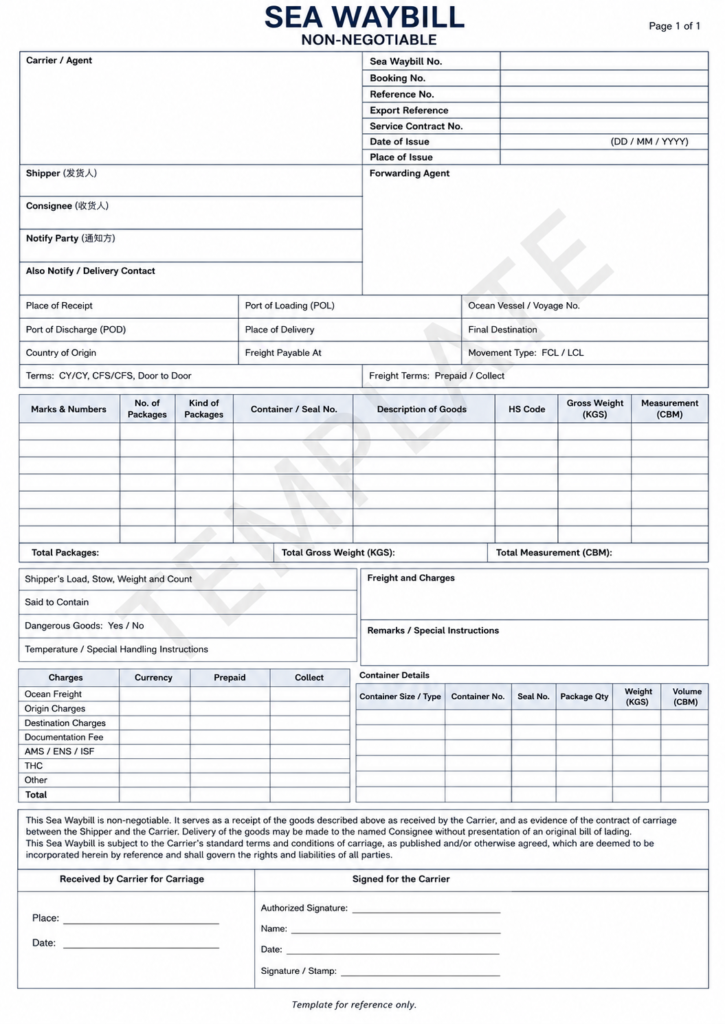
Before approving a sea waybill, check the sea waybill number, shipper, consignee, notify party, vessel/voyage, port of loading, port of discharge, container number, seal number, package count, gross weight, cargo description, freight term, destination details, and release method.
Before delivery, confirm sea waybill release, consignee details, freight payment, destination charges, and customs release.
How Sea Waybill Works Step by Step
- Cargo is handed over for ocean freight. The carrier or forwarder receives the shipment under the agreed booking.
- Carrier or forwarder issues a sea waybill. It is issued instead of a negotiable original B/L.
- No original paper B/L is printed or surrendered. Release does not depend on couriering physical originals.
- Destination carrier or forwarder confirms the named consignee and release status. The named consignee is the key release party.
- Cargo moves only after all release conditions are cleared. Commercial release, charges, customs release, and pickup readiness should be confirmed.
Sea Waybill vs Original Bill of Lading vs Telex Release
| Release method | Original paper needed? | Best for | Main risk |
|---|---|---|---|
| Sea waybill | No. | Trusted parties and prepaid goods. | Supplier has less document-based control after sailing. |
| Original Bill of Lading | Yes, usually at destination. | Letter of Credit, bank documents, or strict payment control. | Paper can be late, lost, or incorrectly endorsed. |
| Telex release | Original is surrendered at origin first. | Faster destination release after original B/L control is no longer needed. | Origin surrender or release instruction may not be confirmed. |
Sea waybill is simpler when paper control is not needed. Original B/L provides stronger document-based control. Telex release can be used when original B/L control was needed first, but destination paper presentation should be avoided after origin surrender.
When Sea Waybill Makes Sense
Sea waybill may be suitable when:
- Supplier has already been paid, so document-based payment control is no longer needed.
- Buyer and supplier have a stable relationship, and both sides trust the release process.
- Cargo is moving between related companies, such as owned factories and owned distribution centers.
- Document-based title control is not needed, and cargo should move to the named consignee directly.
When Sea Waybill May Not Be Suitable
Sea waybill may not fit when:
- Supplier still needs payment control and does not want cargo released automatically.
- Letter of Credit or bank documents require original B/L under the transaction terms.
- Buyer and supplier relationship is new, and stronger release control is preferred.
- Cargo ownership control or consignee details are not settled, especially if goods may be sold while in transit.
Common Sea Waybill Mistakes
| Mistake | Why it causes problems | Better approach |
|---|---|---|
| Using sea waybill before supplier is paid | Supplier may lose release leverage. | Confirm payment terms first. |
| Wrong consignee name | Cargo release may be delayed or blocked. | Use the exact legal company name. |
| Wrong notify party | Arrival notice may go to the wrong party. | List broker or forwarder correctly. |
| Assuming sea waybill means customs clearance | Government release is separate. | Confirm customs status separately. |
| Scheduling delivery before release confirmation | Trucking dry-run or storage risk may occur. | Wait for release confirmation. |
| Confusing sea waybill with telex release | The document workflow is different. | Confirm the release method before booking. |
Destination charges, package count, gross weight, and final document consistency should still be checked before release.
Sea Waybill and Customs Clearance
A sea waybill supports carrier or forwarder commercial cargo release. It removes the original-paper requirement, but it does not give government clearance or remove import responsibilities.
Cargo usually needs both commercial release and customs release before pickup or delivery. For China-to-USA shipments, confirm sea waybill release and customs clearance from China to USA before sending a truck. For Amazon FBA, DDP, or door-to-door shipments, the forwarder may manage release behind the scenes, but customs release and final delivery readiness still matter.
What Information Should You Send to Confirm Sea Waybill Release?
| Information needed | Example | Why it matters |
|---|---|---|
| Sea waybill number | SWB123456789 | Identifies the shipment file. |
| Consignee | Importer company name | Confirms who can receive cargo. |
| Notify party | Broker or forwarder | Supports arrival coordination. |
| Vessel / voyage | Vessel name / voyage number | Tracks arrival timing. |
| Container number | TLLU1234567 | Links release to the cargo. |
| Port of discharge | Los Angeles / New York | Confirms the destination office. |
| Release method | Sea Waybill | Confirms no original paper surrender is expected. |
| Freight payment / destination charge status | Paid / pending | Shows whether commercial release may be blocked. |
Customs release should also be confirmed before arranging final delivery. Fasary Logistics can help check sea waybill details and release readiness.
Confirm Cargo Release?
Share the sea waybill number, consignee, notify party, destination port, freight payment status, destination charge status, and customs release status before pickup.
*Fast response. No obligation.
FAQ
What does sea waybill mean in shipping?
Sea waybill means a non-negotiable ocean freight document used as a receipt and contract of carriage. It allows release to the named consignee without original paper B/L surrender, once other release conditions are satisfied.
How does a sea waybill work?
After cargo is handed over for ocean transport, the carrier or forwarder issues a sea waybill instead of a negotiable original B/L. At destination, release is processed to the named consignee after commercial and customs conditions are confirmed.
Is sea waybill the same as Bill of Lading?
No. A sea waybill is related to ocean transport documentation, but it is non-negotiable and does not require original paper surrender. Some Bills of Lading may be negotiable and used for document-based title control.
Is sea waybill the same as telex release?
No. Telex release starts with an original Bill of Lading that is surrendered at origin. A sea waybill does not involve printing or surrendering original paper B/L documents.
Does a sea waybill require original B/L surrender?
No. Because a sea waybill is non-negotiable and no original paper B/L is issued, there is no original B/L to surrender at origin or destination.
Does sea waybill mean customs clearance is complete?
No. Sea waybill release only supports commercial release from the carrier or forwarder. Customs clearance is separate, and cargo usually cannot move until both release statuses are confirmed.
Conclusion
A sea waybill is a non-negotiable ocean freight document that simplifies release because no original paper B/L needs to be surrendered. It works best when payment is settled and title control is not needed.
Importers should still confirm consignee details, release status, freight payment, destination charges, customs release, and final delivery readiness before arranging cargo pickup.