An air waybill, or AWB, is the main transport document used in air freight. It helps identify the shipment, carrier, shipper, consignee, cargo details, weight, and route.
For importers, the AWB matters because a wrong AWB number, consignee name, airport, cargo description, weight, or declared value can create tracking confusion, customs questions, cargo recovery delays, or delivery problems.
When arranging air freight or air freight from China to USA, importers should treat the AWB as a core document to check before cargo departs.
Quick Answer: What Is an Air Waybill?
| Question | Short answer | Importer note |
|---|---|---|
| What does AWB stand for? | Air Waybill | Main transport document for air cargo. |
| What is an AWB number? | A shipment identification number | Used for tracking and document reference. |
| Is AWB the same as a Bill of Lading? | No | AWB is for air freight; B/L is for ocean freight. |
| Is AWB proof of ownership? | Usually no | AWB is generally not a negotiable title document. |
| What is HAWB? | House Air Waybill | Usually issued by a forwarder. |
| What is MAWB? | Master Air Waybill | Usually issued by the airline or carrier. |
Air Waybill Template
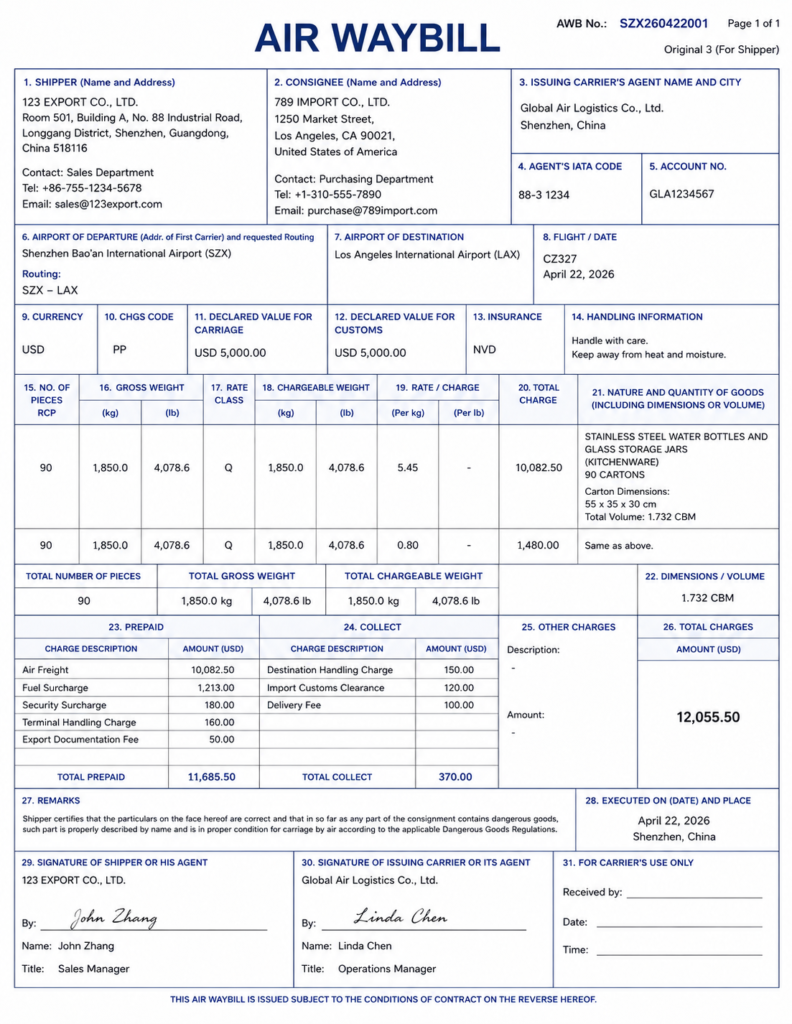
What Is an Air Waybill?
AWB stands for Air Waybill. It is a key air freight transport document that identifies the shipment, shipper, consignee, airline or carrier, route, cargo description, number of packages, weight, and handling information.
IATA describes the AWB as a critical air cargo document and a contract of carriage between the shipper and carrier in its e-AWB guidance. For importers, this means the AWB is more than a tracking number. It connects the cargo movement, document reference, and carrier handling process.
What Is an AWB Number?
An AWB number is used to identify and track an air cargo shipment. Importers may also see terms such as AWB no., AWB nr, airway bill number, or air waybill number.
The AWB number may be used for airline tracking, destination cargo recovery, arrival follow-up, document matching, and communication with the forwarder or airline. However, AWB tracking does not automatically mean customs has cleared or final delivery is ready.
HAWB vs MAWB: House Air Waybill and Master Air Waybill
| Term | Who usually issues it | What importers should know |
|---|---|---|
| HAWB / House Air Waybill | Freight forwarder | Used between forwarder and shipper/importer, often in consolidated air freight. |
| MAWB / Master Air Waybill | Airline or carrier | Used between airline and forwarder or direct shipper. |
| AWB number | Carrier or air freight document reference | Used for tracking and shipment identification. |
Importers may receive a HAWB, MAWB, or both depending on shipment arrangement. Consolidated air freight often uses both house and master numbers. Tracking may depend on which number is used and which party controls the shipment.
Air Waybill vs Bill of Lading
An air waybill is not the same as an ocean Bill of Lading. The difference matters because some ocean B/L types may relate to cargo title or release control, while an AWB is usually a non-negotiable air cargo transport document.
| Document | Used for | Key difference |
|---|---|---|
| Air Waybill | Air freight | Usually non-negotiable and used as air cargo transport document. |
| Bill of Lading | Ocean freight | May act as transport document and, in some cases, title document depending on type. |
| Commercial invoice | Customs/value document | Shows product, value, buyer/seller, and origin. |
| Packing list | Cargo detail document | Shows carton count, weight, and packing information. |
These documents should not conflict. If the AWB, invoice, and packing list show different consignee, product, package count, or weight information, the shipment may need correction.
What Information Should Importers Check on an AWB?
Before air cargo departs, importers should check:
- AWB number
- shipper name and address
- consignee name and address
- notify party if shown
- origin airport
- destination airport
- carrier or airline
- flight or routing details if available
- number of packages
- gross weight
- chargeable weight if shown
- goods description
- declared value if applicable
- special handling notes
- prepaid / collect charges if shown
These details should match the commercial invoice, packing list, air freight quote, and final delivery plan.
Need AWB Details Checked?
Send your AWB draft, invoice, packing list, cargo details, airport, consignee information, and delivery plan before the air shipment departs.
*Fast response. No obligation.
Why AWB Details Matter for Customs, Arrival, and Delivery
AWB details can affect cargo identification, airline handling, destination recovery, customs document matching, and final delivery coordination. If the consignee, cargo description, weight, or airport information is wrong, the shipment may need correction.
AWB tracking is not the same as customs release or door delivery. Importers should confirm whether the air freight quote from China is airport-to-airport, airport-to-door, or door-to-door. Airport arrival only means the cargo reached an air gateway; it does not always mean the receiver can immediately pick up the shipment.
Common AWB Mistakes Importers Should Avoid
| Mistake | Why it causes problems | Better approach |
|---|---|---|
| Only checking AWB number | Other document errors may be missed | Review consignee, airport, cargo, and weight. |
| Using vague product descriptions | Customs or airline questions may increase | Use clear product names and material. |
| Confusing HAWB and MAWB tracking | Status may differ by system | Ask which number to track. |
| Assuming AWB tracking means customs cleared | Tracking and release are different | Confirm clearance status separately. |
| Not checking airports | Cargo may route differently than expected | Verify origin and destination airport. |
| Ignoring package count or weight differences | Recovery and customs matching may be affected | Compare AWB, invoice, and packing list. |
| Assuming airport arrival means door delivery | Delivery scope may be separate | Confirm airport-to-door or door-to-door service. |
What Fasary Can Help With in Air Freight Documents
Fasary can help importers collect cargo details from suppliers, confirm cargo ready date, check carton count, dimensions, gross weight, and chargeable weight, coordinate pickup in China or Vietnam, prepare air freight quote information, and check whether AWB, invoice, and packing list details are consistent.
Fasary can also help coordinate airport-to-door or door-to-door delivery where applicable, and help importers understand AWB number, HAWB, MAWB, and document updates. Fasary’s value is connecting supplier cargo data, air freight documents, quote scope, customs-related information, and final delivery planning before cargo moves.
Planning Air Freight?
We can help organize supplier cargo data, air freight quote details, AWB-related information, customs documents, and final delivery planning.
*Fast response. No obligation.
FAQ
What is an air waybill?
An air waybill is the main transport document used for air freight. It identifies the shipment, shipper, consignee, carrier, route, cargo description, weight, and handling information. It is used for air cargo movement and document reference.
What is an AWB number?
An AWB number is the reference number used to identify and track an air cargo shipment. It may be used for airline tracking, arrival follow-up, document matching, and communication with the freight forwarder or carrier.
What is the difference between HAWB and MAWB?
HAWB means House Air Waybill and is usually issued by a freight forwarder. MAWB means Master Air Waybill and is usually issued by the airline or carrier. Consolidated air freight may involve both numbers.
Is an air waybill the same as a bill of lading?
No. An air waybill is used for air freight and is usually non-negotiable. A Bill of Lading is used for ocean freight and may have different cargo release and title functions depending on the B/L type.
Can AWB be used for customs clearance?
AWB information may support customs document matching, but it does not replace the commercial invoice, packing list, HS code, value, or other customs information. AWB tracking also does not guarantee customs release.
Conclusion
The AWB is one of the key documents in air freight. Importers should check the AWB number, shipper, consignee, airport, cargo description, package count, weight, and document consistency before and during shipment.
For air cargo from China or Vietnam to the U.S.