A packing list for shipping is far more than just a piece of paperwork your supplier attaches to the shipment. In the eyes of U.S. Customs and your freight forwarder, it is the physical blueprint of your cargo. When importers treat it as an afterthought—accepting “estimated” weights or letting carton counts drift from the commercial invoice—they trigger a cascade of expensive problems. A mismatched packing list is the #1 cause of 5H document review holds at the border, surprise LCL destination fees, and Amazon FBA receiving rejections. Below is the exact checklist to ensure your packing list matches your commercial invoice, protects your freight quote, and gets your cargo released without delays.
For importers shipping from China to the USA, the packing list helps the forwarder calculate CBM and chargeable weight, helps customs compare physical cargo details with the declared value, and helps warehouses plan receiving. A good packing list must answer one simple question: what exactly is inside the shipment, how is it packed, and how much space and weight will it take during transit?
Quick Answer: What Is a Packing List for Shipping?
| Question | Short answer | Why it matters |
|---|---|---|
| What is a packing list? | A document showing how goods are physically packed | It connects the cargo to the shipping documents |
| Who uses it? | Forwarder, customs broker, warehouse, carrier, and final receiver | Each party needs cargo data for handling or review |
| What must it include? | Carton count, quantity, dimensions, gross weight, net weight, CBM, marks, and pallet details | Missing data can delay quotes or receiving |
| Is it the same as a commercial invoice? | No | The invoice shows value; the packing list shows physical cargo details |
| Why does it matter for quotes? | It helps calculate CBM, chargeable weight, and delivery requirements | Freight quotes may change if packing data is wrong |
| When should it be final? | After goods are packed, not during production | Estimated data can cause quote and document problems |
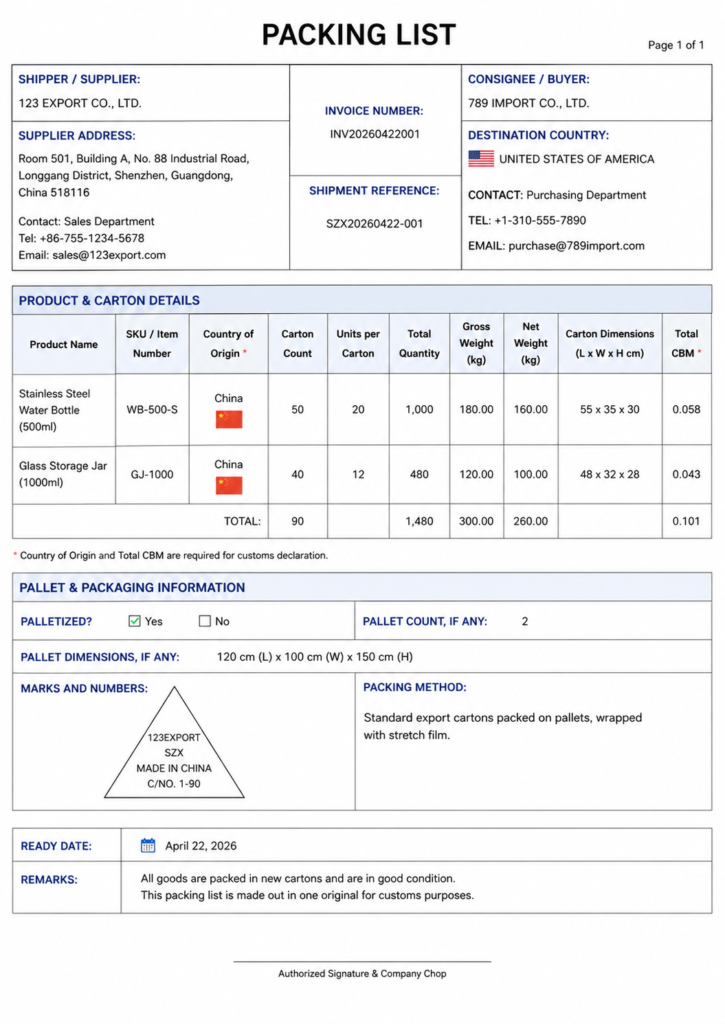
Packing List Sample Template for International Shipping
Use this sample packing list area when asking your supplier for a final packing list. The data should reflect the actual packed cargo, not estimated production data.
If the shipment contains multiple SKUs, ask the supplier to show the carton range for each SKU, such as Cartons 1–30 for SKU A and Cartons 31–60 for SKU B.
What Should a Packing List Include?
| Field | Why it matters | Common mistake |
|---|---|---|
| Shipper and consignee | Connects the cargo to the buyer, seller, and shipment | Using different company names than the invoice |
| Invoice reference | Matches the packing list with the commercial invoice | Missing or wrong invoice number |
| Product name and SKU | Shows what is inside each carton | Vague descriptions like “goods” or “accessories” |
| Carton count | Helps warehouse receiving and shortage checks | Carton count does not match actual cargo |
| Quantity per carton | Shows how many units are inside each carton | Total quantity does not match the invoice |
| Gross weight | Used for freight quotes, trucking, air limits, and handling | Confusing gross weight with net weight |
| Net weight | Shows product-only weight | Missing or mixed with gross weight |
| Carton dimensions | Used to calculate CBM and chargeable weight | Providing product size instead of packed carton size |
| Total CBM | Helps quote LCL, air, and delivery costs | CBM missing or calculated from wrong dimensions |
| Shipping marks | Helps identify cartons in warehouses or CFS | No marks or unclear carton numbering |
| Pallet details | Needed for forklift, trucking, and warehouse delivery | Not showing pallet count, size, or weight |
How Freight Forwarders Use a Packing List for Quotes
A freight forwarder uses the packing list to turn product information into shipping data. The most important fields are carton count, carton dimensions, gross weight, total CBM, pallet details, pickup location, and destination ZIP code.
For LCL sea freight, the packing list helps calculate chargeable CBM and estimate destination handling. For air freight and express, carton dimensions and gross weight help calculate chargeable weight. For door-to-door delivery, pallet details, total weight, and delivery address type help plan trucking, liftgate, appointment, and warehouse receiving.
If the packing list is incomplete, the first quote may look cheaper than the final invoice. For example, missing carton dimensions can affect CBM, and missing pallet details can affect final delivery cost.
If you are preparing a quote request, use a freight quote request template and check whether your cargo data is complete before comparing LCL shipping rates from China to USA.
Check Carton and CBM Details
Share your carton count, dimensions, gross weight, total CBM, and pallet details. We’ll help review whether the packing data is enough for quoting and delivery planning.
*Fast response. No obligation.
Packing List vs Commercial Invoice: What Is the Difference?
A common mistake importers make is sending their forwarder a commercial invoice and packing list combined into one confusing spreadsheet. These are two distinct documents with two distinct purposes.
| Document | Main Purpose | Key Information | Who Uses It |
|---|---|---|---|
| Packing list | Details the physical logistics and packaging of the cargo. | Carton count, gross weight, net weight, dimensions, CBM, marks. | Freight forwarders, warehouses, truckers, and customs broker or customs reviewer. |
| Commercial invoice | Details the financial transaction and value of the goods. | Unit price, total value, currency, terms of sale, country of origin. | Customs broker and CBP to review transaction value and entry details. |
| Proforma invoice | Acts as a preliminary quote or pre-sale agreement. | Estimated costs, expected manufacturing timelines, banking details. | The buyer and seller for initial payment arrangements and order confirmation. |
While the packing list drives the physical movement of the cargo, the commercial invoice supports duty and entry review, including details that influence your import duty from China to USA. You must always ensure you are using final documents for shipping, which means understanding the difference between a commercial invoice vs proforma invoice before giving paperwork to your logistics partner.
Need Help Checking Carton, Weight, and CBM Details?
Share your carton dimensions, gross weight, net weight, total CBM, and pallet details. We’ll help you review whether the packing data is enough for freight quoting and delivery planning.
*Fast response. No obligation.
Why Customs and Warehouses Need the Packing List
Customs brokers may compare the packing list with the commercial invoice, bill of lading, and other shipping documents. If the product quantity, carton count, gross weight, or product description does not match, the shipment may need extra document review.
Warehouses also use the packing list to check whether the right number of cartons, pallets, or SKUs arrived. This is especially important for LCL shipments, Amazon FBA, 3PL receiving, and door-to-door delivery.
For importers shipping from China, document consistency should be checked before customs clearance from China to USA begins, not after cargo is already waiting at the destination warehouse.
Common Packing List Mistakes Importers Should Avoid
A simple data entry error on a carton packing list can create quoting, receiving, or delivery problems. Review your supplier’s documents carefully to catch these common mistakes before the cargo ships.
| Mistake | Why It Causes Problems | Better Approach |
|---|---|---|
| Carton count does not match cargo | Causes discrepancies during warehouse receiving and trucking sign-offs. | Demand a final count only after all boxes are taped and staged. |
| Gross weight missing | Forwarders usually need total gross weight to prepare an accurate quote or booking. | Ensure both net and gross weights are listed in clear columns. |
| Net weight confused with gross weight | Under-reporting weight leads to airline rejections or overweight trucking fines. | Clearly label the weight that includes all packaging materials as gross weight. |
| Carton dimensions missing | Prevents the accurate calculation of total cargo volume (CBM). | Provide L x W x H for every different carton size in the shipment. |
| CBM not calculated | Forces the forwarder to calculate it manually, which can delay quotes. | Ensure the supplier provides a total CBM summary at the bottom of the list. |
| SKU breakdown missing | The destination warehouse will have to open every box to figure out what arrived. | Itemize exactly which SKUs are in which numbered cartons. |
| Pallet details missing | Truckers will not know if they need a forklift or pallet jack for delivery. | Clearly state if cargo is palletized, loose, or crated. |
| Invoice and packing list quantities do not match | Inconsistent quantities may lead to customs questions or document review. | Audit both documents side-by-side to ensure total item quantities match perfectly. |
| Vague product descriptions | Causes confusion during warehouse handling or customs review. | Use the exact plain-English product name used on the commercial invoice. |
| Using estimated data after cargo is packed | Estimated dimensions and weights may change after final packing, which can affect freight quotes. | Never accept a “proforma” packing list for actual shipping; demand actual, final packed data. |
Packing List for LCL, FCL, Air, and Express Shipments
Different shipping modes rely on different aspects of your packing list.
| Shipping Method | Packing List Detail That Matters Most | Why |
|---|---|---|
| LCL sea freight | Total CBM and carton marks | LCL pricing is heavily based on volume (CBM). Marks prevent your cartons from getting mixed up with other importers’ goods. |
| FCL sea freight | Total carton count and gross weight | Ensures the container is not overloaded past legal highway weight limits and confirms all boxes were loaded. |
| Air freight | Total gross weight and carton dimensions | Air freight quoting depends on gross weight and carton dimensions because these affect chargeable weight. |
| Express courier | Carton dimensions and actual weight | Couriers use automated scanners; incorrect dimensions will result in immediate billing adjustments. |
| Amazon FBA | SKU breakdown and carton count | FBA shipments need accurate carton and SKU details for delivery planning and receiving. |
| Door-to-door delivery | Pallet information and total weight | Truckers need this to know if a liftgate or pallet jack is required for door to door shipping from China to USA. |
How Fasary Logistics Helps Review Packing List Details
Fasary Logistics can help importers review packing list details before shipping, including carton count, carton dimensions, gross weight, net weight, total CBM, pallet information, and delivery requirements.
We can also compare the packing list with the commercial invoice to check whether product descriptions, quantities, and shipment details are consistent. If key cargo data is missing, Fasary can help communicate with the supplier before pickup so the freight quote, warehouse receiving, and final delivery plan are based on clearer information.
This does not replace the supplier’s responsibility to provide accurate packing data, but it helps reduce avoidable quote changes, receiving issues, and delivery planning problems before cargo leaves China.
Need a Final Check Before Shipping from China?
Fasary Logistics can help review your packing list, invoice consistency, carton details, CBM, pallet information, and delivery requirements before your cargo leaves China.
*Fast response. No obligation.
FAQ
What is a packing list for shipping from China to USA?
A packing list is a commonly required freight document that details exactly how an export shipment is physically packed. It includes critical logistics data such as carton count, dimensions, gross weight, net weight, and total cubic meters (CBM).
Is a packing list the same as a commercial invoice?
No. A commercial invoice details the financial transaction, unit price, and value of the goods for customs purposes. A packing list details the physical footprint, weight, and packaging of the goods for logistics and handling purposes.
What information should be on a packing list?
A complete packing list should include the shipper and consignee details, product names, carton count, units per carton, total quantity, gross and net weights, carton dimensions, total CBM, marks and numbers, and pallet information if applicable.
Does a packing list need carton dimensions?
Yes. Carton dimensions (length, width, and height) are essential. Freight forwarders use these dimensions because it helps calculate CBM for LCL and chargeable weight for air or express shipments.
Does a packing list need gross weight and net weight?
Yes. Gross weight includes the product plus all packaging materials and is required for freight and trucking limits. Net weight is the weight of the product alone and is often needed for specific customs declarations.
Why does CBM matter on a packing list?
CBM matters because it shows the total cargo volume. It is especially important for LCL sea freight. For air freight and express shipments, carton dimensions help calculate volumetric or chargeable weight.
Can a packing list mistake delay shipping?
Yes. If the packing list shows a different carton count or quantity than the commercial invoice, it may lead to customs questions, document review, quote changes, receiving issues, or delivery delays. Incorrect weights or dimensions can also cause airline rejections or trucking delays.
Do Amazon FBA shipments need a packing list?
Yes. A clear packing list helps your freight forwarder and destination warehouse verify the cargo, sort the SKUs, and plan the final delivery appointment accurately with the Amazon fulfillment center.
Should my supplier provide the packing list?
Yes. The factory or trading company packing the goods in China is responsible for creating the packing list. However, the U.S. buyer should still review the document carefully before shipping.
Can Fasary Logistics help review a packing list?
Yes. Fasary Logistics helps importers by reviewing supplier packing lists, checking weights and dimensions for quote accuracy, verifying consistency with commercial invoices, and planning final delivery logistics based on the cargo details.
Conclusion
A packing list for shipping from China to USA is a practical freight document that explains exactly how your goods are physically packed. It must clearly show the carton count, gross weight, net weight, carton dimensions, total CBM, item details, pallet information, and shipping marks. A clear packing list helps with freight quoting, warehouse receiving, document review, and final delivery planning.
If you are not sure whether your supplier’s packing list is complete, send your carton count, dimensions, weight, CBM, invoice, and destination details to Fasary Logistics. We can help review the information before shipping.