Sea freight transit time from China to USA is rarely just the 14–22 days the vessel spends on the water. A 15-day port-to-port sailing to Los Angeles easily becomes a 25–30 day door-to-door delivery once you add factory pickup, terminal discharge, customs release, and the infamous LA/LB chassis shortage. In our experience, the biggest stockout killer isn’t a delayed ship—it’s importers planning inventory based on the vessel ETA instead of the warehouse delivery date. Below is the real door-to-door timeline for West Coast, Midwest, and East Coast routing, plus the terminal dwell and CFS delays you must buffer for.
For a complete shipping method overview, see our main shipping from China to USA guide. For route planning, see our shipping routes from China to USA map.
Quick Answer: How Long Does Sea Freight from China to USA Take?
| Origin Port (China) | Destination City (USA) | Port-to-Port (Ocean Time) | Door-to-Door (Total Time) |
|---|---|---|---|
| Shenzhen | Los Angeles | 13 – 15 Days | 22 – 26 Days |
| Shenzhen | Chicago | 22 – 26 Days | 32 – 38 Days |
| Shenzhen | Houston | 25 – 28 Days | 35 – 40 Days |
| Shenzhen | New York | 28 – 32 Days | 38 – 42 Days |
| Ningbo | Los Angeles | 13 – 15 Days | 22 – 26 Days |
| Ningbo | Chicago | 22 – 26 Days | 32 – 38 Days |
| Ningbo | Houston | 25 – 28 Days | 35 – 40 Days |
| Ningbo | New York | 28 – 32 Days | 38 – 42 Days |
Not Sure How Long Your China to USA Sea Shipment Will Take?
Send us your origin city, destination ZIP code, cargo volume, and target delivery date. We’ll help you estimate a realistic port-to-door or door-to-door sea freight timeline.
*Response within 2 hours. No obligation.
Why West Coast Sea Freight Is Usually Faster
The US West Coast is usually the fastest destination for sea freight from China to the USA because vessels can move directly across the Pacific.
Common West Coast ports include:
- Los Angeles
- Long Beach
- Oakland
- Seattle
- Tacoma
This route is common for shipments from major China ports such as Shenzhen, Yantian, Guangzhou, Ningbo, Shanghai, Qingdao, and Xiamen. A shipment to Southern California may have a relatively short ocean transit and a short final truck delivery if the warehouse is near the port. This is why West Coast delivery is often the fastest sea freight option for importers with warehouses in California, Nevada, Arizona, or nearby states. For routing comparison, see our shipping routes from China to USA map.
Why Midwest Delivery Takes Longer
For Midwest destinations such as Chicago, Columbus, Indianapolis, Kansas City, St. Louis, or nearby inland markets, cargo often moves by ocean to the West Coast first, then continues inland by rail. This is called inland rail or intermodal routing.
The shipment may follow this pattern:
- Vessel arrives at Los Angeles / Long Beach / Seattle / Tacoma.
- Container is discharged at the terminal.
- Container waits for rail loading.
- Rail moves the container inland.
- Container arrives at inland rail terminal.
- Trucking company picks up the container.
- Final delivery is arranged to the warehouse.
Each handoff adds time. Even if the ocean leg is fast, the inland rail portion can extend the total door-to-door timeline. For importers shipping to Chicago or other inland hubs, always plan based on door-to-door time, not only vessel arrival date.
Why East Coast Delivery Takes Longer
Sea freight from China to the US East Coast usually takes longer because the vessel route is much longer than a direct West Coast crossing. Common East Coast ports include New York / New Jersey, Savannah, Norfolk, Charleston, and Miami. Cargo may move by all-water service through canal routing or other longer ocean paths. This increases the ocean transit time compared with West Coast routing.
East Coast routing may still be the right choice if your final destination is in New York, New Jersey, Pennsylvania, Georgia, Florida, or other Eastern states. Even though the ocean journey is longer, the final inland delivery may be shorter and more direct. The key point is: West Coast is usually faster for the ocean leg. East Coast may be better for final delivery if your warehouse is in the East.
FCL vs LCL: Which Is Faster?
FCL is usually faster and more predictable than LCL. FCL means Full Container Load. Your goods move in a dedicated container. LCL means Less than Container Load. Your goods share container space with cargo from other importers.
| Shipping Type | Time Impact | Why |
|---|---|---|
| FCL | Usually faster | Fewer warehouse handling steps and no deconsolidation with other cargo |
| LCL | Usually slower | Requires origin consolidation and destination CFS sorting |
| FCL to warehouse | More direct | Container can move after customs and terminal release |
| LCL to warehouse | More handoffs | Cargo must be unpacked, sorted, and released from CFS |
LCL shipments often add extra time because they need delivery to a consolidation warehouse in China, cargo matching, container loading at CFS, destination CFS unloading, sorting, and final delivery after deconsolidation. This can add several days or more compared with FCL, especially during busy periods. If your shipment volume is high enough for a full container, FCL may give better timeline control. For small cargo planning, see LCL shipping rates from China to USA. For container planning, see 20GP, 40GP, and 40HQ container sizes.
What Affects Sea Freight Transit Time from China to USA?
Sea freight delays can happen before departure, during the ocean leg, after port arrival, or during final delivery.
| Factor | Where It Happens | How It Affects Time |
|---|---|---|
| Supplier loading delay | China origin | Cargo misses the planned cutoff |
| Export warehouse delay | China origin | LCL cargo waits for consolidation |
| Vessel rollover | China origin port | Cargo moves to a later sailing |
| Transshipment | During routing | Adds extra handoff and waiting time |
| Port congestion | US destination port | Container waits longer after arrival |
| Customs hold | US import clearance | Cargo cannot be released on time |
| Rail delay | Inland routing | Midwest delivery takes longer |
| Chassis shortage | US destination | Container cannot be moved quickly |
| Truck appointment issue | Final delivery | Delivery is delayed by scheduling |
The safest planning method is to add buffer time instead of relying on the fastest possible published schedule.
Understanding Terminal Dwell Time
Terminal dwell time means the time a container stays at the port or terminal after vessel arrival before it is picked up or moved onward. A container may dwell at the terminal because of customs release delay, terminal congestion, rail loading delay, chassis shortage, truck appointment shortage, or warehouse appointment not ready. Even if the ship arrives on time, terminal dwell can delay final delivery.
In our experience routing China-to-USA ocean freight, the single most expensive planning mistake is treating the vessel ETA as the delivery date. We regularly see importers book a 14-day sailing to LA/LB, only to have the container sit at the terminal for 5–7 days due to a chassis shortage or a missed truck appointment, turning a “fast” West Coast route into a 28-day ordeal. For LCL shipments, the destination CFS deconsolidation alone can add 3–5 days of waiting before the cargo is even available for pickup. We always build a 7-day terminal dwell buffer into West Coast door-to-door estimates and a 10-day buffer for inland rail. For destination delivery planning, see customs hold from China to USA and U.S. customs exam.
Customs Holds and Documentation Delays
Customs delays are one of the most common reasons sea freight takes longer than expected. A shipment may be held for document review, X-ray inspection, or a more detailed customs exam.
| Customs Delay Reason | What It Means | How to Reduce Risk |
|---|---|---|
| Incomplete commercial invoice | Key shipment or transaction details are missing. | Prepare a complete invoice before vessel arrival. |
| Vague product description | Descriptions like “goods” or “parts” may not be clear enough. | Use specific product names, material, and usage. |
| Incorrect HS code | Product classification may not match the cargo. | Confirm HS code logic with the broker or customs professional. |
| Missing importer information | Importer name, EIN, bond, or broker setup may be incomplete. | Confirm importer information before shipment departure. |
| Wood packaging issue | Wooden pallets or crates may need proper treatment or markings. | Confirm ISPM 15 compliance when wood packaging is used. |
For document preparation, review what is a commercial invoice. If the shipment is entering the United States, our customs clearance from China to USA guide explains the documents, broker workflow, and common release problems in more detail.
How DDP Changes the Timing Picture
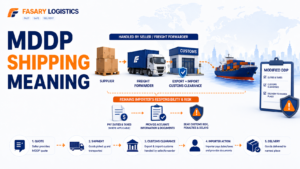
DDP does not make the vessel sail faster. A DDP service can only affect the timeline through coordination. In a well-managed DDP workflow, one logistics provider may coordinate customs handling, destination delivery, and final-mile scheduling together. This can reduce handoff confusion compared with a shipment where multiple parties are not aligned. However, DDP still depends on the same real-world factors: vessel schedule, port discharge, customs release, truck availability, and warehouse appointment. For this reason, do not assume DDP automatically means faster sea freight. For the meaning of DDP, see DDP shipping from China to USA.
Common Mistakes When Planning Sea Freight Transit Time
| Mistake | What Goes Wrong | Better Approach |
|---|---|---|
| Using port-to-port time as delivery time | Warehouse delivery is later than expected | Plan by door-to-door timeline |
| Ignoring LCL warehouse handling | LCL cargo takes longer than expected | Add CFS handling buffer |
| Choosing West Coast without checking final destination | Inland delivery adds extra time | Route based on final warehouse location |
| Preparing customs documents late | Shipment gets held after arrival | Prepare invoice, packing list, and HS code early |
| Ignoring rail and chassis delays | Inland delivery is pushed back | Confirm inland movement plan |
| Assuming DDP makes the ocean faster | Vessel time does not change | Use DDP for coordination, not faster sailing |
FAQ
How long does sea freight from China to USA take?
Sea freight from China to the USA can take around 15–30 days for many West Coast door-to-door shipments, 25–40+ days for Midwest deliveries, and 35–50+ days for East Coast or more complex routes. The exact time depends on origin port, destination, FCL or LCL, customs release, rail, trucking, and final delivery.
What is the difference between port-to-port and door-to-door transit time?
Port-to-port transit time only measures the ocean journey between ports. Door-to-door transit time includes supplier pickup, export handling, vessel departure, port discharge, customs clearance, rail or truck movement, and final warehouse delivery.
Is FCL faster than LCL?
Usually yes. FCL is usually faster because the container does not need to be consolidated and deconsolidated with other importers’ cargo. LCL often requires extra warehouse handling at both origin and destination.
Why does my shipment take longer after the vessel arrives?
After vessel arrival, the container still needs terminal discharge, customs release, truck or rail movement, appointment scheduling, and final delivery. Port arrival does not mean the cargo is ready at your warehouse.
Does DDP make sea freight faster?
Not necessarily. DDP can help coordinate customs and delivery under one workflow, but it does not change the vessel sailing time. The final timeline still depends on port, customs, rail, truck, and warehouse conditions.
Conclusion: Sea Freight Transit Time Is Built by the Whole Chain
Sea freight transit time from China to the USA is not only the number of days the vessel spends on the water. The full timeline includes origin pickup, export handling, vessel departure, port arrival, terminal discharge, customs clearance, rail transfer, truck delivery, and warehouse receiving.
If you want one rule to remember, use this: Do not judge sea freight by port-to-port sailing time alone. Judge it by the full door-to-door chain.
West Coast delivery is usually the fastest sea freight option. Midwest delivery needs extra rail and final trucking time. East Coast delivery usually has a longer ocean timeline. LCL usually takes longer than FCL because of CFS handling. Customs or terminal delays can change any timeline. The safest way to plan is to confirm the route, service type, customs documents, final destination, and warehouse receiving schedule before the shipment leaves China. For broader ocean service context, see sea shipping from China to USA.