A Certificate of Origin, or COO, is a trade document that states the country where goods were produced, manufactured, or processed. Importers may need it for customs, buyer requests, letters of credit, bank documents, or country-of-origin documentation.
Before shipping, the COO country, invoice details, packing list, product description, and origin claim should match. If they do not, importers may face document questions, duty/tariff review problems, or clearance delays.
For shipments from China or Vietnam, check origin documents early when preparing customs clearance from China to USA or customs clearance from China to Canada. The COO should be prepared before cargo departs if the importer, broker, buyer, bank, or destination process requires it.
Quick Answer: What Is a Certificate of Origin?
| Question | Short answer | Importer note |
|---|---|---|
| What does COO stand for? | Certificate of Origin | A document showing the origin country of goods. |
| Is a COO always required? | Not always | It depends on country, product, buyer, bank, or customs request. |
| Who provides the COO? | Usually exporter, manufacturer, supplier, or chamber of commerce | Confirm before shipment. |
| Is a COO the same as invoice? | No | Invoice shows transaction value; COO supports origin information. |
| Does COO reduce duty automatically? | No | Preferential duty needs specific rules and certification. |
| What should importers check? | Origin, exporter, goods description, invoice reference, shipment details, signature/stamp if required | Details should match other documents. |
Certificate of Origin Template:
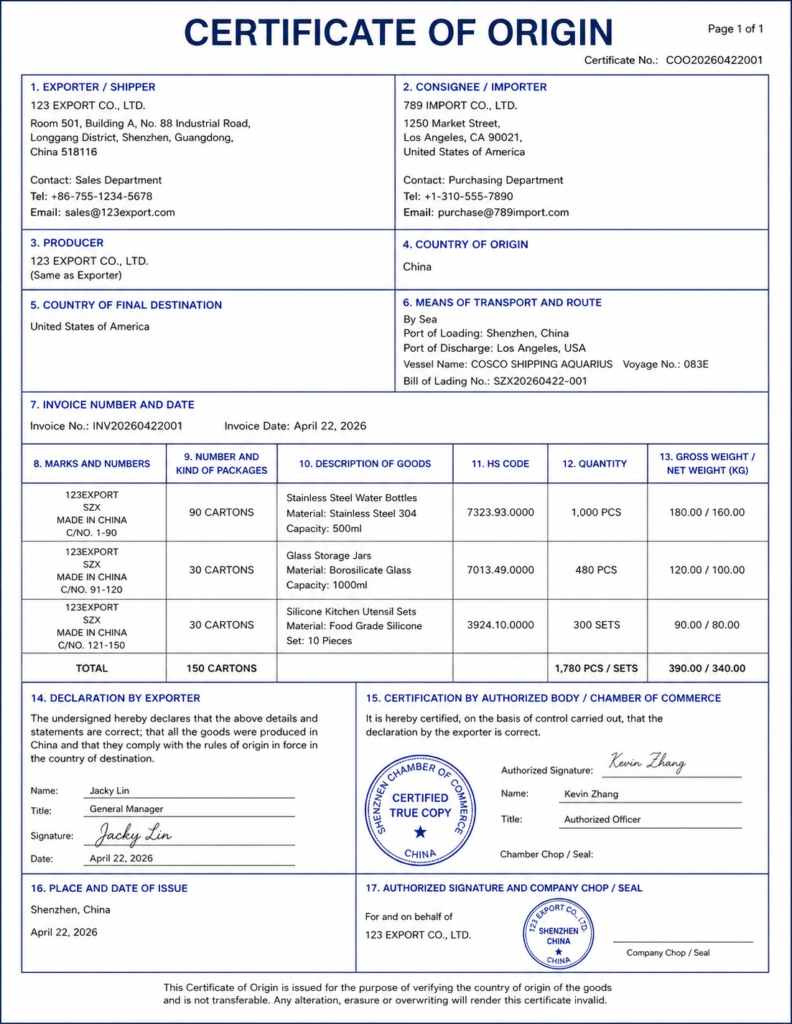
This is a general sample format only. If customs, a chamber of commerce, a bank, buyer, or trade agreement requires a specific official form or certification wording, use the required format instead of a generic template.
Need COO Details Checked?
Send your supplier details, invoice, packing list, product description, origin country, HS code if available, and destination before shipping.
*Fast response. No obligation.
What Is a Certificate of Origin?
COO stands for Certificate of Origin. It identifies the country of origin of goods and may be requested for customs, buyer requirements, letters of credit, bank documents, or shipment documentation.
Trade.gov explains that Certificates of Origin may be required by foreign customs, letters of credit, or buyers, and also distinguishes generic/non-preferential COOs from certificates used for FTA preferential tariff treatment through its Special Documents guidance.
A COO is different from a commercial invoice and packing list. It also does not automatically prove preferential tariff eligibility unless it meets the specific trade agreement requirements.
Certificate of Origin Sample Fields Explained
| Field | What it means | What importers should check |
|---|---|---|
| Exporter / seller | Company selling or exporting goods | Should match supplier or transaction documents. |
| Manufacturer | Actual producer if different | Important when seller and factory differ. |
| Consignee / buyer | Receiver or buyer | Should match import or delivery documents. |
| Country of origin | Where goods were made or processed | Must be accurate and consistent. |
| Invoice number | Related sales invoice | Should match the commercial invoice. |
| Goods description | Product name and details | Avoid vague descriptions. |
| HS code if available | Product classification reference | Should be reviewed separately. |
| Quantity / weight | Shipment quantity and weight | Should match packing list. |
| Signature / stamp | Authorization if required | Check if official certification is needed. |
| Issue date | Date of declaration or certification | Should be reasonable for shipment timing. |
Who Provides the Certificate of Origin?
A Certificate of Origin may be prepared by the exporter, manufacturer, supplier, or seller depending on the requirement. Some certificates may need chamber of commerce certification or another official process.
A manufacturer certificate of origin template may be useful for internal document checks, but it may not replace an official or chamber-certified COO when one is required. For goods sourced from China, importers should confirm whether the Chinese supplier can provide a COO, whether it needs a stamp or certification, and whether the origin matches the invoice, product label, and customs documents.
Ask early. If the buyer, customs broker, bank, or destination authority requests a specific COO format, do not rely only on a generic blank certificate of origin template.
When Do Importers Need a Certificate of Origin?
Not every shipment needs a COO. Importers may need one when a customs broker requests origin proof, a buyer or bank requests it, a letter of credit requires it, destination customs or product category requires it, or the importer needs country-of-origin documentation for duty/tariff review.
A COO may also be useful when a shipment involves multiple suppliers, multiple manufacturing countries, unclear origin, or regulated/sensitive product documentation. For Canada, CBSA’s Proof of Origin of Imported Goods guidance explains proof of origin requirements for different tariff treatments and notes that proof may be requested depending on the situation.
Certificate of Origin vs Country of Origin vs Commercial Invoice
| Item | What it shows | Importer note |
|---|---|---|
| Certificate of Origin | Origin country declaration/document | May be requested as proof of origin. |
| Country of origin | The origin country of the goods | Must be accurate and consistent. |
| Commercial invoice | Transaction value and product details | Should match COO product and origin details. |
| Packing list | Carton, weight, and packing details | Should support shipment consistency. |
| HS code | Product classification | Helps duty/tariff review but is not the same as origin. |
A COO is about origin. A commercial invoice is about transaction value and buyer/seller details. A packing list is about cartons, weight, and packing data. These documents should not contradict each other.
Does a Certificate of Origin Reduce Duty?
A general or non-preferential COO usually supports origin documentation, but it does not automatically reduce duty. Preferential tariff treatment may require a specific trade agreement certificate or origin certification, and the goods must meet the applicable rules of origin.
Duty depends on HS code, country of origin, tariff treatment, and applicable rules. For China-origin products, importers should review import duty from China to USA separately instead of assuming a COO changes the duty result.
Common Certificate of Origin Mistakes Importers Should Avoid
| Mistake | Why it causes problems | Better approach |
|---|---|---|
| Assuming every shipment needs a COO | Creates unnecessary document work | Confirm if it is required. |
| Using a generic template when an official form is required | Customs, buyer, or bank may reject it | Use the required format. |
| Origin does not match invoice or marking | Document inconsistency can trigger questions | Check all documents together. |
| Confusing supplier location with origin | Seller country may not equal manufacturing origin | Confirm actual production origin. |
| Using vague product descriptions | Origin and duty review becomes weaker | Use clear product names. |
| Assuming COO lowers duty automatically | Preferential claims need rules and certification | Confirm trade agreement requirements. |
| Asking after cargo ships | Supplier certification may take time | Request early. |
| Missing signature, date, stamp, or invoice reference | Document may look incomplete | Check required fields before shipment. |
What Fasary Can Help With Before Shipping
Fasary can help importers collect supplier documents before shipment, check whether invoice, packing list, country of origin, product description, carton count, and value are consistent, ask suppliers whether a COO can be provided when needed, and organize customs-related document information for the broker or clearance provider.
Fasary can also coordinate pickup in China or Vietnam, arrange freight, and plan final delivery to the U.S. or Canada. Fasary’s value is not issuing official COO documents or replacing customs authorities. The value is helping importers connect supplier documents, shipping details, customs preparation, and delivery planning before cargo departs.
Prepare Before Cargo Departs
We can help organize supplier documents, check document consistency, coordinate pickup, arrange freight, and plan final delivery to the U.S. or Canada.
*Fast response. No obligation.
FAQ
What is a Certificate of Origin?
A Certificate of Origin is a document that states the country where goods were produced, manufactured, or processed. It may be requested for customs, buyer requirements, bank documents, letters of credit, or origin documentation.
What does COO stand for?
COO stands for Certificate of Origin. In shipping and importing, it usually refers to a document supporting the declared origin country of goods, not to a company’s chief operating officer.
Is a Certificate of Origin always required?
No. A COO is not required for every shipment. It depends on the destination country, product type, customs request, buyer requirement, bank requirement, or whether a specific origin certification is needed.
Who provides the Certificate of Origin?
It may be provided by the exporter, manufacturer, supplier, seller, or chamber of commerce depending on the requirement. Importers should confirm the required format before cargo leaves the factory or warehouse.
Can I use a blank Certificate of Origin template?
A blank certificate of origin template can help collect basic information, but it may not be accepted if an official, certified, chamber-stamped, bank-specific, or trade-agreement form is required.
Does a Certificate of Origin reduce duty?
Not automatically. A general COO may support origin documentation, but preferential duty treatment requires specific rules of origin and certification. Importers should confirm with a customs broker or official customs guidance.
Conclusion
A Certificate of Origin can help document where goods were produced, manufactured, or processed. Importers should confirm whether a generic template, supplier declaration, chamber-certified COO, or trade-agreement certification is required.
Before shipping, check the COO against the commercial invoice, packing list, product description, HS code if available, origin claim, and destination requirement. Fasary can help organize supplier documents, shipping details, customs-related information, and final delivery planning from China or Vietnam to the U.S. or Canada.