Landed cost is the true total cost of getting a product from the supplier to your warehouse or customer. It includes not only the product price, but also freight, customs duties, insurance, and other import-related expenses.
If you calculate profit using only the supplier’s invoice, you are almost certainly underestimating your real cost. That is why landed cost matters: it shows what you actually paid to put the product into saleable inventory.
Quick Answer: The Landed Cost Formula
| Component | Included in Landed Cost? |
|---|---|
| Product Cost | Yes |
| Freight | Yes |
| Customs Duties and Fees | Yes |
| Insurance | Usually yes |
| Brokerage / Handling / Banking Overhead | Often yes |
Basic Formula: Landed Cost = Product Cost + Freight + Duties/Fees + Insurance + Import-Related Overhead
What is Landed Cost? Why is it More Important Than You Think?
In simple terms, landed cost is the total price of moving a product from the factory floor of a foreign supplier directly to your warehouse door or your customer’s hands. It transitions your view from a basic “unit purchase price” to a complete, end-to-end supply chain expense.
Many businesses fall into the dangerous trap of relying purely on the Cost of Goods Sold (COGS) provided on the commercial invoice. This creates a massive profitability illusion. Relying solely on the foreign supplier’s invoice price ignores the reality of international trade: shipping containers face fuel surcharges, governments levy import taxes, and banks charge foreign exchange fees.
| Concept | What It Tracks | Financial Impact on Business |
|---|---|---|
| Unit Price (Invoice) | Only the factory manufacturing cost. | Creates false profit margins; leads to underpricing. |
| Total Landed Cost | Factory cost + all logistics, taxes, and fees. | Reveals true profitability; ensures accurate retail pricing. |
The 5 Core Pillars of Landed Cost
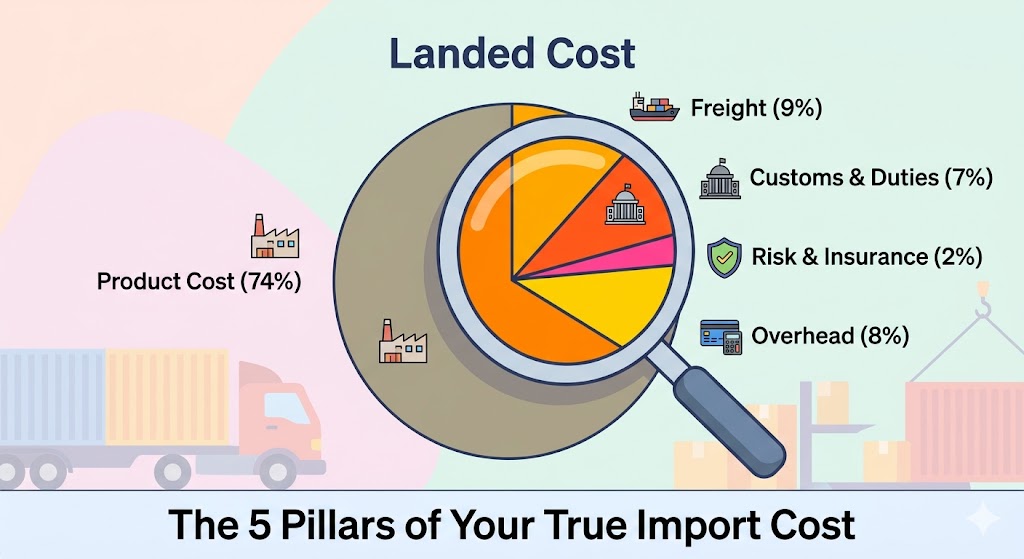
To calculate this metric correctly, you must break down the expenses into five distinct pillars. Here is what makes up your true import cost:
- Product Cost: The foundational expense paid to the foreign supplier for the raw materials or finished goods.
- Freight & Transportation: The capital required to physically move the goods, including ocean freight, air freight, trucking, and fuel surcharges. Getting an accurate freight cost estimate is critical here. If your shipment is from China to the United States, our shipping quote from China to USA guide explains what a complete logistics quote should include.
- Customs Duties & Taxes: Government-imposed levies based on product classification. It’s important to understand the difference between import duty vs tariff vs tax when mapping these expenses.
- Risk & Insurance: The premiums paid to protect cargo against loss, theft, damage, or transit delays. Learn more in our guide to cargo insurance explained.
- Overhead & Admin: Brokerage clearance fees, port handling, currency conversion spreads, and payment gateways.
| Cost Category | Specific Sub-Costs |
|---|---|
| Product Cost | Unit price, tooling expenses, supplier markup |
| Freight Transport | Ocean/Air freight, drayage, LTL trucking |
| Customs & Duties | Import tariffs, anti-dumping duties, MPF/HMF fees |
| Risk Mitigation | Cargo insurance premiums, quality inspections |
| Overhead | Brokerage fees, foreign exchange spreads, port handling |
How to Calculate Landed Cost Step by Step
| Step | What to Confirm |
|---|---|
| 1 | Supplier invoice value |
| 2 | Freight and inland transport cost |
| 3 | Customs duties and import fees |
| 4 | Insurance premium |
| 5 | Brokerage, port handling, and admin fees |
| 6 | Incoterm scope (what the seller already covers) |
| 7 | Per-unit landed cost after dividing by shipment quantity |
Practical Calculation Example
Let’s do a hand-held calculation. Consider a North American enterprise importing 1,000 consumer electronics units from China.
The Raw Expenses:
- Product Purchase Price: $20.00 per unit (Total: $20,000)
- Freight (Ocean & Trucking): $2,500 total shipment cost
- Customs Duties: 10% of the invoice value (Total: $2,000)
- Insurance Premium: $500 total for the batch
- Overhead (Broker & Bank Fees): $2.00 per unit (Total: $2,000)
The Math: Total Landed Cost = $20,000 + $2,500 + $2,000 + $500 + $2,000 = $27,000
To find your true cost per item, divide the total by the 1,000 units. Your per-unit landed cost is $27.00.
How Incoterms Affect Your Landed Cost
A massive factor in what you actually pay is your chosen International Chamber of Commerce Incoterm. Incoterms decide the exact point where cost responsibility and risk transfer between seller and buyer. For the official rule source, see the ICC’s Incoterms rules.
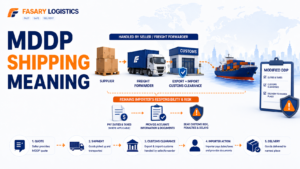
Choosing the wrong Incoterm can force you to absorb massive unexpected freight and tax penalties. When comparing FOB vs EXW vs CIF, you will see the buyer takes on vastly different levels of freight and customs costs. Conversely, understanding what is DDP shipping reveals a model where the supplier pays for both the shipping and the import taxes.
For a complete breakdown of how these terms dictate your final invoice, review our guide on FOB, CIF, EXW vs DAP, DDP.
| Incoterm (2020) | Ocean/Air Freight Paid By | Import Duties Paid By | Impact on Buyer’s Landed Cost |
|---|---|---|---|
| EXW (Ex Works) | Buyer | Buyer | Maximum: Buyer pays for every logistical step. |
| FOB (Free on Board) | Buyer | Buyer | High: Buyer assumes Freight, Risk, and Customs. |
| CIF (Cost, Ins, Freight) | Seller | Buyer | Medium: Buyer pays Duties and Last-mile delivery. |
| DDP (Delivered Duty Paid) | Seller | Seller | Minimal: Supplier invoice equals total landed cost. |
Hidden Landed Cost Killers (Beware!)
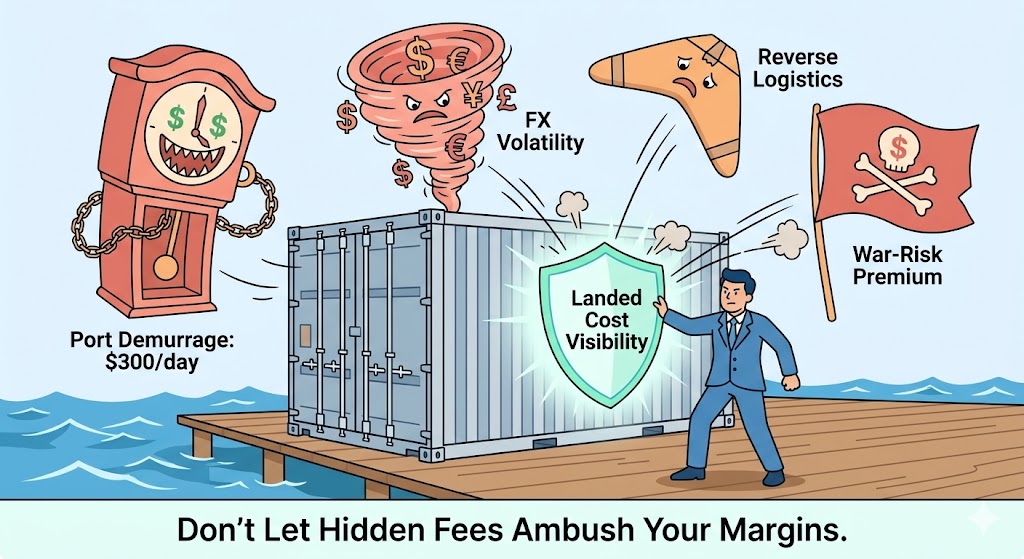
Here’s where margins go to die. Beyond the obvious freight and tax bills, the supply chain is littered with stealth fees that don’t show up on your supplier’s invoice—but they’ll absolutely show up on your balance sheet.
- Port Demurrage Fees: Punitive daily penalties charged by ocean carriers if your cargo sits at a congested port beyond its allotted free time. These demurrage and detention charges can easily exceed the cost of ocean freight itself. Ensure your broker coordinates customs clearance digitally before the vessel arrives to prevent holds.
- Foreign Exchange (FX) Spread: The profit you quietly lose to currency conversion volatility and international credit card gateway fees.
- Reverse Logistics: The massive administrative and shipping costs associated with managing international customer returns.
- New Retaliatory Tariffs: Aggressive trade actions that can hike an effective import tax overnight.
Advanced Note: Valuation Strategy Can Change Landed Cost
If you want to legally shrink your tax bill according to official CBP basic importing and exporting guidelines, you should be aware of valuation strategies like the First Sale Rule (FSR). In modern trade, if you buy from a middleman rather than directly from a factory, customs usually taxes you on the middleman’s markup. Under the First Sale Rule, qualified importers can legally declare the original factory price as the taxable value, legally minimizing tariffs.
Furthermore, ensuring accurate classification via the Harmonized Tariff Schedule (HTSUS) can legally change your import duty rate, as slight variations in product composition often fall into entirely different tax brackets.
Note: Additionally, if you import into the EU, carbon-related border costs such as the Carbon Border Adjustment Mechanism (CBAM) may become an additional landed-cost factor for certain goods and sectors, so route-specific and destination-specific analysis matters.
Conclusion: Landed Cost Is the Number That Protects Your Margin
Landed cost is not just the supplier invoice. It is the full cost of putting imported goods into saleable inventory, including freight, duties, insurance, and all the smaller charges that appear along the way. If you want one rule to remember, calculate landed cost before you set your price—not after the shipment arrives.