A customs bond is a financial guarantee required by U.S. Customs and Border Protection (CBP) for many commercial imports. It ensures that duties, taxes, fees, and certain compliance obligations will be paid if the importer fails to meet them.
For most importers, the key questions are simple: when is a bond required, should you use a single entry bond or a continuous bond, and who actually bears the customs risk in the transaction.
Quick Answer
| Question | Short Answer |
|---|---|
| What is a customs bond? | A financial guarantee to CBP that import duties, taxes, fees, and certain obligations will be paid. |
| Who usually needs one? | Importers filing formal entries over $2,500, or shipments requiring other agency control, generally need bond coverage. |
| What are the main types? | Single Entry Bond and Continuous Bond. |
| Why does it matter? | Without valid bond coverage, CBP can refuse release of the cargo. |
| What is the main decision? | Whether your import volume justifies a single-entry bond or a continuous bond. |
CBP says a customs bond is generally required for commercial imports over $2,500, or for shipments regulated by partner government agencies regardless of value. Continuous bonds are generally set at the greater of $50,000 or 10% of duties, taxes, and fees from the prior 12 months.
Customs Bond Definition & Core Operational Mechanism
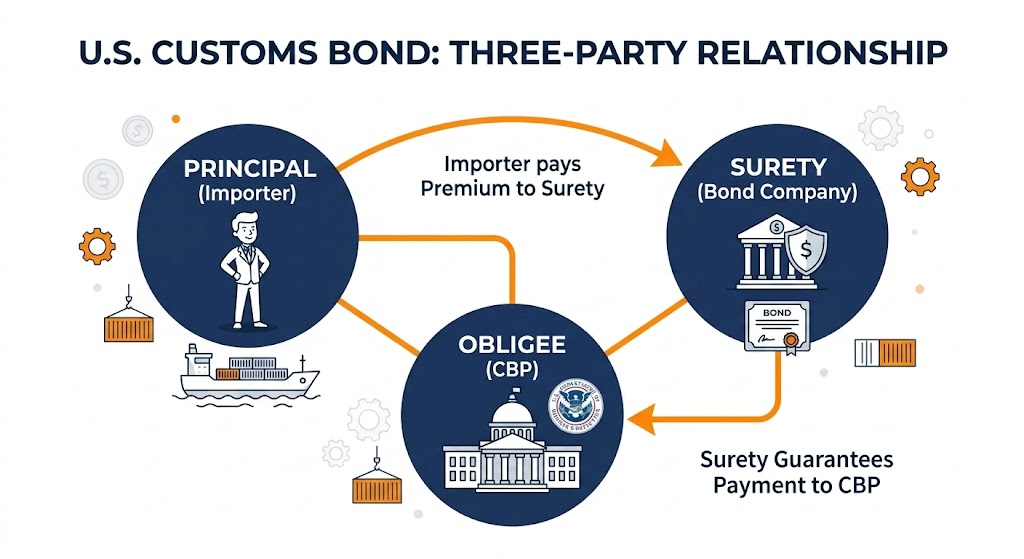
To truly understand how a customs bond functions, it is easiest to look at the parties involved. Unlike standard insurance that protects your business, a customs bond exists mainly to protect the U.S. government’s revenue. For broader importing responsibilities, see U.S. Customs and Border Protection.
Below is a breakdown of the three key entities involved in every customs bond contract:
| Party | Legal Role | Core Responsibility |
|---|---|---|
| Principal | The Importer of Record (IOR) | The business bringing goods into the U.S. They are legally responsible for filing accurate entries and paying all required duties and taxes. |
| Surety | The Bond Provider | A Treasury-approved surety company that issues the bond. If the importer fails to pay CBP, the Surety guarantees the payment on their behalf. |
| Obligee | U.S. Customs & Border Protection (CBP) | The beneficiary of the bond. CBP requires this guarantee to ensure the U.S. government does not lose revenue due to importer negligence or bankruptcy. |
Crucial Distinction: Customs Bond vs. Cargo Insurance
Many new importers confuse customs bonds with traditional cargo insurance. Understanding the difference is vital for your financial protection.
| Feature | Customs Bond | Cargo Insurance |
|---|---|---|
| Primary Beneficiary | Protects the U.S. Government (CBP). | Protects the Importer / Cargo Owner. |
| Coverage Scope | Guarantees payment of import duties, taxes, compliance penalties, and liquidated damages. | Covers the physical loss, theft, or damage of the actual goods while in transit. |
| Financial Recourse | If the Surety pays CBP for a penalty, they will legally pursue the importer for full reimbursement. | The insurance company pays the importer for the lost goods and does not ask for the money back. |
Quick Decision: Single Entry Bond or Continuous Bond?
For standard importers bringing goods into U.S. commerce, the most important decision is choosing between a Single Entry Bond (SEB) and a Continuous Bond.
| Situation | Usually Better Choice | Why |
|---|---|---|
| 1–2 formal imports per year | Single Entry Bond | Lower commitment for occasional shipments |
| 3+ imports per year | Continuous Bond | More cost-effective over repeated entries |
| Ocean imports with repeated ISF filing | Continuous Bond | Usually simpler because ISF coverage is built into the annual structure |
| Import volume or duties may spike | Continuous Bond, with monitoring | CBP may require bond sufficiency increases if exposure rises |
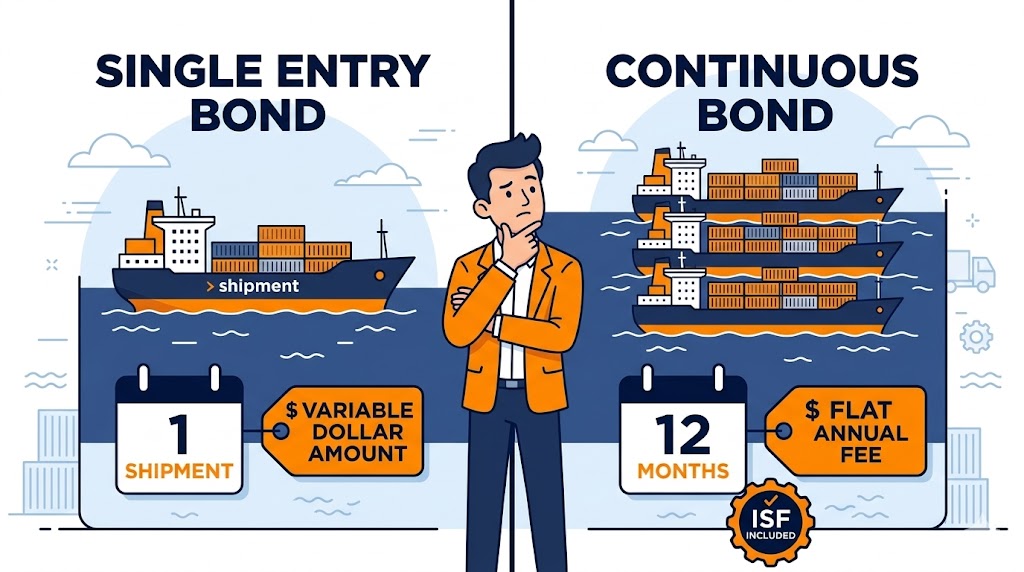
CBP guidance notes that continuous bonds generally become the more efficient structure for recurring importers, and they usually include ongoing coverage for repeated import activity. CBP also notes that single-entry bonds do not automatically solve Importer Security Filing (ISF) needs the way continuous structures do.
A customs bond is generally required for commercial imports valued over $2,500, and it may also be required for certain regulated goods regardless of value. A continuous bond is generally set at the greater of $50,000 or 10% of the duties, taxes, and fees paid during the prior 12-month period.
Not sure which bond you need?
*Free assessment. No obligation.
Specialized Activity Codes
Depending on your role in the supply chain, CBP assigns specific “Activity Codes” to ensure the correct type of bond is used.
| Activity Code | Official Bond Name | Core Business Application Scenario |
|---|---|---|
| Code 1 | Import Customs Bond | The standard bond used by commercial importers to clear everyday goods into the U.S. market. |
| Code 1a | Drawback Bond | Used by exporters to secure accelerated refunds on duties paid for goods that are subsequently exported out of the U.S. |
| Code 2 | Custodian of Bonded Merchandise | Required for bonded warehouses, carriers, and freight stations that hold or move uncleared goods. |
| Code 3 | International Carrier Bond | Mandatory for commercial airlines, ocean steamship lines, and cross-border trucking companies moving cargo. |
| Code 4 | Foreign Trade Zone (FTZ) Operator | Secures compliance for facilities operating within a designated U.S. FTZ. |
| Code 16 | Importer Security Filing (ISF) Bond | Ensures that maritime importers transmit accurate cargo data to CBP 24 hours before the container is loaded onto the vessel. |
When a Managed DDP Structure Changes the Bond Question
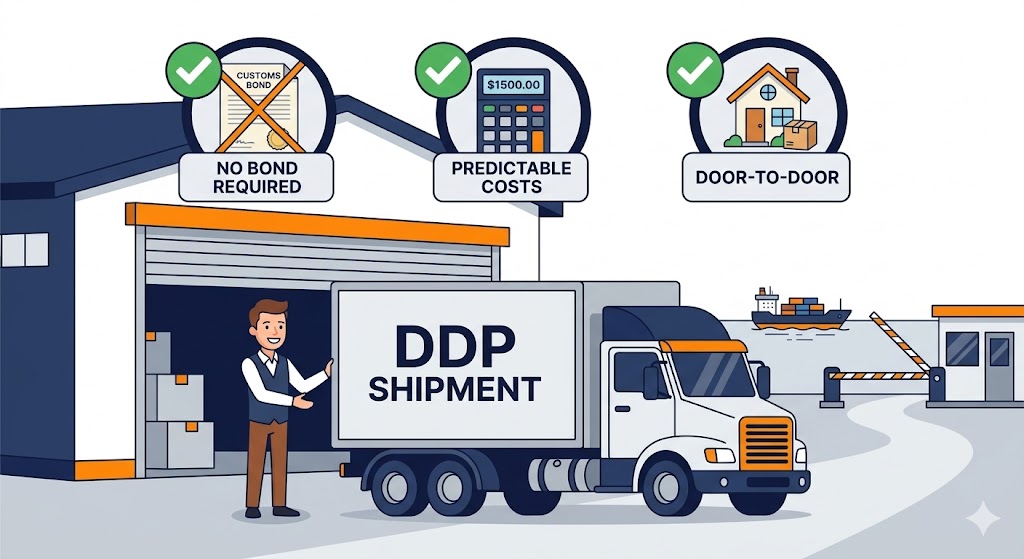
For some buyers, especially those who do not want to act as the Importer of Record, a managed DDP structure can reduce the operational burden of customs compliance. In that model, the buyer may not need to hold their own customs bond because the import side is handled through the logistics provider’s structure. However, the shipment still requires proper customs responsibility, bond coverage, and compliance management somewhere in the transaction.
If you are exploring what is DDP shipping, it is critical to understand the distinction between FOB, CIF, EXW vs DAP, DDP to clarify exactly who is providing the bond and filing the entry.
Outsourcing vs. In-House Customs Management
Some importers prefer to outsource bond and customs clearance handling to a managed provider, while others keep the importer role in-house and maintain their own bond structure. The right setup depends on shipment frequency, internal compliance resources, and how much customs administration the buyer wants to control.
Without valid bond coverage, CBP can hold cargo indefinitely, subjecting you to massive demurrage and detention charges that will quickly inflate your landed cost calculations. Whether you are shipping from China to USA or shipping from Vietnam to USA, establishing clear bond responsibilities upfront ensures your supply chain remains uninterrupted and compliant.
A customs bond issue may also connect with classification, duty, and document accuracy. Before importing, review the official HTS code database, our HS code for imports from China to USA guide, and our import duty from China to USA guide so the bond, entry value, and duty exposure are not underestimated.
Frequently Asked Questions (FAQ)
What is a customs bond?
A customs bond is a financial guarantee to CBP that duties, taxes, fees, and certain compliance obligations will be paid if the importer fails to meet them.
Who needs a customs bond?
Commercial importers generally need bond coverage for formal entries over $2,500, and many regulated goods may also require it regardless of shipment value.
What is the difference between a Single Entry Bond and a Continuous Bond?
A Single Entry Bond covers one shipment. A Continuous Bond covers unlimited entries for 12 months.
How is a continuous bond amount calculated?
It is generally set at the greater of $50,000 or 10% of the duties, taxes, and fees paid in the previous 12 months.
Does DDP eliminate the customs bond requirement?
Not exactly. It may eliminate the need for the buyer to hold their own bond, but the shipment still needs proper customs responsibility and bond coverage where required.
What is a bond insufficiency notice?
It is a CBP notice indicating that the existing continuous bond may no longer be large enough relative to the importer’s duties, taxes, and fees exposure.
Conclusion: The Financial Anchor of U.S. Imports
A customs bond is an unavoidable reality for commercial importers. Whether you are bringing in a single shipment or managing a massive supply chain, CBP requires a firm financial guarantee that duties, taxes, and compliance obligations will be met.
The real decision is not whether a bond is required, but how you choose to manage that liability. Occasional importers can rely on single-entry bonds, while high-volume sellers benefit from the efficiency and built-in ISF coverage of a continuous bond. Alternatively, utilizing a managed logistics provider can shift the administrative burden away from your internal team.
If you want one rule to remember, secure your customs bond structure well before your cargo reaches the U.S. border to avoid unnecessary cargo holds and storage fees.
Ready to Simplify Your Imports?
Whether you need a bond or want DDP door-to-door service, our team is ready to help.
*Response within 2 business hours.