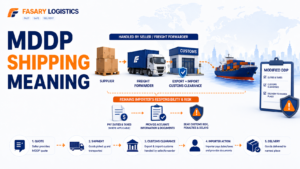
What is an Importer of Record (IOR)? The Importer of Record is the entity legally responsible for declaring imported goods to customs, ensuring compliance, and paying applicable duties, taxes, and fees. In the United States, commercial imports generally require a clearly designated IOR before cargo can be released. If you need a broader explanation of how the border process works, review our guide to customs clearance from China to USA. For official importing guidance, see U.S. Customs and Border Protection.
For international sellers, the real question is not only what an IOR is, but who can act as the IOR, what liabilities come with that role, and whether it makes sense to handle those responsibilities directly or through a managed import structure.
Quick Answer
| Question | Short Answer |
|---|---|
| What is an IOR? | The legal importer responsible for customs compliance, duties, and entry filing. |
| Is the IOR always the consignee? | No. They can be the same entity, but they do not have to be. |
| Can a foreign seller act as IOR? | Sometimes, but it depends on the country, import setup, and customs requirements. |
| Why does the IOR matter? | Because customs liability, bond requirements, and compliance risk sit with the IOR. |
| Why do importers care? | Because the wrong IOR setup can delay clearance, raise cost, and create legal exposure. |
To better understand the charges the IOR may need to pay, see our guide to import duty vs tariff vs tax. If your shipment is from China to the United States, also review import duty from China to USA before estimating your total landed cost.
Who Might Need a Managed IOR Solution?
| Buyer Situation | Managed IOR / DDP May Help Because… |
|---|---|
| No U.S. company or entity | Import setup may be more complex |
| No internal customs team | Compliance workload is harder to manage |
| First-time importer | Customs, bond, and filing requirements can be overwhelming |
| Amazon FBA seller | Entry responsibility must be defined before shipment |
| Buyer wants one bundled landed-cost model | A managed structure may simplify execution |
The Real Legal Responsibilities of an IOR
Many sellers attempt to act as their own IOR because they mistakenly believe it simply involves paying a tariff invoice at the port. This is a dangerous misconception. Under the Customs Modernization Act, CBP enforces the doctrine of “reasonable care,” which legally shifts the absolute burden of proof and compliance entirely onto the IOR.
Understanding actual IOR responsibilities is usually enough to deter any rational seller from wanting the job. When you act as the IOR, you are not just a logistics coordinator; you are the primary target for federal audits and severe financial penalties.
| Legal Responsibility | What You Must Do | Cost of Getting It Wrong |
|---|---|---|
| Pay Duties, Taxes, MPF, HMF | Calculate and remit full payment to CBP within 10 days. | Cargo held, daily storage fees, potential seizure. |
| Maintain a Customs Bond | Purchase and renew a Continuous Bond annually. | Cargo will not be released from the port. |
| Retain Records for 5 Years | Keep all commercial invoices and entry summaries on file. | Fines from CBP during a random audit. |
| Ensure Product Compliance | Guarantee goods meet FDA, FCC, CPSC, or DOT standards. | Goods destroyed at importer’s expense. |
If you are unclear about the financial guarantee required for customs release, read our explanation of what is a customs bond.
To further illustrate why you do not want this liability, examine the statutory penalty framework enforced by CBP under 19 U.S.C. § 1592. If you make a mistake on your entry documents, the government does not merely correct it—they penalize it heavily.
| CBP Violation Category | Legal Definition of the Offense | Maximum Financial Penalty (19 U.S.C. § 1592) |
|---|---|---|
| Fraud | Intentional falsification or omission of entry data. | 100% of the domestic value of the merchandise. |
| Gross Negligence | Severe failure to exercise reasonable care in compliance. | The lesser of the domestic value or 4 times the loss of duties. |
| Negligence | Clerical errors that form a pattern of compliance failure. | The lesser of the domestic value or 2 times the loss of duties. |
In a nutshell: Being your own IOR is a part-time job with full-time legal risk. Unless you have a dedicated compliance team, the administrative exposure can be immense.
A wrong IOR setup does not only create paperwork problems. It can also lead to a customs hold from China to USA, U.S. customs exam, 5H customs hold, or 9H customs hold depending on the entry issue, document problem, or consignee-information mismatch confirmed by the broker.
Why Amazon FBA Sellers Must Clarify the IOR Setup in Advance
A common error made by new e-commerce entrepreneurs is assuming that their fulfillment platform will absorb the friction of international trade. Amazon acts solely as a fulfillment center, not a customs broker or an importer of record. Sellers cannot assume that the warehouse will handle customs responsibilities on their behalf.
If you attempt to ship inventory into the United States without a properly designated third-party IOR, your supply chain will likely stall at the border. Without a clear IOR, the cargo may be unable to clear customs or enter the fulfillment network. Therefore, for any FBA shipment, the IOR and customs bond responsibilities must be explicitly defined before the shipment departs the origin port.
| What You Might Think | The Reality Check |
|---|---|
| “Amazon receives the goods, so they are the IOR.” | Amazon’s policy strictly states they are NEVER the IOR. Your shipment will be refused if billed to them. |
| “My factory will handle the customs stuff.” | The factory handles export in China/Vietnam. They do not handle import in the USA unless DDP is structured. |
| “I can just use my friend’s LLC address.” | The entity on the paperwork will receive the tax bill and audit risk, exposing them to federal liability. |
In practice, sellers often compare platform-integrated logistics with independent forwarders to balance cost, control, and IOR responsibility. For a broader look at routing, prep, and compliance for FBA cargo, review our guide to shipping from China to Amazon FBA worldwide.
How Managed Import Structures Handle IOR Duties
For some importers, especially those without a U.S. entity or internal customs team, a managed DDP structure can reduce administrative burden and shift much of the compliance handling to the logistics provider. If you want a clearer breakdown of how this model works in practice, see our guide to what is DDP shipping.
Delivered Duty Paid (DDP) shipping is an Incoterm where the logistics provider assumes end-to-end responsibility for the transaction, frequently utilizing their own network or bonded third parties to manage the IOR requirement.
| Import Step | Self-Managed IOR Experience | Managed DDP Experience |
|---|---|---|
| U.S. Entity Requirement | Requires registering an LLC and applying for an EIN. | Logistics partner utilizes their established customs credentials. |
| Customs Bond | Requires purchasing a Single or Continuous Bond. | Bond coverage is generally bundled into the final quote. |
| Paying Duties & Taxes | Researching and paying CBP bills after they arrive. | Pre-paid upfront. You receive a finalized landed-cost invoice. |
| Customs Exams | Dealing with CBP or a broker yourself during an exam. | The provider manages CBP communications and exams directly. |
| Final Experience | Highly administrative, time-consuming, unpredictable. | Peace of mind, streamlined paperwork, predictable budget. |
To understand why many importers prefer one bundled invoice, review our explanation of what is landed cost.
CBP actively audits import records to enforce compliance. By utilizing a managed logistics service, you insulate your business from many of these direct administrative reviews. The forwarder helps ensure that all Importer Security Filings are submitted flawlessly before the vessel departs the origin port.
Frequently Asked Questions (FAQ)
What is an Importer of Record (IOR)?
The Importer of Record is the entity legally responsible for customs entry, duties, taxes, and compliance when goods are imported.
Is the customs broker the same as the IOR?
No. A customs broker is a licensed professional hired to clear the goods and file the necessary paperwork, but the legal and financial liability ultimately remains with the Importer of Record.
Is the IOR the same as the consignee?
No. The consignee receives the goods, while the IOR is the entity legally responsible for the customs entry. They can be the same, but they do not have to be.
Can a foreign company act as the IOR in the USA?
It may be possible in some cases, but it typically requires proper customs registration, documentation, and bond setup. If you do not have a U.S. entity, you can also read our guide on how to ship from China to US without a US company or IOR.
Does Amazon act as the IOR for FBA shipments?
Sellers should not assume that Amazon will act as the IOR. The IOR setup must be clarified before shipping.
Why do importers use DDP instead of acting as their own IOR?
Because DDP can simplify the import process by shifting much of the customs coordination and landed-cost handling to the logistics provider.
Need Help Defining Your IOR Strategy?
Ensure your import structure is compliant and optimized before your goods arrive at the border.
Request an Import Setup Review (Response within 2 hours. No obligation.)
Conclusion: The IOR Is the Legal Anchor of the Import Process
Every commercial shipment needs a clearly defined Importer of Record, because customs compliance, duties, and legal responsibility do not disappear just because the goods are moving internationally. The key question for most buyers is not whether an IOR is required, but whether they should manage that role directly or use a structure that reduces administrative exposure.
If you want one rule to remember, clarify the IOR setup before the cargo ships, not after it arrives at the border. It also helps to understand how shipping terms affect responsibility, so review our guide to FOB, CIF, EXW vs DAP, DDP.
Stop managing logistics. Start scaling revenue.
*Free estimate. Reply within 2 hours.