Customs clearance from China to USA is not a formality you handle after the ship sails—it is a pre-departure document process that decides whether your cargo releases in hours or sits in a hold for weeks. In our experience, most China-to-USA clearance delays trace back to three avoidable errors: a vague commercial invoice, an unreviewed HS/HTS code, and no confirmed Importer of Record or customs bond before arrival. As part of our broader shipping from China to USA process, this guide walks through the exact documents, the IOR / broker / bond responsibilities, and the CBP release, hold, and exam signals to check before your cargo leaves China.
The goal is not only to “clear customs.” The real goal is to avoid document problems, duty surprises, customs holds, exams, storage, and delivery delays after the cargo reaches the United States. If your shipment is already delayed, compare the situation with customs hold from China to USA and customs exam from China to USA.
Quick Answer: Customs Clearance Checklist Before Shipping from China to USA
| Clearance item | What importers should prepare | Why it matters |
|---|---|---|
| Commercial invoice | Seller, buyer, product description, value, currency, origin | Supports value, duty, and product review |
| Packing list | Carton count, dimensions, gross weight, net weight, marks, pallets | Helps match cargo, documents, and delivery planning |
| HS / HTS code | Product classification based on material, function, and use | Affects duty rate, tariff risk, and customs review |
| Importer of Record | EIN or importer number, company details, POA, bond setup | Defines who is responsible for the import |
| Customs broker | Licensed broker or broker arranged through service scope | Files entry and communicates with CBP |
| Duty and import fees | Duty, tariff, MPF/HMF if applicable, broker fee, bond fee | Helps avoid cost surprises |
| CBP release status | Whether cargo is released, held, examined, or pending | Determines whether cargo can move to delivery |
| Final delivery plan | Warehouse, Amazon FBA, 3PL, business, residential, ZIP code | Needed after release for trucking and appointment planning |
If any of these items are missing or inconsistent before departure, the shipment may still move from China but face problems after arrival in the United States.
What Importers Should Check First
Before booking freight, importers should check five things:
- Are the invoice and packing list complete? Product name, value, quantity, carton count, dimensions, and weight should be consistent.
- Has the HS/HTS code been reviewed? Supplier export codes are not always correct for U.S. import classification.
- Who is the Importer of Record? The IOR should be clear before the shipment arrives.
- Who is the customs broker? Broker setup, POA, bond, and importer details should not be left until the cargo reaches the port or airport.
- Who pays duties and customs-related costs? DDP, DAP, door-to-door, and standard freight quotes may handle these costs differently.
This check should happen before cargo leaves China, not after the shipment is already waiting at the U.S. port, airport, CFS, or warehouse.
Who Is Responsible for Customs Clearance?
Customs clearance involves several parties, but the Importer of Record is usually the key responsibility role. The IOR is responsible for accurate import information, duty responsibility, and import compliance.
| Party | Main role | What to confirm |
|---|---|---|
| Importer of Record | Legal importer responsible for entry accuracy | Importer name, EIN/importer number, POA, bond, duty responsibility |
| Customs broker | Files entry and communicates with CBP | Broker setup, documents needed, classification review, release status |
| Freight forwarder | Coordinates freight and logistics steps | Whether customs coordination is included or separate |
| Supplier / factory | Provides product and shipping documents | Invoice, packing list, product details, origin, cargo value |
| Amazon FBA | Final receiving destination after clearance | Amazon does not act as IOR for third-party seller imports |
| Express courier | Handles many parcel clearance processes | Importer still needs correct product value and description |
A freight forwarder is not automatically the Importer of Record or the customs broker unless this is agreed in writing. For the broker role, see customs broker for importers.
Documents Needed Before Cargo Leaves China
Complete and consistent customs documents reduce avoidable questions during entry review. The most important documents are the commercial invoice, packing list, transport document, HS/HTS code support, customs bond information, and any product compliance documents.
Commercial Invoice
The commercial invoice supports transaction value, seller, buyer, product description, quantity, currency, and country of origin. It should use clear product descriptions instead of vague words such as “parts,” “accessories,” or “goods.” The invoice value should reflect the actual transaction value. If CBP or the broker requests payment proof, the payment record should match the declared value.
Packing List
The packing list shows the physical cargo details. It should include carton count, dimensions, gross weight, net weight, pallet details if applicable, and shipping marks. The packing list should match the commercial invoice. If the invoice says 500 units but the packing list shows a different quantity, carton count, or weight, the broker may need clarification before entry filing or release.
Bill of Lading or Air Waybill
The bill of lading is used for ocean freight and identifies shipment movement, carrier details, origin, destination, and consignee information. For air freight, the equivalent transport document is the air waybill. Your broker or forwarder uses the B/L or AWB to connect the customs entry with the shipment arrival. Incorrect consignee, notify party, or shipment reference information can create extra coordination work.
HS / HTS Code
Every product imported into the United States must be classified under the Harmonized Tariff Schedule. The HS code is the international classification base, while the U.S. HTS code is more specific and affects duty rate. If classification is unclear, review import duty from China to USA and ask your broker to confirm the code based on the product’s material, function, and use. Do not rely only on the supplier’s China export code.
Customs Bond
A customs bond is a financial guarantee related to duties, taxes, and fees owed to CBP. Many formal commercial entries require a bond. Importers may use a single-entry bond for one shipment or a continuous bond for repeated imports. The right option depends on shipment value, import frequency, and broker advice.
Product Compliance Documents
Some products require documents beyond the invoice and packing list. Depending on the product, Partner Government Agencies may require test reports, registration numbers, certificates, labels, safety documents, or other product-specific information. Examples may include FDA-related products, electronics subject to FCC rules, EPA-regulated goods, children’s products, textiles, wood packaging, or lithium battery shipments. If compliance documents are missing, the shipment may face additional review.
Not Sure If Documents Match?
Share your commercial invoice, packing list, product description, cargo value, carton details, and shipping method. We’ll help review whether the key information looks consistent before cargo leaves China.
*Fast response. No obligation.
CBP Release, Customs Holds, and Exams: What Importers Should Know
Customs clearance does not always end immediately after documents are submitted. A shipment may be released by CBP, held for review, selected for exam, or delayed because documents, importer details, value, classification, or product compliance information need clarification.
| Status | What it means | What importer should check |
|---|---|---|
| CBP release | Customs has allowed the cargo to proceed | Carrier release, destination charges, delivery order, final delivery schedule |
| Pending release | Entry or review is not complete yet | Broker filing, invoice, packing list, duty, bond, or PGA review |
| Customs hold | Customs may be reviewing cargo or documents | Ask broker or forwarder for the hold reason and required action |
| Customs exam | Cargo may be inspected physically or through an exam process | Exam type, exam site, timing, and possible costs |
| Released but not delivered | Customs step may be done, but logistics steps remain | CFS/terminal availability, delivery appointment, truck dispatch, final receiver |
Do not confuse customs release with final delivery. Release is a customs milestone; delivery still depends on carrier release, terminal/CFS availability, payment, truck scheduling, and the receiving address. If the broker says the shipment is under hold or exam, use the specific status instead of treating every delay as a general customs clearance issue. For deeper guidance, see customs hold from China to USA and customs exam from China to USA.
Customs Issue Before Arrival?
Share your broker update, invoice, packing list, product description, HS code if available, and shipment status. We’ll help identify whether the issue may relate to documents, broker setup, duty, hold, exam, or delivery scope.
*Fast response. No obligation.
Duties, Customs Cost, and Bond: What to Confirm Before Arrival
Duties and customs-related costs should be discussed before shipment, but this article is not a full duty calculation guide. Duty depends on HTS code, declared value, country of origin, and applicable tariff measures. Customs cost may also include broker fee, bond, MPF/HMF where applicable, customs exams, storage, demurrage, detention, destination charges, and delivery-related costs depending on the shipment and quote scope. For a full fee breakdown, see customs cost from China to USA.
| Item to confirm | Why it matters | What to ask |
|---|---|---|
| HTS code | Affects duty rate and possible tariff exposure | Has the broker reviewed the product description, material, and use? |
| Declared value | Affects duty amount and entry review | Does the invoice match the actual transaction value? |
| Country of origin | May affect tariff treatment and marking | Is origin shown consistently on documents and packaging? |
| MPF / HMF | May apply depending on shipment type and mode | Are these included, separate, or billed through the broker? |
| Broker fee | Varies by broker and entry complexity | Is the broker fee included in the freight quote? |
| Customs bond | May be required for formal entry | Is a single-entry or continuous bond needed? |
| Exam / storage cost | May occur if cargo is held or examined | Who pays if this happens? |
Exact duty amount should be confirmed with the broker, official HTS data, and final shipment documents. For a deeper duty explanation, see import duty from China to USA.
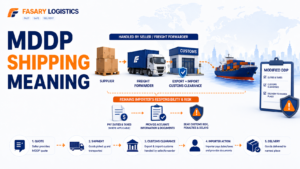
DDP, DAP, and Door-to-Door: Who Handles Customs?
Shipping terms affect who usually coordinates customs clearance, who pays duties, and who controls the customs broker. Door-to-door delivery and DDP are not the same thing.
| Shipping scope | Who usually coordinates clearance | What to confirm |
|---|---|---|
| DDP-style | Seller, forwarder, or their broker depending on scope | IOR, broker, duty/tax handling, declared value, exclusions |
| DAP-style | Buyer/importer or buyer’s broker | Buyer usually handles import duty and customs responsibility |
| Door-to-door duty-unpaid | Forwarder coordinates freight and delivery depending on scope | Whether customs broker, duty, and import fees are included or separate |
| Standard ocean / air freight | Buyer/importer or broker | Broker, bond, duty, destination charges, and final delivery scope |
| Express courier | Courier may handle parcel clearance | How duties are billed and whether product details are accurate |
DDP-style may include customs and duty responsibility under the written quote scope, but importers should still confirm IOR, declared value, HS/HTS code, duty/tax handling, exclusions, and final delivery conditions. For duty-paid shipping scope, see DDP shipping from China to USA.
Common Clearance Risk Signals to Check Before Shipping
Many customs problems start before the shipment leaves China. The best time to check documents is before pickup or loading, not after the cargo arrives in the United States.
| Risk signal | Why it matters | What to check before shipping |
|---|---|---|
| Vague product description | Broker or CBP may not understand the product | Use clear product name, material, and function |
| Incorrect HS/HTS code | Can affect duty, tariff, and review risk | Ask broker to verify classification before shipping |
| Underdeclared value | May trigger questions or proof-of-payment review | Use actual transaction value and keep payment records |
| Invoice and packing list mismatch | Creates document inconsistency | Match units, carton count, weight, and value |
| Missing compliance documents | Regulated products may need extra review | Confirm FDA, FCC, EPA, CPSIA, lithium battery, or other documents if applicable |
| Unclear Importer of Record | Entry responsibility may be unclear | Confirm importer name, EIN/importer number, POA, and bond status |
| Broker not set up | Entry filing may be delayed | Confirm broker and POA before arrival |
| Bond not ready | Formal entry may be delayed | Confirm single-entry or continuous bond needs |
In our experience, the clearance failures that cost importers the most are almost never “CBP being slow”—they are document mismatches discovered at entry. The three we see weekly: an invoice that says “accessories” while the packing list lists 12 different SKUs, a declared value that doesn’t match the payment record (triggering a proof-of-payment review), and an IOR/bond that was never set up because the buyer assumed the forwarder handled it. Every one of these is fixable in a day if caught before the vessel departs, and nearly impossible to fix quickly once the cargo is sitting at a U.S. terminal accruing storage.
If the shipment is already delayed, use the specific status instead of treating every delay as a general customs clearance issue. A customs hold from China to USA and a customs exam from China to USA may require different next steps.
Customs Clearance for Amazon FBA Shipments
Amazon FBA shipments need customs preparation before delivery to the fulfillment center. Amazon does not act as Importer of Record for third-party seller shipments, does not pay import duties, and does not manage your customs entry. The shipment must clear customs before delivery to Amazon. Depending on the service scope, the seller may act as IOR, use their own broker, or use a DDP-style service arranged by a forwarder. FBA labels, shipment IDs, pallet labels, delivery appointments, and Amazon receiving rules are separate from customs clearance, but they still affect the final delivery plan. For a full logistics guide, review Amazon FBA shipping from China to USA.
How Fasary Logistics Helps with China-to-USA Customs Preparation
Fasary Logistics helps importers organize customs-related information before cargo leaves China. Our role is practical coordination: document review, broker communication, IOR clarification, DDP/DAP scope review, duty discussion, and final delivery planning after official release. We can help review whether the commercial invoice, packing list, product description, cargo value, carton details, HS/HTS code if available, importer information, and destination details are complete enough for broker discussion and shipping coordination.
Fasary Logistics does not guarantee customs clearance, exact duty amount, no customs holds, no exams, or a fixed delivery date. The goal is to help importers prepare cleaner documents, clarify responsibility, and coordinate practical next steps before shipping.
FAQ
What documents are needed for customs clearance from China to USA?
Common documents include the commercial invoice, packing list, bill of lading or air waybill, HS/HTS code information, declared value support, customs bond information, and product compliance documents if applicable.
Who is responsible for customs clearance?
The Importer of Record is generally responsible for entry accuracy, duty responsibility, and import compliance. A licensed customs broker usually files the entry and communicates with CBP.
Do I need a customs broker?
For most commercial imports, especially formal entries, working with a licensed customs broker is strongly recommended because the broker can file the customs entry, review documents, and communicate with CBP.
Do I need a customs bond?
Many formal commercial entries require a customs bond. Importers may use a single-entry bond for one shipment or a continuous bond for repeated importing. Confirm the requirement with your broker before shipping.
How are duties handled?
Duties depend on the HTS code, declared value, country of origin, and any applicable tariff rules. Duties may be paid by the importer or included in a DDP-style quote if agreed in writing.
Does DDP include customs clearance?
DDP-style shipping may include customs clearance and duties depending on the written scope. Importers should confirm who acts as IOR, who files the entry, how duties are calculated, and what costs are excluded.
What causes customs clearance delays?
Common causes include vague product descriptions, incorrect HS/HTS codes, underdeclared value, invoice and packing list mismatch, missing compliance documents, unclear Importer of Record details, broker setup problems, bond issues, or additional customs review.
Conclusion
Customs clearance from China to USA works best when importers prepare documents and responsibility before cargo leaves China. The key items are a clear Importer of Record, accurate commercial invoice, consistent packing list, correct HS/HTS code, declared value support, customs bond when required, and broker coordination.
This route-specific preparation helps reduce avoidable document problems and makes it easier to understand who handles duties, customs entry, DDP/DAP scope, and final delivery after release. If you are unsure what documents are needed or how customs responsibility should be handled for your shipment, send your cargo details to Fasary Logistics. We can help review the shipment scope and coordinate practical customs preparation before your goods leave China.