Import duty, tariff, and tax are closely related, but they are not the same thing. A tariff is the government rate assigned to a product classification, duty is the actual amount you pay based on that rate, and taxes or customs fees are additional charges that may apply on top.
For importers shipping into the United States, understanding the difference is essential because customs clearance cost is rarely just one line item. If your shipment is entering from China, our customs clearance from China to USA guide explains how duties, documents, broker filing, and release steps fit together.
Quick Answer
| Term | What It Really Means | Practical Effect |
|---|---|---|
| Tariff | The rate assigned to a product classification | Determines the percentage used in duty calculation |
| Duty | The actual customs charge calculated from the tariff rate and customs value | Appears as part of your CBP bill |
| Tax / Import Fees | Additional government charges such as MPF, HMF, or excise tax | Added on top depending on shipment type and product |
U.S. Exclusive Import Surcharges
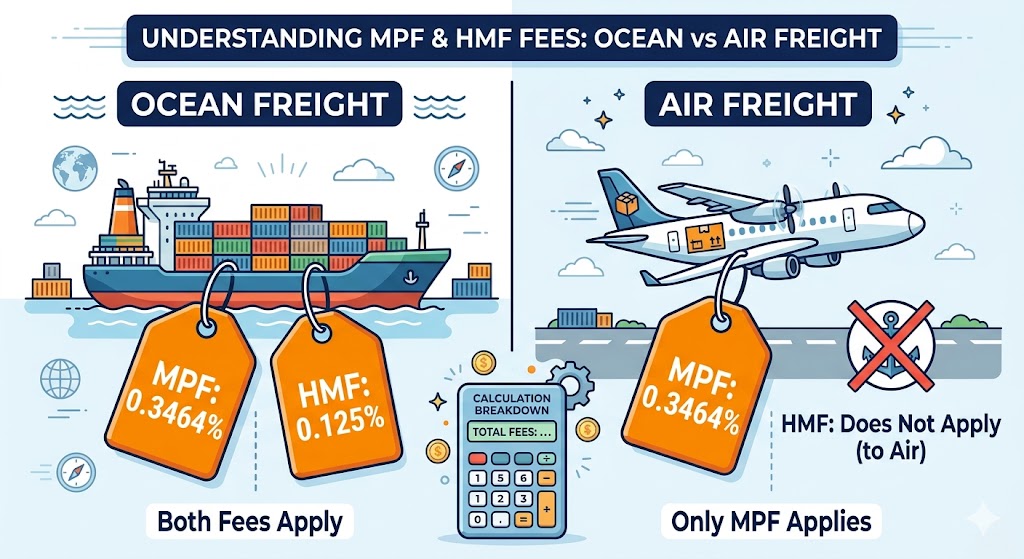
Beyond standard duties, the U.S. government charges “invisible” customs fees. These mandatory surcharges often catch new importers off guard. Even if your product enjoys a 0% duty rate, you will likely still pay these fees.
| Fee | Full Name | How It’s Calculated | Applies To |
|---|---|---|---|
| MPF | Merchandise Processing Fee | 0.3464% of cargo value (Min $33.58, Max $651.50) | Formal Entries (Value > $2,500) |
| HMF | Harbor Maintenance Fee | 0.125% of cargo value | Ocean Freight Only |
The Merchandise Processing Fee (MPF) helps fund CBP operations. For formal entries in 2026, the minimum MPF is $33.58 and the maximum is $651.50. The ad valorem MPF rate remains 0.3464%, while the Harbor Maintenance Fee (HMF) is generally 0.125% of value for qualifying ocean imports, as defined by eCFR 19 CFR 24.24. Unlike the MPF, the HMF only applies to imports moving via ocean freight, and there is no maximum cap. A massive ocean shipment will incur a large HMF bill.
How to Estimate Duty, Tariff, and Import Fees Step by Step
For most importers, the easiest way to understand customs cost is to break the calculation into steps. First, confirm the HTSUS classification of the product. Second, identify the base tariff rate for that classification. Third, check whether any additional duties, such as Section 301 duties on goods from China, still apply. Fourth, calculate MPF. Finally, add HMF if the cargo moves by ocean and any product-specific excise tax or other trade remedy if applicable. For a route-specific explanation, see our import duty from China to USA guide.
This approach helps importers separate the tariff rate itself from the final customs bill, which usually includes multiple layers of charges. Getting a proper freight cost estimate requires accounting for all these variables.
| Step | What To Check |
|---|---|
| 1 | Confirm the HTSUS classification |
| 2 | Check the base tariff rate |
| 3 | Check whether Section 301 or other special duties apply |
| 4 | Estimate MPF |
| 5 | Add HMF if the shipment moves by ocean |
| 6 | Add any product-specific excise tax or trade remedy if relevant |
The duty calculation also depends on clean shipping documents. The commercial invoice supports customs value and product description, while the packing list supports quantity, carton count, gross weight, and packaging details. If these documents do not match, the broker may need to clarify the entry before release.
Real-World Case Study: Customs Calculation
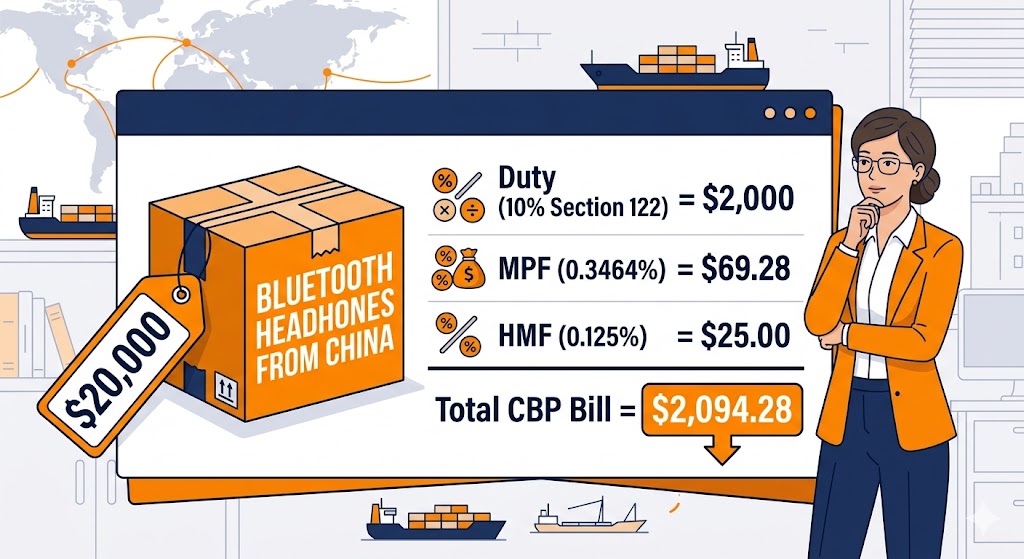
Let’s look at a real-world calculation. Suppose you are an Amazon seller importing $20,000 worth of wireless Bluetooth headphones from China.
Bluetooth headphones often fall under HTSUS 8518.30.20, which has a 0% baseline tariff. However, depending on HTSUS decisions, Section 301 tariffs might still apply. Furthermore, a temporary Section 122 import surcharge of 10% took effect on February 24, 2026, under a presidential action addressing balance-of-payments concerns. Because this measure is temporary and policy-sensitive, importers should always verify whether it is still active and whether their goods fall within any exemption or updated enforcement guidance before relying on it in landed cost calculations.
Note: This scenario is for illustrative planning purposes. Always verify current rates with your customs broker.
| Calculation Step | Formula | Amount |
|---|---|---|
| 1. Customs Value | Commercial Invoice Value | $20,000.00 |
| 2. Duty Calculation | $20,000 x Tariff Rate (0% Base + 10% Sec. 122) | $2,000.00 |
| 3. MPF Calculation | $20,000 x 0.3464% (Capped) | $69.28 |
| 4. HMF Calculation | $20,000 x 0.125% (Ocean Freight) | $25.00 |
| Total CBP Bill | Duty + MPF + HMF | **$2,094.28** |
If your shipment consisted of apparel from Vietnam, your baseline tariff could jump from 16.5% to over 30%. This drastically shifts your duty burden upward.
In a nutshell: While your product might have a 0% Tariff rate, you still owe the government MPF and HMF just for the privilege of importing.
Strategic Risk Mitigation: When a Managed DDP Structure Helps
Calculating U.S. customs fees by yourself is extremely risky. For e-commerce sellers without in-house compliance teams, a single mistake can ruin your profit margins. If you misclassify a product, fail to designate the correct Importer of Record (IOR), or fail to secure the right customs bond, CBP can hold your cargo at the port. This triggers massive demurrage and detention charges, easily costing hundreds of dollars per day.
To avoid these risks, using a managed DDP solution is a practical option. If you are exploring what is DDP shipping, it essentially means the logistics provider handles the legal responsibilities, customs clearance, and duty payments. It’s crucial to understand the difference between FOB, CIF, EXW vs DAP, DDP to know who bears the financial liability.
A managed DDP structure helps:
- Buyers without an internal customs team
- Importers who want one landed-cost number
- Amazon sellers who want fewer customs surprises
For some importers, a managed DDP structure reduces the operational burden of classification, customs coordination, and fee forecasting. This allows you to focus your time and money on growing your business instead of fighting unpredictable customs bills.
Conclusion
Knowing the difference between a tariff and a duty is smart business. By understanding how the HTSUS classification dictates your tariff rate, how CBP calculates your final duty bill, and where invisible import fees like MPF and HMF fit in, you can protect your profit margins. Taking the time to accurately estimate these costs—or outsourcing that risk to a managed logistics partner—ensures your supply chain remains predictable and profitable.
Know your costs before you ship.
*Free estimate. Reply within 2 hours.